

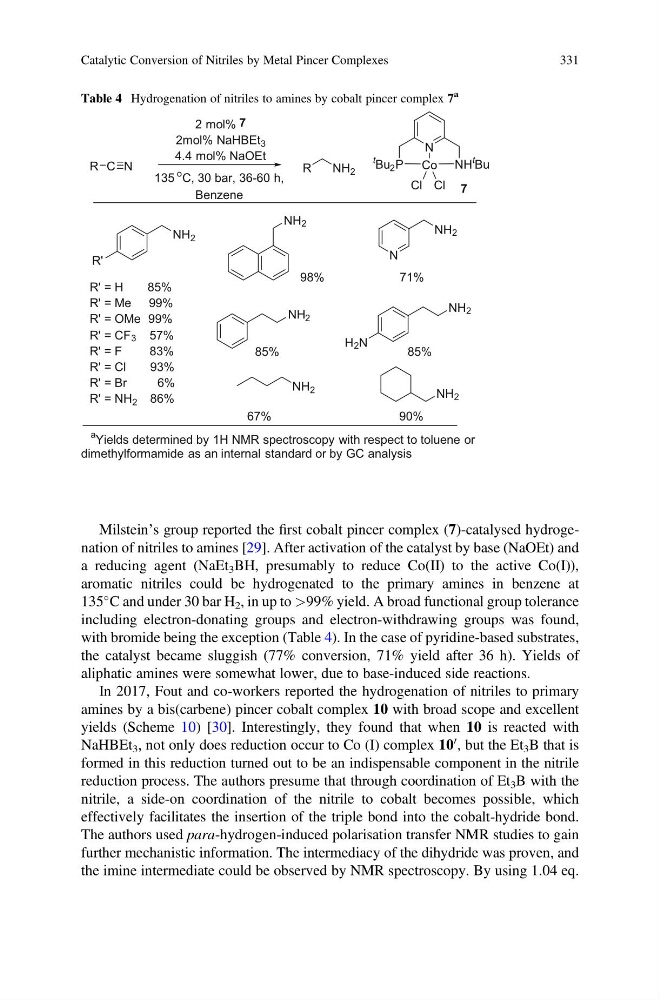
Milstein’s group reported the first cobalt pincer complex (7)-catalysed hydrogenation of nitriles to amines [29]. After activation of the catalyst by base (NaOEt) and
a reducing agent (NaEt 3 BH, presumably to reduce Co(II) to the active Co(I)),
aromatic nitriles could be hydrogenated to the primary amines in benzene at
135
C and under 30 bar H 2 , in up to >99% yield. A broad functional group tolerance
including electron-donating groups and electron-withdrawing groups was found,
with bromide being the exception (Table 4). In the case of pyridine-based substrates,
the catalyst became sluggish (77% conversion, 71% yield after 36 h). Yields of
aliphatic amines were somewhat lower, due to base-induced side reactions.
In 2017, Fout and co-workers reported the hydrogenation of nitriles to primary
amines by a bis(carbene) pincer cobalt complex 10 with broad scope and excellent
yields (Scheme 10) [30]. Interestingly, they found that when 10 is reacted with
NaHBEt 3 , not only does reduction occur to Co (I) complex 10
0 , but the Et 3 B that is
formed in this reduction turned out to be an indispensable component in the nitrile
reduction process. The authors presume that through coordination of Et 3 B with the
nitrile, a side-on coordination of the nitrile to cobalt becomes possible, which
effectively facilitates the insertion of the triple bond into the cobalt-hydride bond.
The authors used para-hydrogen-induced polarisation transfer NMR studies to gain
further mechanistic information. The intermediacy of the dihydride was proven, and
the imine intermediate could be observed by NMR spectroscopy. By using 1.04 eq.
Table 4 Hydrogenation of nitriles to amines by cobalt pincer complex 7
a
R C N
2 mol% 7
2mol% NaHBEt 3
4.4 mol% NaOEt
R
NH 2
135
o C, 30 bar, 36-60 h,
Benzene
R'
NH 2
R' = H
85%
R' = Me 99%
R' = OMe 99%
R' = CF 3 57%
R' = F
83%
R' = Cl
93%
R' = Br
6%
R' = NH 2 86%
NH 2
98%
N
NH 2
71%
NH 2
85%
85%
NH 2
67%
NH 2
90%
NH 2
H 2 N
N
t
Bu 2 P
N H
t
Bu
Co
Cl Cl
a
Yields determined by 1H NMR spectroscopy with respect to toluene or
dimethylformamide as an internal standard or by GC analysis
7
Catalytic Conversion of Nitriles by Metal Pincer Complexes
331
a reducing agent (NaEt 3 BH, presumably to reduce Co(II) to the active Co(I)),
aromatic nitriles could be hydrogenated to the primary amines in benzene at
135
C and under 30 bar H 2 , in up to >99% yield. A broad functional group tolerance
including electron-donating groups and electron-withdrawing groups was found,
with bromide being the exception (Table 4). In the case of pyridine-based substrates,
the catalyst became sluggish (77% conversion, 71% yield after 36 h). Yields of
aliphatic amines were somewhat lower, due to base-induced side reactions.
In 2017, Fout and co-workers reported the hydrogenation of nitriles to primary
amines by a bis(carbene) pincer cobalt complex 10 with broad scope and excellent
yields (Scheme 10) [30]. Interestingly, they found that when 10 is reacted with
NaHBEt 3 , not only does reduction occur to Co (I) complex 10
0 , but the Et 3 B that is
formed in this reduction turned out to be an indispensable component in the nitrile
reduction process. The authors presume that through coordination of Et 3 B with the
nitrile, a side-on coordination of the nitrile to cobalt becomes possible, which
effectively facilitates the insertion of the triple bond into the cobalt-hydride bond.
The authors used para-hydrogen-induced polarisation transfer NMR studies to gain
further mechanistic information. The intermediacy of the dihydride was proven, and
the imine intermediate could be observed by NMR spectroscopy. By using 1.04 eq.
Table 4 Hydrogenation of nitriles to amines by cobalt pincer complex 7
a
R C N
2 mol% 7
2mol% NaHBEt 3
4.4 mol% NaOEt
R
NH 2
135
o C, 30 bar, 36-60 h,
Benzene
R'
NH 2
R' = H
85%
R' = Me 99%
R' = OMe 99%
R' = CF 3 57%
R' = F
83%
R' = Cl
93%
R' = Br
6%
R' = NH 2 86%
NH 2
98%
N
NH 2
71%
NH 2
85%
85%
NH 2
67%
NH 2
90%
NH 2
H 2 N
N
t
Bu 2 P
N H
t
Bu
Co
Cl Cl
a
Yields determined by 1H NMR spectroscopy with respect to toluene or
dimethylformamide as an internal standard or by GC analysis
7
Catalytic Conversion of Nitriles by Metal Pincer Complexes
331