

yields (81–99%), whereas benzonitriles with electron-withdrawing substituents as
well as heteroaromatic nitriles required slightly higher temperatures (100–130
C).
Remarkably, not only common halogens (CF 3 , F, Cl, Br), amino and methoxy
functional groups were tolerated as aromatic substituents (71–93% yields), but
ester- and acetamide-substituted nitriles were also reduced in synthetically useful
yields (75% and 70%). Primary, secondary as well as tertiary aliphatic nitriles were
all converted with good yields (63–95%). Noteworthily, cinnamonitrile could be
selectivity hydrogenated without reducing the C¼C bond (allylamine: saturated
amine >25:1). Adiponitrile was reduced in excellent yield to
hexamethylenediamine, a monomer for nylon-6,6, with good selectivity (95% isolated yield) and high rate (TOF of 250 h
À1 ). In addition, this reaction was scaled up
to 25 mmol.
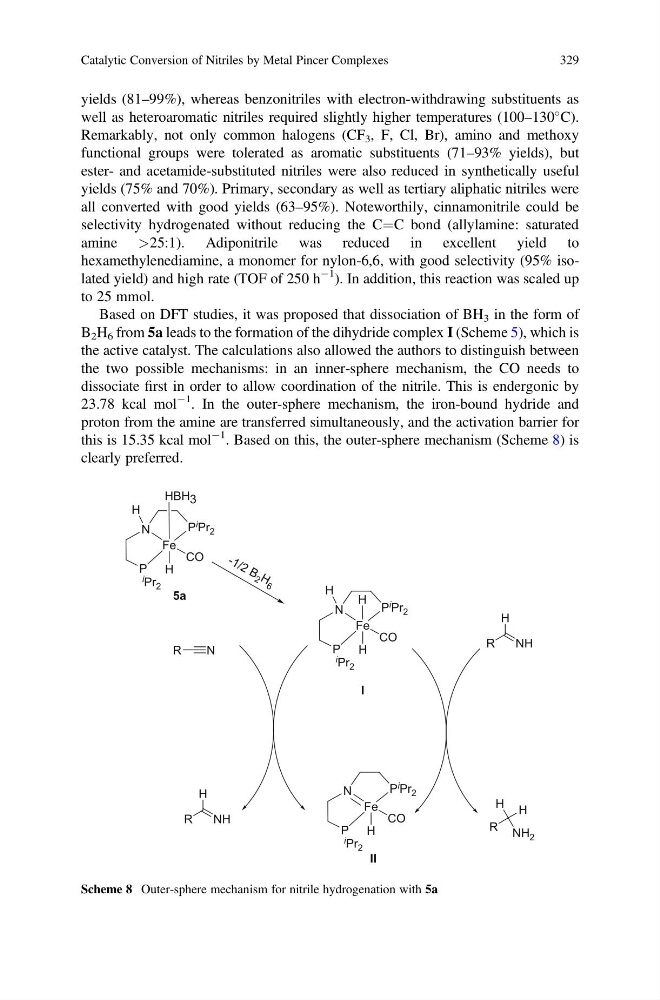
Based on DFT studies, it was proposed that dissociation of BH 3 in the form of
B 2 H 6 from 5a leads to the formation of the dihydride complex I (Scheme 5), which is
the active catalyst. The calculations also allowed the authors to distinguish between
the two possible mechanisms: in an inner-sphere mechanism, the CO needs to
dissociate first in order to allow coordination of the nitrile. This is endergonic by
23.78 kcal mol
À1 . In the outer-sphere mechanism, the iron-bound hydride and
proton from the amine are transferred simultaneously, and the activation barrier for
this is 15.35 kcal mol
À1 . Based on this, the outer-sphere mechanism (Scheme 8) is
clearly preferred.
N
P
P i Pr 2
Fe
CO
H
HBH 3
H
- 1 / 2 B
2 H
6
N
R
NH
R
H
NH
R
H
NH 2
R
H H
5a
I
II
i Pr 2
N
P
P i Pr 2
Fe
CO
H
H
H
i Pr 2
N
P
P i Pr 2
Fe
CO
H
i Pr 2
Scheme 8 Outer-sphere mechanism for nitrile hydrogenation with 5a
Catalytic Conversion of Nitriles by Metal Pincer Complexes
329
well as heteroaromatic nitriles required slightly higher temperatures (100–130
C).
Remarkably, not only common halogens (CF 3 , F, Cl, Br), amino and methoxy
functional groups were tolerated as aromatic substituents (71–93% yields), but
ester- and acetamide-substituted nitriles were also reduced in synthetically useful
yields (75% and 70%). Primary, secondary as well as tertiary aliphatic nitriles were
all converted with good yields (63–95%). Noteworthily, cinnamonitrile could be
selectivity hydrogenated without reducing the C¼C bond (allylamine: saturated
amine >25:1). Adiponitrile was reduced in excellent yield to
hexamethylenediamine, a monomer for nylon-6,6, with good selectivity (95% isolated yield) and high rate (TOF of 250 h
À1 ). In addition, this reaction was scaled up
to 25 mmol.
Based on DFT studies, it was proposed that dissociation of BH 3 in the form of
B 2 H 6 from 5a leads to the formation of the dihydride complex I (Scheme 5), which is
the active catalyst. The calculations also allowed the authors to distinguish between
the two possible mechanisms: in an inner-sphere mechanism, the CO needs to
dissociate first in order to allow coordination of the nitrile. This is endergonic by
23.78 kcal mol
À1 . In the outer-sphere mechanism, the iron-bound hydride and
proton from the amine are transferred simultaneously, and the activation barrier for
this is 15.35 kcal mol
À1 . Based on this, the outer-sphere mechanism (Scheme 8) is
clearly preferred.
N
P
P i Pr 2
Fe
CO
H
HBH 3
H
- 1 / 2 B
2 H
6
N
R
NH
R
H
NH
R
H
NH 2
R
H H
5a
I
II
i Pr 2
N
P
P i Pr 2
Fe
CO
H
H
H
i Pr 2
N
P
P i Pr 2
Fe
CO
H
i Pr 2
Scheme 8 Outer-sphere mechanism for nitrile hydrogenation with 5a
Catalytic Conversion of Nitriles by Metal Pincer Complexes
329