

sphere mechanism (intermediate III), the hydride is transferred to the carbon atom
under simultaneous protonation of the nitrogen atom by the proton on the side arm
under dearomatisation of the pyridine resulting in the imine complex IV, which
releases the imine which is further hydrogenated to the amine by a similar
mechanism.
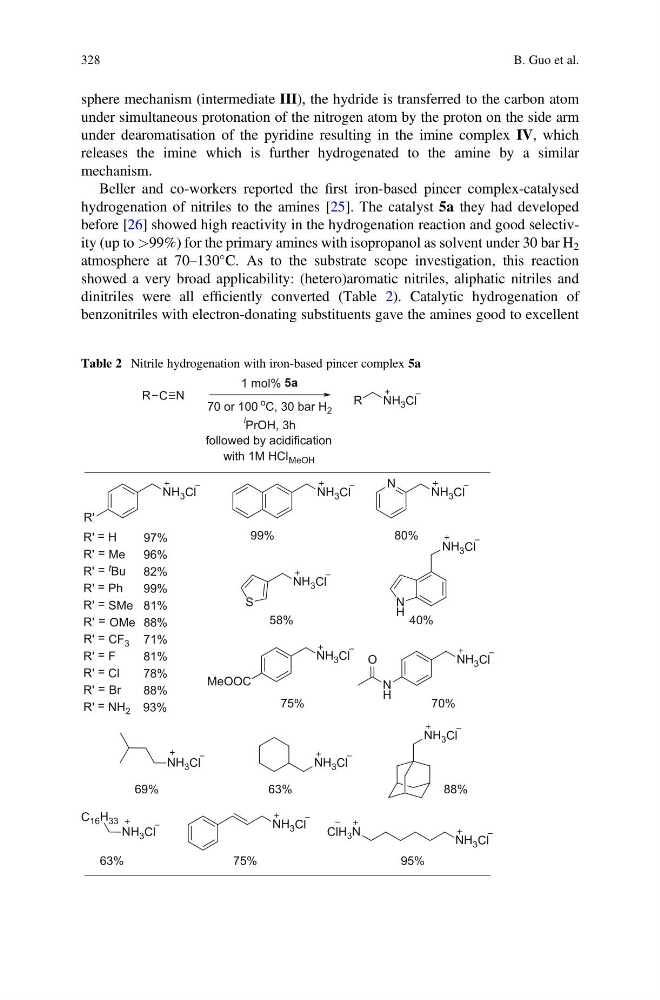
Beller and co-workers reported the first iron-based pincer complex-catalysed
hydrogenation of nitriles to the amines [25]. The catalyst 5a they had developed
before [26] showed high reactivity in the hydrogenation reaction and good selectivity (up to >99%) for the primary amines with isopropanol as solvent under 30 bar H 2
atmosphere at 70–130
C. As to the substrate scope investigation, this reaction
showed a very broad applicability: (hetero)aromatic nitriles, aliphatic nitriles and
dinitriles were all efficiently converted (Table 2). Catalytic hydrogenation of
benzonitriles with electron-donating substituents gave the amines good to excellent
Table 2 Nitrile hydrogenation with iron-based pincer complex 5a
R C N
1 mol% 5a
R
NH 3 Cl
70 or 100
o C, 30 bar H 2
i PrOH, 3h
followed by acidification
with 1M HCl MeOH
R'
NH 3 Cl
R' = H
97%
R' = Me
96%
R' = t Bu 82%
R' = Ph
99%
R' = SMe 81%
R' = OMe 88%
R' = CF 3 71%
R' = F
81%
R' = Cl
78%
R' = Br
88%
R' = NH 2 93%
NH 3 Cl
99%
N
NH 3 Cl
80%
NH 3 Cl
58%
S
NH 3 Cl
40%
N
H
NH 3 Cl
MeOOC
75%
NH 3 Cl
N
H
70%
O
NH 3 Cl
69%
C 16 H 33
NH 3 Cl
63%
NH 3 Cl
63%
NH 3 Cl
88%
NH 3 Cl
75%
95%
ClH 3 N
NH 3 Cl
328
B. Guo et al.
under simultaneous protonation of the nitrogen atom by the proton on the side arm
under dearomatisation of the pyridine resulting in the imine complex IV, which
releases the imine which is further hydrogenated to the amine by a similar
mechanism.
Beller and co-workers reported the first iron-based pincer complex-catalysed
hydrogenation of nitriles to the amines [25]. The catalyst 5a they had developed
before [26] showed high reactivity in the hydrogenation reaction and good selectivity (up to >99%) for the primary amines with isopropanol as solvent under 30 bar H 2
atmosphere at 70–130
C. As to the substrate scope investigation, this reaction
showed a very broad applicability: (hetero)aromatic nitriles, aliphatic nitriles and
dinitriles were all efficiently converted (Table 2). Catalytic hydrogenation of
benzonitriles with electron-donating substituents gave the amines good to excellent
Table 2 Nitrile hydrogenation with iron-based pincer complex 5a
R C N
1 mol% 5a
R
NH 3 Cl
70 or 100
o C, 30 bar H 2
i PrOH, 3h
followed by acidification
with 1M HCl MeOH
R'
NH 3 Cl
R' = H
97%
R' = Me
96%
R' = t Bu 82%
R' = Ph
99%
R' = SMe 81%
R' = OMe 88%
R' = CF 3 71%
R' = F
81%
R' = Cl
78%
R' = Br
88%
R' = NH 2 93%
NH 3 Cl
99%
N
NH 3 Cl
80%
NH 3 Cl
58%
S
NH 3 Cl
40%
N
H
NH 3 Cl
MeOOC
75%
NH 3 Cl
N
H
70%
O
NH 3 Cl
69%
C 16 H 33
NH 3 Cl
63%
NH 3 Cl
63%
NH 3 Cl
88%
NH 3 Cl
75%
95%
ClH 3 N
NH 3 Cl
328
B. Guo et al.