

excellent hydrogenation and dehydrogenation catalysts that, depending on the ligand
structure, may operate according to the classic Noyori-type (transfer) hydrogenation
mechanism. However, in the PNP and PNN metal complexes based on pyridines,
Milstein and co-workers also found novel mechanisms based on metal-ligand
cooperativity [15] in which the pyridine undergoes dearomatisation induced by
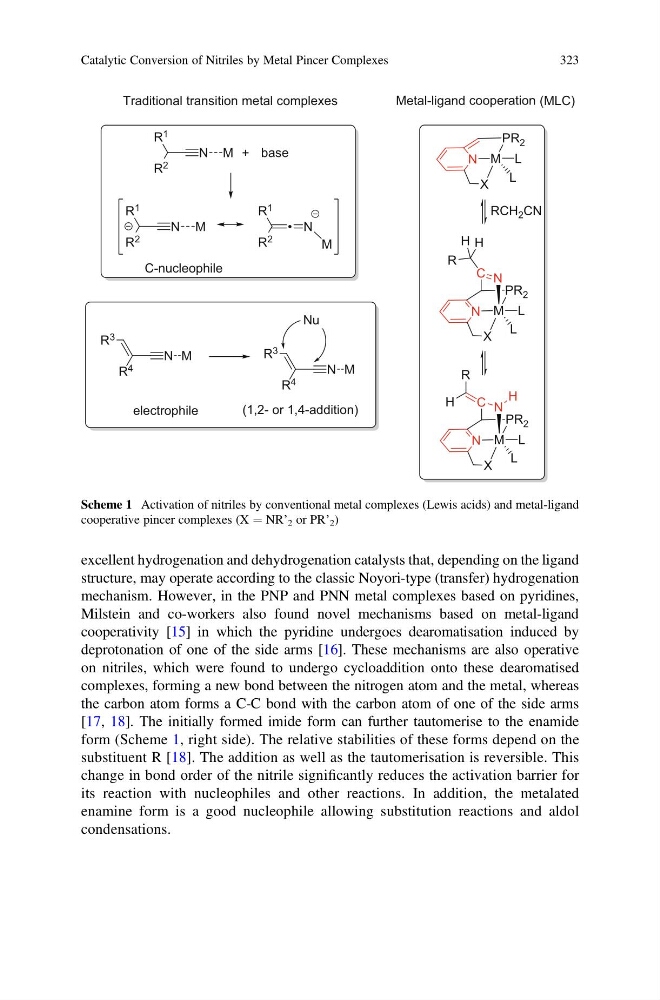
deprotonation of one of the side arms [16]. These mechanisms are also operative
on nitriles, which were found to undergo cycloaddition onto these dearomatised
complexes, forming a new bond between the nitrogen atom and the metal, whereas
the carbon atom forms a C-C bond with the carbon atom of one of the side arms
[17, 18]. The initially formed imide form can further tautomerise to the enamide
form (Scheme 1, right side). The relative stabilities of these forms depend on the
substituent R [18]. The addition as well as the tautomerisation is reversible. This
change in bond order of the nitrile significantly reduces the activation barrier for
its reaction with nucleophiles and other reactions. In addition, the metalated
enamine form is a good nucleophile allowing substitution reactions and aldol
condensations.
Traditional transition metal complexes
M
N
R 2
R 1
C-nucleophile
M
N
R 3
Nu
R 4
M
N
R 3
R 4
(1,2- or 1,4-addition)
Metal-ligand cooperation (MLC)
N
X
PR 2
M L
L
N
X
PR 2
M L
L
N
C
R
H
N
X
PR 2
M L
L
N
C
R
H H
RCH 2 CN
M
N
•
R 2
R 1
M
N
R 2
R 1
+ base
electrophile
H
Scheme 1 Activation of nitriles by conventional metal complexes (Lewis acids) and metal-ligand
cooperative pincer complexes (X ¼ NR’ 2 or PR’ 2 )
Catalytic Conversion of Nitriles by Metal Pincer Complexes
323
structure, may operate according to the classic Noyori-type (transfer) hydrogenation
mechanism. However, in the PNP and PNN metal complexes based on pyridines,
Milstein and co-workers also found novel mechanisms based on metal-ligand
cooperativity [15] in which the pyridine undergoes dearomatisation induced by
deprotonation of one of the side arms [16]. These mechanisms are also operative
on nitriles, which were found to undergo cycloaddition onto these dearomatised
complexes, forming a new bond between the nitrogen atom and the metal, whereas
the carbon atom forms a C-C bond with the carbon atom of one of the side arms
[17, 18]. The initially formed imide form can further tautomerise to the enamide
form (Scheme 1, right side). The relative stabilities of these forms depend on the
substituent R [18]. The addition as well as the tautomerisation is reversible. This
change in bond order of the nitrile significantly reduces the activation barrier for
its reaction with nucleophiles and other reactions. In addition, the metalated
enamine form is a good nucleophile allowing substitution reactions and aldol
condensations.
Traditional transition metal complexes
M
N
R 2
R 1
C-nucleophile
M
N
R 3
Nu
R 4
M
N
R 3
R 4
(1,2- or 1,4-addition)
Metal-ligand cooperation (MLC)
N
X
PR 2
M L
L
N
X
PR 2
M L
L
N
C
R
H
N
X
PR 2
M L
L
N
C
R
H H
RCH 2 CN
M
N
•
R 2
R 1
M
N
R 2
R 1
+ base
electrophile
H
Scheme 1 Activation of nitriles by conventional metal complexes (Lewis acids) and metal-ligand
cooperative pincer complexes (X ¼ NR’ 2 or PR’ 2 )
Catalytic Conversion of Nitriles by Metal Pincer Complexes
323