

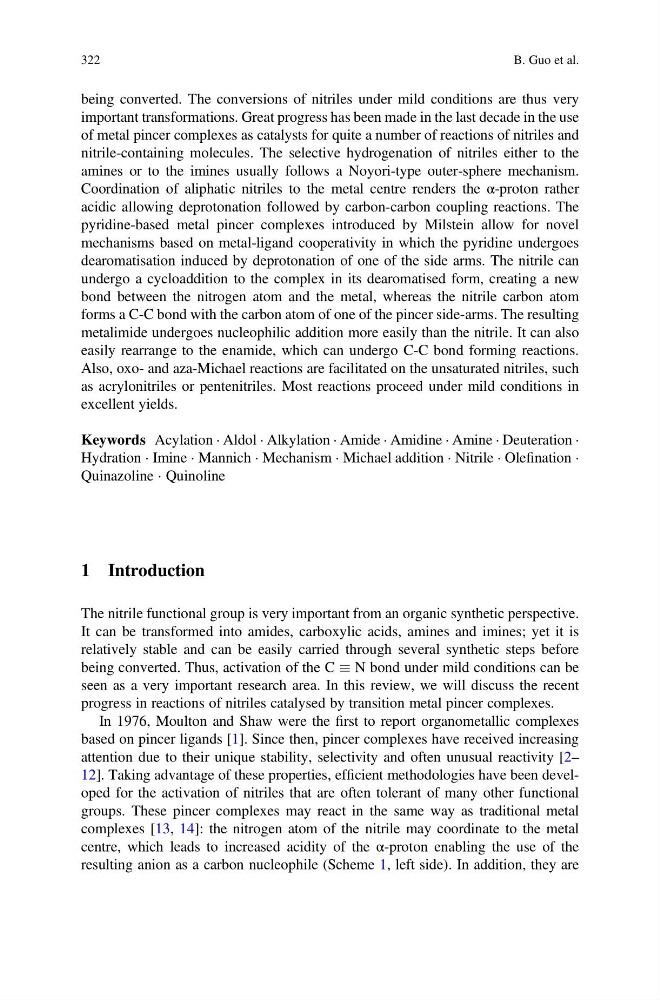
being converted. The conversions of nitriles under mild conditions are thus very
important transformations. Great progress has been made in the last decade in the use
of metal pincer complexes as catalysts for quite a number of reactions of nitriles and
nitrile-containing molecules. The selective hydrogenation of nitriles either to the
amines or to the imines usually follows a Noyori-type outer-sphere mechanism.
Coordination of aliphatic nitriles to the metal centre renders the α-proton rather
acidic allowing deprotonation followed by carbon-carbon coupling reactions. The
pyridine-based metal pincer complexes introduced by Milstein allow for novel
mechanisms based on metal-ligand cooperativity in which the pyridine undergoes
dearomatisation induced by deprotonation of one of the side arms. The nitrile can
undergo a cycloaddition to the complex in its dearomatised form, creating a new
bond between the nitrogen atom and the metal, whereas the nitrile carbon atom
forms a C-C bond with the carbon atom of one of the pincer side-arms. The resulting
metalimide undergoes nucleophilic addition more easily than the nitrile. It can also
easily rearrange to the enamide, which can undergo C-C bond forming reactions.
Also, oxo- and aza-Michael reactions are facilitated on the unsaturated nitriles, such
as acrylonitriles or pentenitriles. Most reactions proceed under mild conditions in
excellent yields.
Keywords Acylation · Aldol · Alkylation · Amide · Amidine · Amine · Deuteration ·
Hydration · Imine · Mannich · Mechanism · Michael addition · Nitrile · Olefination ·
Quinazoline · Quinoline
1 Introduction
The nitrile functional group is very important from an organic synthetic perspective.
It can be transformed into amides, carboxylic acids, amines and imines; yet it is
relatively stable and can be easily carried through several synthetic steps before
being converted. Thus, activation of the C N bond under mild conditions can be
seen as a very important research area. In this review, we will discuss the recent
progress in reactions of nitriles catalysed by transition metal pincer complexes.
In 1976, Moulton and Shaw were the first to report organometallic complexes
based on pincer ligands [1]. Since then, pincer complexes have received increasing
attention due to their unique stability, selectivity and often unusual reactivity [2–
12]. Taking advantage of these properties, efficient methodologies have been developed for the activation of nitriles that are often tolerant of many other functional
groups. These pincer complexes may react in the same way as traditional metal
complexes [13, 14]: the nitrogen atom of the nitrile may coordinate to the metal
centre, which leads to increased acidity of the α-proton enabling the use of the
resulting anion as a carbon nucleophile (Scheme 1, left side). In addition, they are
322
B. Guo et al.
important transformations. Great progress has been made in the last decade in the use
of metal pincer complexes as catalysts for quite a number of reactions of nitriles and
nitrile-containing molecules. The selective hydrogenation of nitriles either to the
amines or to the imines usually follows a Noyori-type outer-sphere mechanism.
Coordination of aliphatic nitriles to the metal centre renders the α-proton rather
acidic allowing deprotonation followed by carbon-carbon coupling reactions. The
pyridine-based metal pincer complexes introduced by Milstein allow for novel
mechanisms based on metal-ligand cooperativity in which the pyridine undergoes
dearomatisation induced by deprotonation of one of the side arms. The nitrile can
undergo a cycloaddition to the complex in its dearomatised form, creating a new
bond between the nitrogen atom and the metal, whereas the nitrile carbon atom
forms a C-C bond with the carbon atom of one of the pincer side-arms. The resulting
metalimide undergoes nucleophilic addition more easily than the nitrile. It can also
easily rearrange to the enamide, which can undergo C-C bond forming reactions.
Also, oxo- and aza-Michael reactions are facilitated on the unsaturated nitriles, such
as acrylonitriles or pentenitriles. Most reactions proceed under mild conditions in
excellent yields.
Keywords Acylation · Aldol · Alkylation · Amide · Amidine · Amine · Deuteration ·
Hydration · Imine · Mannich · Mechanism · Michael addition · Nitrile · Olefination ·
Quinazoline · Quinoline
1 Introduction
The nitrile functional group is very important from an organic synthetic perspective.
It can be transformed into amides, carboxylic acids, amines and imines; yet it is
relatively stable and can be easily carried through several synthetic steps before
being converted. Thus, activation of the C N bond under mild conditions can be
seen as a very important research area. In this review, we will discuss the recent
progress in reactions of nitriles catalysed by transition metal pincer complexes.
In 1976, Moulton and Shaw were the first to report organometallic complexes
based on pincer ligands [1]. Since then, pincer complexes have received increasing
attention due to their unique stability, selectivity and often unusual reactivity [2–
12]. Taking advantage of these properties, efficient methodologies have been developed for the activation of nitriles that are often tolerant of many other functional
groups. These pincer complexes may react in the same way as traditional metal
complexes [13, 14]: the nitrogen atom of the nitrile may coordinate to the metal
centre, which leads to increased acidity of the α-proton enabling the use of the
resulting anion as a carbon nucleophile (Scheme 1, left side). In addition, they are
322
B. Guo et al.