

computational screening and experimental validation, scatole and pyrrole were
identified as the best promoters that balance the difficulty of amine carbonylation
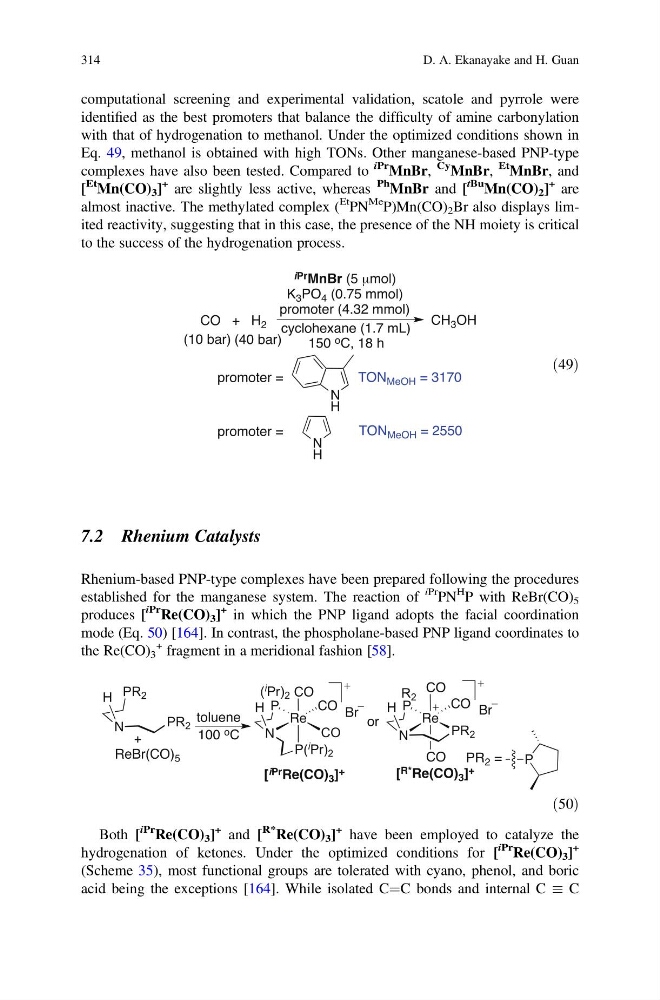
with that of hydrogenation to methanol. Under the optimized conditions shown in
Eq. 49, methanol is obtained with high TONs. Other manganese-based PNP-type
complexes have also been tested. Compared to
iPr MnBr,
Cy MnBr,
Et
MnBr, and
[
Et
Mn(CO) 3 ]
+ are slightly less active, whereas
Ph
MnBr and [
tBu
Mn(CO) 2 ]
+ are
almost inactive. The methylated complex (
Et
PN
Me
P)Mn(CO) 2 Br also displays limited reactivity, suggesting that in this case, the presence of the NH moiety is critical
to the success of the hydrogenation process.
ð49Þ
7.2 Rhenium Catalysts
Rhenium-based PNP-type complexes have been prepared following the procedures
established for the manganese system. The reaction of
iPr
PN
H P with ReBr(CO) 5
produces [
iPr
Re(CO) 3 ]
+ in which the PNP ligand adopts the facial coordination
mode (Eq. 50) [164]. In contrast, the phospholane-based PNP ligand coordinates to
the Re(CO) 3
+ fragment in a meridional fashion [58].
ð50Þ
Both [
iPr
Re(CO) 3 ]
+ and [
R*
Re(CO) 3 ]
+ have been employed to catalyze the
hydrogenation of ketones. Under the optimized conditions for [
iPr
Re(CO) 3 ]
+
(Scheme 35), most functional groups are tolerated with cyano, phenol, and boric
acid being the exceptions [164]. While isolated C¼C bonds and internal C C
314
D. A. Ekanayake and H. Guan
identified as the best promoters that balance the difficulty of amine carbonylation
with that of hydrogenation to methanol. Under the optimized conditions shown in
Eq. 49, methanol is obtained with high TONs. Other manganese-based PNP-type
complexes have also been tested. Compared to
iPr MnBr,
Cy MnBr,
Et
MnBr, and
[
Et
Mn(CO) 3 ]
+ are slightly less active, whereas
Ph
MnBr and [
tBu
Mn(CO) 2 ]
+ are
almost inactive. The methylated complex (
Et
PN
Me
P)Mn(CO) 2 Br also displays limited reactivity, suggesting that in this case, the presence of the NH moiety is critical
to the success of the hydrogenation process.
ð49Þ
7.2 Rhenium Catalysts
Rhenium-based PNP-type complexes have been prepared following the procedures
established for the manganese system. The reaction of
iPr
PN
H P with ReBr(CO) 5
produces [
iPr
Re(CO) 3 ]
+ in which the PNP ligand adopts the facial coordination
mode (Eq. 50) [164]. In contrast, the phospholane-based PNP ligand coordinates to
the Re(CO) 3
+ fragment in a meridional fashion [58].
ð50Þ
Both [
iPr
Re(CO) 3 ]
+ and [
R*
Re(CO) 3 ]
+ have been employed to catalyze the
hydrogenation of ketones. Under the optimized conditions for [
iPr
Re(CO) 3 ]
+
(Scheme 35), most functional groups are tolerated with cyano, phenol, and boric
acid being the exceptions [164]. While isolated C¼C bonds and internal C C
314
D. A. Ekanayake and H. Guan