

(e.g.,
iPr
Mn(CO) 2 ), although such process has not been validated experimentally.
The closest work was done by Prakash, who used
iPr MnBr and
Cy MnBr to catalyze
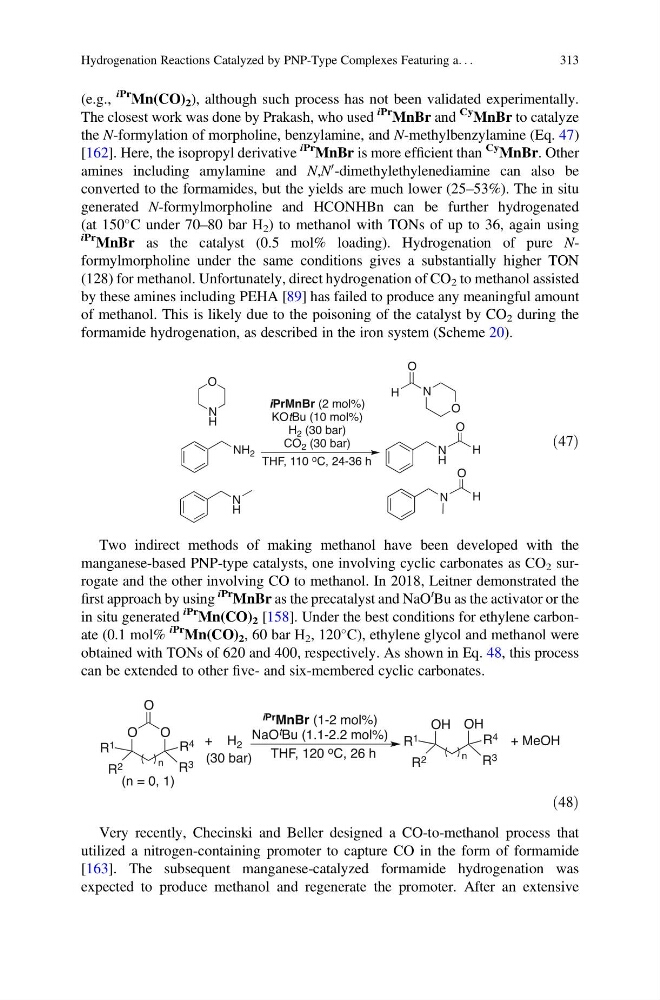
the N-formylation of morpholine, benzylamine, and N-methylbenzylamine (Eq. 47)
[162]. Here, the isopropyl derivative
iPr
MnBr is more efficient than
Cy
MnBr. Other
amines including amylamine and N,N
0 -dimethylethylenediamine can also be
converted to the formamides, but the yields are much lower (25–53%). The in situ
generated N-formylmorpholine and HCONHBn can be further hydrogenated
(at 150
C under 70–80 bar H 2 ) to methanol with TONs of up to 36, again using
iPr
MnBr as the catalyst (0.5 mol% loading). Hydrogenation of pure Nformylmorpholine under the same conditions gives a substantially higher TON
(128) for methanol. Unfortunately, direct hydrogenation of CO 2 to methanol assisted
by these amines including PEHA [89] has failed to produce any meaningful amount
of methanol. This is likely due to the poisoning of the catalyst by CO 2 during the
formamide hydrogenation, as described in the iron system (Scheme 20).
ð47Þ
Two indirect methods of making methanol have been developed with the
manganese-based PNP-type catalysts, one involving cyclic carbonates as CO 2 surrogate and the other involving CO to methanol. In 2018, Leitner demonstrated the
first approach by using
iPr
MnBr as the precatalyst and NaO
t
Bu as the activator or the
in situ generated
iPr Mn(CO) 2 [158]. Under the best conditions for ethylene carbonate (0.1 mol%
iPr
Mn(CO) 2 , 60 bar H 2 , 120
C), ethylene glycol and methanol were
obtained with TONs of 620 and 400, respectively. As shown in Eq. 48, this process
can be extended to other five- and six-membered cyclic carbonates.
ð48Þ
Very recently, Checinski and Beller designed a CO-to-methanol process that
utilized a nitrogen-containing promoter to capture CO in the form of formamide
[163]. The subsequent manganese-catalyzed formamide hydrogenation was
expected to produce methanol and regenerate the promoter. After an extensive
Hydrogenation Reactions Catalyzed by PNP-Type Complexes Featuring a. . .
313
iPr
Mn(CO) 2 ), although such process has not been validated experimentally.
The closest work was done by Prakash, who used
iPr MnBr and
Cy MnBr to catalyze
the N-formylation of morpholine, benzylamine, and N-methylbenzylamine (Eq. 47)
[162]. Here, the isopropyl derivative
iPr
MnBr is more efficient than
Cy
MnBr. Other
amines including amylamine and N,N
0 -dimethylethylenediamine can also be
converted to the formamides, but the yields are much lower (25–53%). The in situ
generated N-formylmorpholine and HCONHBn can be further hydrogenated
(at 150
C under 70–80 bar H 2 ) to methanol with TONs of up to 36, again using
iPr
MnBr as the catalyst (0.5 mol% loading). Hydrogenation of pure Nformylmorpholine under the same conditions gives a substantially higher TON
(128) for methanol. Unfortunately, direct hydrogenation of CO 2 to methanol assisted
by these amines including PEHA [89] has failed to produce any meaningful amount
of methanol. This is likely due to the poisoning of the catalyst by CO 2 during the
formamide hydrogenation, as described in the iron system (Scheme 20).
ð47Þ
Two indirect methods of making methanol have been developed with the
manganese-based PNP-type catalysts, one involving cyclic carbonates as CO 2 surrogate and the other involving CO to methanol. In 2018, Leitner demonstrated the
first approach by using
iPr
MnBr as the precatalyst and NaO
t
Bu as the activator or the
in situ generated
iPr Mn(CO) 2 [158]. Under the best conditions for ethylene carbonate (0.1 mol%
iPr
Mn(CO) 2 , 60 bar H 2 , 120
C), ethylene glycol and methanol were
obtained with TONs of 620 and 400, respectively. As shown in Eq. 48, this process
can be extended to other five- and six-membered cyclic carbonates.
ð48Þ
Very recently, Checinski and Beller designed a CO-to-methanol process that
utilized a nitrogen-containing promoter to capture CO in the form of formamide
[163]. The subsequent manganese-catalyzed formamide hydrogenation was
expected to produce methanol and regenerate the promoter. After an extensive
Hydrogenation Reactions Catalyzed by PNP-Type Complexes Featuring a. . .
313