

acetophenone derivatives are hydrogenated to the corresponding alcohols with ee’s
up to 55%. Both experimental and computational studies support the involvement of
(
R PNP)Mn(CO) 2 and (
R PN
H P)Mn(CO) 2 H in the catalytic cycle. It is interesting to
know that the iron precatalyst (S,S)MetBu FeHBr (shown in Scheme 17) is about
30 times more active than (S,S)-[
MetBu Mn(CO) 3 ]
+
. This is due to the formation of a
more stable alkoxide species with manganese, which is generated after hydrogen
transfer from (
R PN
H
P)Mn(CO) 2 H to the ketone substrate.
Esters are comparatively more challenging substrates for hydrogenation. In a
2016 report, Beller showed that at 100
C under 30 bar H 2 ,
iPr
MnBr and
Cy MnBr
(activated with KO
t Bu) displayed very limited catalytic activity for the hydrogenation of methyl benzoate [37]. Lan and Liu recently also reported that at 120
C under
45 bar H 2 ,
iPr MnBr and
Ph
MnBr (activated with KO
t Bu) catalyzed the hydrogenation of the ketone part of methyl 4-acetylbenzoate with only 3–9% of the ester
functionality being reduced [159]. However, Beller demonstrated that both
Et
MnBr
and [
Et
Mn(CO) 3 ]
+ were effective hydrogenation catalysts for esters, converting
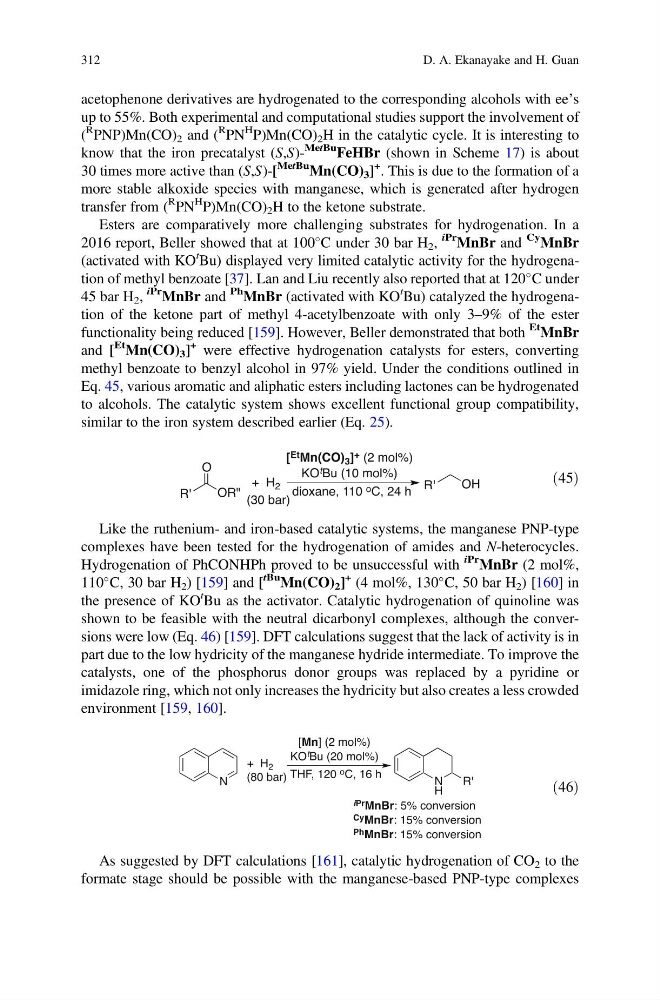
methyl benzoate to benzyl alcohol in 97% yield. Under the conditions outlined in
Eq. 45, various aromatic and aliphatic esters including lactones can be hydrogenated
to alcohols. The catalytic system shows excellent functional group compatibility,
similar to the iron system described earlier (Eq. 25).
ð45Þ
Like the ruthenium- and iron-based catalytic systems, the manganese PNP-type
complexes have been tested for the hydrogenation of amides and N-heterocycles.
Hydrogenation of PhCONHPh proved to be unsuccessful with
iPr
MnBr (2 mol%,
110
C, 30 bar H 2 ) [159] and [
tBu
Mn(CO) 2 ]
+ (4 mol%, 130
C, 50 bar H 2 ) [160] in
the presence of KO
t Bu as the activator. Catalytic hydrogenation of quinoline was
shown to be feasible with the neutral dicarbonyl complexes, although the conversions were low (Eq. 46) [159]. DFT calculations suggest that the lack of activity is in
part due to the low hydricity of the manganese hydride intermediate. To improve the
catalysts, one of the phosphorus donor groups was replaced by a pyridine or
imidazole ring, which not only increases the hydricity but also creates a less crowded
environment [159, 160].
ð46Þ
As suggested by DFT calculations [161], catalytic hydrogenation of CO 2 to the
formate stage should be possible with the manganese-based PNP-type complexes
312
D. A. Ekanayake and H. Guan
up to 55%. Both experimental and computational studies support the involvement of
(
R PNP)Mn(CO) 2 and (
R PN
H P)Mn(CO) 2 H in the catalytic cycle. It is interesting to
know that the iron precatalyst (S,S)MetBu FeHBr (shown in Scheme 17) is about
30 times more active than (S,S)-[
MetBu Mn(CO) 3 ]
+
. This is due to the formation of a
more stable alkoxide species with manganese, which is generated after hydrogen
transfer from (
R PN
H
P)Mn(CO) 2 H to the ketone substrate.
Esters are comparatively more challenging substrates for hydrogenation. In a
2016 report, Beller showed that at 100
C under 30 bar H 2 ,
iPr
MnBr and
Cy MnBr
(activated with KO
t Bu) displayed very limited catalytic activity for the hydrogenation of methyl benzoate [37]. Lan and Liu recently also reported that at 120
C under
45 bar H 2 ,
iPr MnBr and
Ph
MnBr (activated with KO
t Bu) catalyzed the hydrogenation of the ketone part of methyl 4-acetylbenzoate with only 3–9% of the ester
functionality being reduced [159]. However, Beller demonstrated that both
Et
MnBr
and [
Et
Mn(CO) 3 ]
+ were effective hydrogenation catalysts for esters, converting
methyl benzoate to benzyl alcohol in 97% yield. Under the conditions outlined in
Eq. 45, various aromatic and aliphatic esters including lactones can be hydrogenated
to alcohols. The catalytic system shows excellent functional group compatibility,
similar to the iron system described earlier (Eq. 25).
ð45Þ
Like the ruthenium- and iron-based catalytic systems, the manganese PNP-type
complexes have been tested for the hydrogenation of amides and N-heterocycles.
Hydrogenation of PhCONHPh proved to be unsuccessful with
iPr
MnBr (2 mol%,
110
C, 30 bar H 2 ) [159] and [
tBu
Mn(CO) 2 ]
+ (4 mol%, 130
C, 50 bar H 2 ) [160] in
the presence of KO
t Bu as the activator. Catalytic hydrogenation of quinoline was
shown to be feasible with the neutral dicarbonyl complexes, although the conversions were low (Eq. 46) [159]. DFT calculations suggest that the lack of activity is in
part due to the low hydricity of the manganese hydride intermediate. To improve the
catalysts, one of the phosphorus donor groups was replaced by a pyridine or
imidazole ring, which not only increases the hydricity but also creates a less crowded
environment [159, 160].
ð46Þ
As suggested by DFT calculations [161], catalytic hydrogenation of CO 2 to the
formate stage should be possible with the manganese-based PNP-type complexes
312
D. A. Ekanayake and H. Guan