

amines. In contrast, hydrogenation of α,β-saturated aldehydes is highly selective for
the C¼O bonds, forming the allylic alcohols exclusively. Under the conditions for
ketone hydrogenation, other reducible functional groups such as ester, lactam, and
cyclopropyl ring are unaffected. The proposed mechanism involves an outer-sphere
hydrogen transfer from
iPr
MnH to the substrates followed by regeneration of the
hydride through the reaction of
iPr Mn(CO) 2 with H 2 . Consistent with this mechanism,
iPr MnH catalyzes the hydrogenation of benzonitrile under similar but basefree conditions, although for some unknown reason, the addition of NaO
t
Bu
improves the catalytic efficiency. The cyclohexyl derivative
Cy MnBr is slightly
less reactive than
iPr
MnBr in nitrile hydrogenation. Using
iPr
MnBr and
Cy
MnBr
as the precatalysts is more advantageous due to their high stability in air.
Given the availability of chiral
R PN
H P ligands, it is possible to develop
manganese-based PNP-type catalysts for asymmetric hydrogenation of ketones.
Since high temperatures often erode enantioselectivity, the reaction conditions
need to be further optimized. Using phospholane-based complex [
R* Mn(CO) 3 ]
+ as
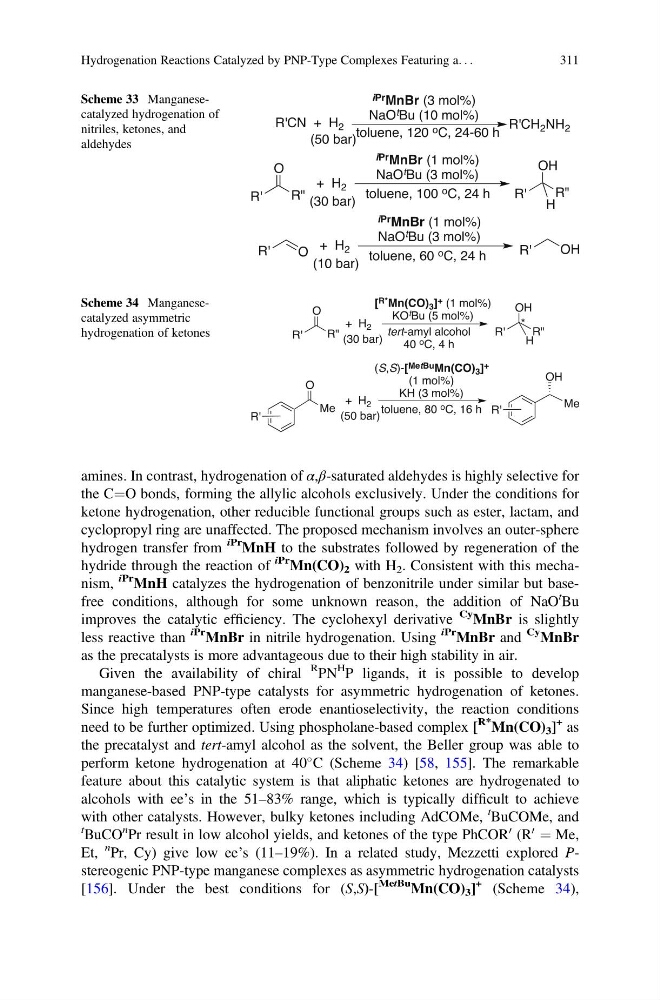
the precatalyst and tert-amyl alcohol as the solvent, the Beller group was able to
perform ketone hydrogenation at 40
C (Scheme 34) [58, 155]. The remarkable
feature about this catalytic system is that aliphatic ketones are hydrogenated to
alcohols with ee’s in the 51–83% range, which is typically difficult to achieve
with other catalysts. However, bulky ketones including AdCOMe,
t BuCOMe, and
t BuCO
n Pr result in low alcohol yields, and ketones of the type PhCOR
0 (R
0
¼ Me,
Et,
n Pr, Cy) give low ee’s (11–19%). In a related study, Mezzetti explored Pstereogenic PNP-type manganese complexes as asymmetric hydrogenation catalysts
[156]. Under the best conditions for (S,S)-[
MetBu Mn(CO) 3 ]
+ (Scheme 34),
Scheme 33 Manganesecatalyzed hydrogenation of
nitriles, ketones, and
aldehydes
Scheme 34 Manganesecatalyzed asymmetric
hydrogenation of ketones
Hydrogenation Reactions Catalyzed by PNP-Type Complexes Featuring a. . .
311
the C¼O bonds, forming the allylic alcohols exclusively. Under the conditions for
ketone hydrogenation, other reducible functional groups such as ester, lactam, and
cyclopropyl ring are unaffected. The proposed mechanism involves an outer-sphere
hydrogen transfer from
iPr
MnH to the substrates followed by regeneration of the
hydride through the reaction of
iPr Mn(CO) 2 with H 2 . Consistent with this mechanism,
iPr MnH catalyzes the hydrogenation of benzonitrile under similar but basefree conditions, although for some unknown reason, the addition of NaO
t
Bu
improves the catalytic efficiency. The cyclohexyl derivative
Cy MnBr is slightly
less reactive than
iPr
MnBr in nitrile hydrogenation. Using
iPr
MnBr and
Cy
MnBr
as the precatalysts is more advantageous due to their high stability in air.
Given the availability of chiral
R PN
H P ligands, it is possible to develop
manganese-based PNP-type catalysts for asymmetric hydrogenation of ketones.
Since high temperatures often erode enantioselectivity, the reaction conditions
need to be further optimized. Using phospholane-based complex [
R* Mn(CO) 3 ]
+ as
the precatalyst and tert-amyl alcohol as the solvent, the Beller group was able to
perform ketone hydrogenation at 40
C (Scheme 34) [58, 155]. The remarkable
feature about this catalytic system is that aliphatic ketones are hydrogenated to
alcohols with ee’s in the 51–83% range, which is typically difficult to achieve
with other catalysts. However, bulky ketones including AdCOMe,
t BuCOMe, and
t BuCO
n Pr result in low alcohol yields, and ketones of the type PhCOR
0 (R
0
¼ Me,
Et,
n Pr, Cy) give low ee’s (11–19%). In a related study, Mezzetti explored Pstereogenic PNP-type manganese complexes as asymmetric hydrogenation catalysts
[156]. Under the best conditions for (S,S)-[
MetBu Mn(CO) 3 ]
+ (Scheme 34),
Scheme 33 Manganesecatalyzed hydrogenation of
nitriles, ketones, and
aldehydes
Scheme 34 Manganesecatalyzed asymmetric
hydrogenation of ketones
Hydrogenation Reactions Catalyzed by PNP-Type Complexes Featuring a. . .
311