

(
iPr
PN
H P)MnCl 2 prepared from
iPr
PN
H P and MnCl 2 does not bind CO [153]. Successful routes to the carbonyl complexes have relied on the use of MnBr(CO) 5 as the
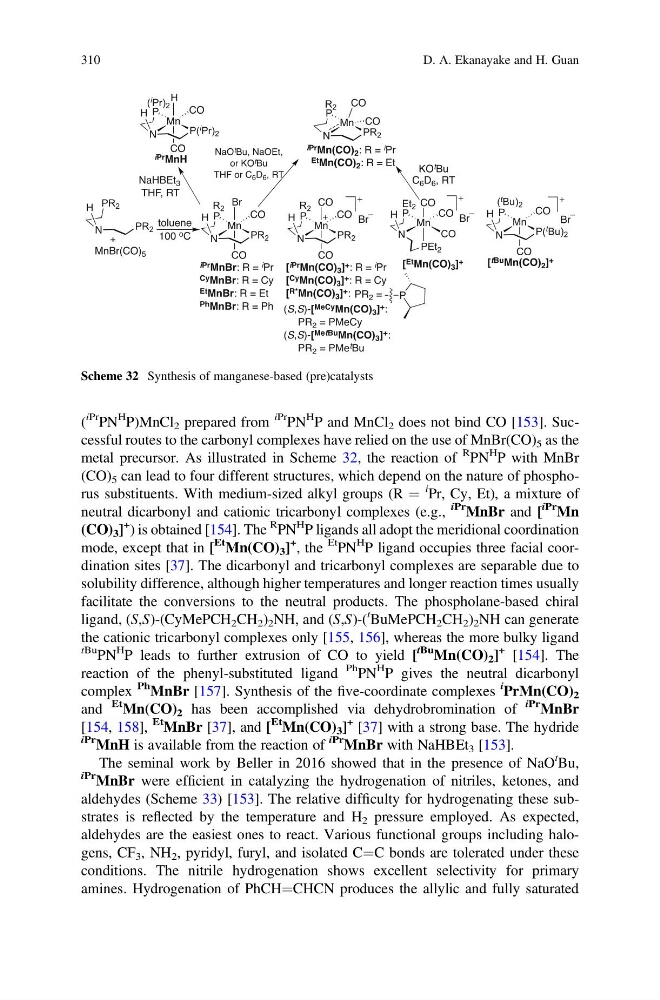
metal precursor. As illustrated in Scheme 32, the reaction of
R PN
H P with MnBr
(CO) 5 can lead to four different structures, which depend on the nature of phosphorus substituents. With medium-sized alkyl groups (R ¼
i Pr, Cy, Et), a mixture of
neutral dicarbonyl and cationic tricarbonyl complexes (e.g.,
iPr
MnBr and [
iPr Mn
(CO) 3 ]
+
) is obtained [154]. The
R PN
H P ligands all adopt the meridional coordination
mode, except that in [
Et Mn(CO) 3 ]
+
, the
Et
PN
H P ligand occupies three facial coordination sites [37]. The dicarbonyl and tricarbonyl complexes are separable due to
solubility difference, although higher temperatures and longer reaction times usually
facilitate the conversions to the neutral products. The phospholane-based chiral
ligand, (S,S)-(CyMePCH 2 CH 2 ) 2 NH, and (S,S)-(
t BuMePCH 2 CH 2 ) 2 NH can generate
the cationic tricarbonyl complexes only [155, 156], whereas the more bulky ligand
tBu PN
H P leads to further extrusion of CO to yield [
tBu Mn(CO) 2 ]
+ [154]. The
reaction of the phenyl-substituted ligand
Ph PN
H P gives the neutral dicarbonyl
complex
Ph
MnBr [157]. Synthesis of the five-coordinate complexes
i
PrMn(CO) 2
and
Et Mn(CO) 2 has been accomplished via dehydrobromination of
iPr
MnBr
[154, 158],
Et MnBr [37], and [
Et Mn(CO) 3 ]
+ [37] with a strong base. The hydride
iPr
MnH is available from the reaction of
iPr
MnBr with NaHBEt 3 [153].
The seminal work by Beller in 2016 showed that in the presence of NaO
t Bu,
iPr
MnBr were efficient in catalyzing the hydrogenation of nitriles, ketones, and
aldehydes (Scheme 33) [153]. The relative difficulty for hydrogenating these substrates is reflected by the temperature and H 2 pressure employed. As expected,
aldehydes are the easiest ones to react. Various functional groups including halogens, CF 3 , NH 2 , pyridyl, furyl, and isolated C¼C bonds are tolerated under these
conditions. The nitrile hydrogenation shows excellent selectivity for primary
amines. Hydrogenation of PhCH¼CHCN produces the allylic and fully saturated
Scheme 32 Synthesis of manganese-based (pre)catalysts
310
D. A. Ekanayake and H. Guan
iPr
PN
H P)MnCl 2 prepared from
iPr
PN
H P and MnCl 2 does not bind CO [153]. Successful routes to the carbonyl complexes have relied on the use of MnBr(CO) 5 as the
metal precursor. As illustrated in Scheme 32, the reaction of
R PN
H P with MnBr
(CO) 5 can lead to four different structures, which depend on the nature of phosphorus substituents. With medium-sized alkyl groups (R ¼
i Pr, Cy, Et), a mixture of
neutral dicarbonyl and cationic tricarbonyl complexes (e.g.,
iPr
MnBr and [
iPr Mn
(CO) 3 ]
+
) is obtained [154]. The
R PN
H P ligands all adopt the meridional coordination
mode, except that in [
Et Mn(CO) 3 ]
+
, the
Et
PN
H P ligand occupies three facial coordination sites [37]. The dicarbonyl and tricarbonyl complexes are separable due to
solubility difference, although higher temperatures and longer reaction times usually
facilitate the conversions to the neutral products. The phospholane-based chiral
ligand, (S,S)-(CyMePCH 2 CH 2 ) 2 NH, and (S,S)-(
t BuMePCH 2 CH 2 ) 2 NH can generate
the cationic tricarbonyl complexes only [155, 156], whereas the more bulky ligand
tBu PN
H P leads to further extrusion of CO to yield [
tBu Mn(CO) 2 ]
+ [154]. The
reaction of the phenyl-substituted ligand
Ph PN
H P gives the neutral dicarbonyl
complex
Ph
MnBr [157]. Synthesis of the five-coordinate complexes
i
PrMn(CO) 2
and
Et Mn(CO) 2 has been accomplished via dehydrobromination of
iPr
MnBr
[154, 158],
Et MnBr [37], and [
Et Mn(CO) 3 ]
+ [37] with a strong base. The hydride
iPr
MnH is available from the reaction of
iPr
MnBr with NaHBEt 3 [153].
The seminal work by Beller in 2016 showed that in the presence of NaO
t Bu,
iPr
MnBr were efficient in catalyzing the hydrogenation of nitriles, ketones, and
aldehydes (Scheme 33) [153]. The relative difficulty for hydrogenating these substrates is reflected by the temperature and H 2 pressure employed. As expected,
aldehydes are the easiest ones to react. Various functional groups including halogens, CF 3 , NH 2 , pyridyl, furyl, and isolated C¼C bonds are tolerated under these
conditions. The nitrile hydrogenation shows excellent selectivity for primary
amines. Hydrogenation of PhCH¼CHCN produces the allylic and fully saturated
Scheme 32 Synthesis of manganese-based (pre)catalysts
310
D. A. Ekanayake and H. Guan