

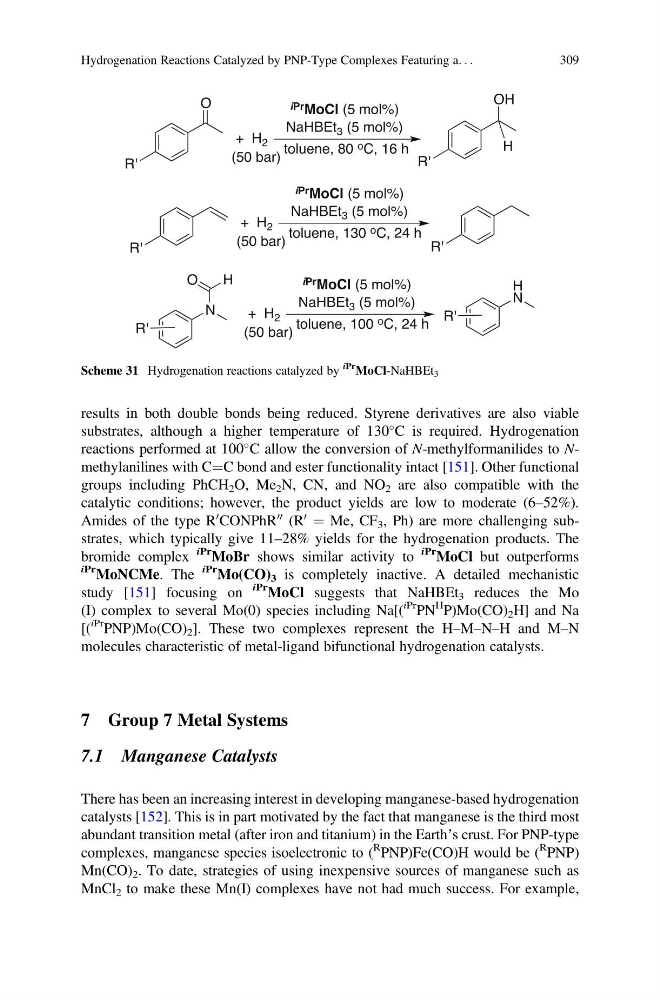
results in both double bonds being reduced. Styrene derivatives are also viable
substrates, although a higher temperature of 130
C is required. Hydrogenation
reactions performed at 100
C allow the conversion of N-methylformanilides to Nmethylanilines with C¼C bond and ester functionality intact [151]. Other functional
groups including PhCH 2 O, Me 2 N, CN, and NO 2 are also compatible with the
catalytic conditions; however, the product yields are low to moderate (6–52%).
Amides of the type R
0 CONPhR
00 (R
0
¼ Me, CF 3 , Ph) are more challenging substrates, which typically give 11–28% yields for the hydrogenation products. The
bromide complex
iPr MoBr shows similar activity to
iPr
MoCl but outperforms
iPr
MoNCMe. The
iPr
Mo(CO) 3 is completely inactive. A detailed mechanistic
study [151] focusing on
iPr
MoCl suggests that NaHBEt 3 reduces the Mo
(I) complex to several Mo(0) species including Na[(
iPr PN
H
P)Mo(CO) 2 H] and Na
[(
iPr PNP)Mo(CO) 2 ]. These two complexes represent the H–M–N–H and M–N
molecules characteristic of metal-ligand bifunctional hydrogenation catalysts.
7 Group 7 Metal Systems
7.1 Manganese Catalysts
There has been an increasing interest in developing manganese-based hydrogenation
catalysts [152]. This is in part motivated by the fact that manganese is the third most
abundant transition metal (after iron and titanium) in the Earth’s crust. For PNP-type
complexes, manganese species isoelectronic to (
R PNP)Fe(CO)H would be (
R PNP)
Mn(CO) 2 . To date, strategies of using inexpensive sources of manganese such as
MnCl 2 to make these Mn(I) complexes have not had much success. For example,
Scheme 31 Hydrogenation reactions catalyzed by
iPr MoCl-NaHBEt 3
Hydrogenation Reactions Catalyzed by PNP-Type Complexes Featuring a. . .
309
substrates, although a higher temperature of 130
C is required. Hydrogenation
reactions performed at 100
C allow the conversion of N-methylformanilides to Nmethylanilines with C¼C bond and ester functionality intact [151]. Other functional
groups including PhCH 2 O, Me 2 N, CN, and NO 2 are also compatible with the
catalytic conditions; however, the product yields are low to moderate (6–52%).
Amides of the type R
0 CONPhR
00 (R
0
¼ Me, CF 3 , Ph) are more challenging substrates, which typically give 11–28% yields for the hydrogenation products. The
bromide complex
iPr MoBr shows similar activity to
iPr
MoCl but outperforms
iPr
MoNCMe. The
iPr
Mo(CO) 3 is completely inactive. A detailed mechanistic
study [151] focusing on
iPr
MoCl suggests that NaHBEt 3 reduces the Mo
(I) complex to several Mo(0) species including Na[(
iPr PN
H
P)Mo(CO) 2 H] and Na
[(
iPr PNP)Mo(CO) 2 ]. These two complexes represent the H–M–N–H and M–N
molecules characteristic of metal-ligand bifunctional hydrogenation catalysts.
7 Group 7 Metal Systems
7.1 Manganese Catalysts
There has been an increasing interest in developing manganese-based hydrogenation
catalysts [152]. This is in part motivated by the fact that manganese is the third most
abundant transition metal (after iron and titanium) in the Earth’s crust. For PNP-type
complexes, manganese species isoelectronic to (
R PNP)Fe(CO)H would be (
R PNP)
Mn(CO) 2 . To date, strategies of using inexpensive sources of manganese such as
MnCl 2 to make these Mn(I) complexes have not had much success. For example,
Scheme 31 Hydrogenation reactions catalyzed by
iPr MoCl-NaHBEt 3
Hydrogenation Reactions Catalyzed by PNP-Type Complexes Featuring a. . .
309