

ð44Þ
6.2 Bis(Carbonyl) Complexes
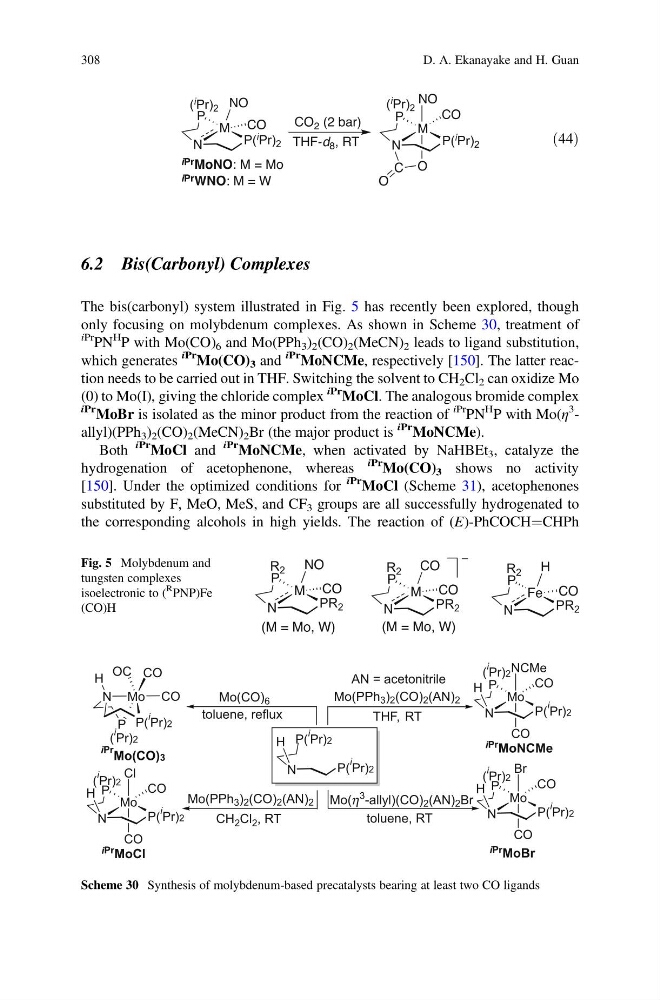
The bis(carbonyl) system illustrated in Fig. 5 has recently been explored, though
only focusing on molybdenum complexes. As shown in Scheme 30, treatment of
iPr
PN
H P with Mo(CO) 6 and Mo(PPh 3 ) 2 (CO) 2 (MeCN) 2 leads to ligand substitution,
which generates
iPr
Mo(CO) 3 and
iPr
MoNCMe, respectively [150]. The latter reaction needs to be carried out in THF. Switching the solvent to CH 2 Cl 2 can oxidize Mo
(0) to Mo(I), giving the chloride complex
iPr
MoCl. The analogous bromide complex
iPr
MoBr is isolated as the minor product from the reaction of
iPr PN
H P with Mo(η
3 -
allyl)(PPh 3 ) 2 (CO) 2 (MeCN) 2 Br (the major product is
iPr MoNCMe).
Both
iPr
MoCl and
iPr
MoNCMe, when activated by NaHBEt 3 , catalyze the
hydrogenation of acetophenone, whereas
iPr
Mo(CO) 3 shows no activity
[150]. Under the optimized conditions for
iPr MoCl (Scheme 31), acetophenones
substituted by F, MeO, MeS, and CF 3 groups are all successfully hydrogenated to
the corresponding alcohols in high yields. The reaction of (E)-PhCOCH¼CHPh
Fig. 5 Molybdenum and
tungsten complexes
isoelectronic to (
R PNP)Fe
(CO)H
P(
i Pr)
N
P(
i Pr)2
H
P(
i Pr)2
Mo
N
P
CO
Cl
(
i Pr)2
CO
H
P(
i Pr)2
Mo
N
P
CO
Br
(
i Pr)2
CO
H
P(
i Pr)2
Mo
N
P
CO
NCMe
CO
H
P(
i Pr)2
Mo
N
P
CO
H
(
i Pr)2
CO
OC
iPr MoCl
iPr MoBr
iPr Mo(CO)3
toluene, reflux
Mo(PPh 3 ) 2 (CO) 2 (AN) 2
THF, RT
Mo(
3
-allyl)(CO) 2 (AN) 2 Br
toluene, RT
Mo(PPh 3 ) 2 (CO) 2 (AN) 2
CH 2 Cl 2 , RT
Mo(CO) 6
AN = acetonitrile
(
i Pr)2
iPr MoNCMe
2
h
Scheme 30 Synthesis of molybdenum-based precatalysts bearing at least two CO ligands
308
D. A. Ekanayake and H. Guan
6.2 Bis(Carbonyl) Complexes
The bis(carbonyl) system illustrated in Fig. 5 has recently been explored, though
only focusing on molybdenum complexes. As shown in Scheme 30, treatment of
iPr
PN
H P with Mo(CO) 6 and Mo(PPh 3 ) 2 (CO) 2 (MeCN) 2 leads to ligand substitution,
which generates
iPr
Mo(CO) 3 and
iPr
MoNCMe, respectively [150]. The latter reaction needs to be carried out in THF. Switching the solvent to CH 2 Cl 2 can oxidize Mo
(0) to Mo(I), giving the chloride complex
iPr
MoCl. The analogous bromide complex
iPr
MoBr is isolated as the minor product from the reaction of
iPr PN
H P with Mo(η
3 -
allyl)(PPh 3 ) 2 (CO) 2 (MeCN) 2 Br (the major product is
iPr MoNCMe).
Both
iPr
MoCl and
iPr
MoNCMe, when activated by NaHBEt 3 , catalyze the
hydrogenation of acetophenone, whereas
iPr
Mo(CO) 3 shows no activity
[150]. Under the optimized conditions for
iPr MoCl (Scheme 31), acetophenones
substituted by F, MeO, MeS, and CF 3 groups are all successfully hydrogenated to
the corresponding alcohols in high yields. The reaction of (E)-PhCOCH¼CHPh
Fig. 5 Molybdenum and
tungsten complexes
isoelectronic to (
R PNP)Fe
(CO)H
P(
i Pr)
N
P(
i Pr)2
H
P(
i Pr)2
Mo
N
P
CO
Cl
(
i Pr)2
CO
H
P(
i Pr)2
Mo
N
P
CO
Br
(
i Pr)2
CO
H
P(
i Pr)2
Mo
N
P
CO
NCMe
CO
H
P(
i Pr)2
Mo
N
P
CO
H
(
i Pr)2
CO
OC
iPr MoCl
iPr MoBr
iPr Mo(CO)3
toluene, reflux
Mo(PPh 3 ) 2 (CO) 2 (AN) 2
THF, RT
Mo(
3
-allyl)(CO) 2 (AN) 2 Br
toluene, RT
Mo(PPh 3 ) 2 (CO) 2 (AN) 2
CH 2 Cl 2 , RT
Mo(CO) 6
AN = acetonitrile
(
i Pr)2
iPr MoNCMe
2
h
Scheme 30 Synthesis of molybdenum-based precatalysts bearing at least two CO ligands
308
D. A. Ekanayake and H. Guan