

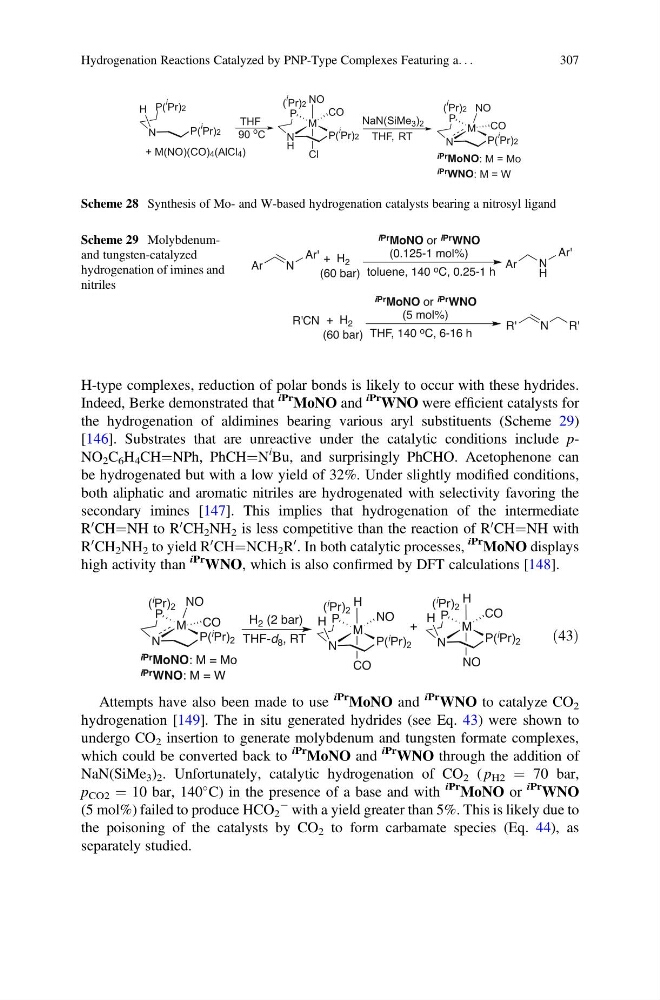
H-type complexes, reduction of polar bonds is likely to occur with these hydrides.
Indeed, Berke demonstrated that
iPr MoNO and
iPr
WNO were efficient catalysts for
the hydrogenation of aldimines bearing various aryl substituents (Scheme 29)
[146]. Substrates that are unreactive under the catalytic conditions include pNO 2 C 6 H 4 CH¼NPh, PhCH¼N
i Bu, and surprisingly PhCHO. Acetophenone can
be hydrogenated but with a low yield of 32%. Under slightly modified conditions,
both aliphatic and aromatic nitriles are hydrogenated with selectivity favoring the
secondary imines [147]. This implies that hydrogenation of the intermediate
R
0 CH¼NH to R
0 CH 2 NH 2 is less competitive than the reaction of R
0 CH¼NH with
R
0 CH 2 NH 2 to yield R
0 CH¼NCH 2 R
0 . In both catalytic processes,
iPr
MoNO displays
high activity than
iPr
WNO, which is also confirmed by DFT calculations [148].
ð43Þ
Attempts have also been made to use
iPr MoNO and
iPr WNO to catalyze CO 2
hydrogenation [149]. The in situ generated hydrides (see Eq. 43) were shown to
undergo CO 2 insertion to generate molybdenum and tungsten formate complexes,
which could be converted back to
iPr MoNO and
iPr WNO through the addition of
NaN(SiMe 3 ) 2 . Unfortunately, catalytic hydrogenation of CO 2 ( p H2 ¼ 70 bar,
p CO2 ¼ 10 bar, 140
C) in the presence of a base and with
iPr
MoNO or
iPr WNO
(5 mol%) failed to produce HCO 2
À with a yield greater than 5%. This is likely due to
the poisoning of the catalysts by CO 2 to form carbamate species (Eq. 44), as
separately studied.
P(
i Pr)2
N
P(
i Pr)2
H
P(
i Pr)2
M
N
H
P
CO
NO
(
i Pr)2
Cl
P(
i Pr)2
M
N
P
CO
NO
(
i Pr)2
+ M(NO)(CO)4(AlCl4)
THF
90
o C
NaN(SiMe 3 ) 2
THF, RT
iPr MoNO: M = Mo
iPr WNO: M = W
Scheme 28 Synthesis of Mo- and W-based hydrogenation catalysts bearing a nitrosyl ligand
Scheme 29 Molybdenumand tungsten-catalyzed
hydrogenation of imines and
nitriles
Hydrogenation Reactions Catalyzed by PNP-Type Complexes Featuring a. . .
307
Indeed, Berke demonstrated that
iPr MoNO and
iPr
WNO were efficient catalysts for
the hydrogenation of aldimines bearing various aryl substituents (Scheme 29)
[146]. Substrates that are unreactive under the catalytic conditions include pNO 2 C 6 H 4 CH¼NPh, PhCH¼N
i Bu, and surprisingly PhCHO. Acetophenone can
be hydrogenated but with a low yield of 32%. Under slightly modified conditions,
both aliphatic and aromatic nitriles are hydrogenated with selectivity favoring the
secondary imines [147]. This implies that hydrogenation of the intermediate
R
0 CH¼NH to R
0 CH 2 NH 2 is less competitive than the reaction of R
0 CH¼NH with
R
0 CH 2 NH 2 to yield R
0 CH¼NCH 2 R
0 . In both catalytic processes,
iPr
MoNO displays
high activity than
iPr
WNO, which is also confirmed by DFT calculations [148].
ð43Þ
Attempts have also been made to use
iPr MoNO and
iPr WNO to catalyze CO 2
hydrogenation [149]. The in situ generated hydrides (see Eq. 43) were shown to
undergo CO 2 insertion to generate molybdenum and tungsten formate complexes,
which could be converted back to
iPr MoNO and
iPr WNO through the addition of
NaN(SiMe 3 ) 2 . Unfortunately, catalytic hydrogenation of CO 2 ( p H2 ¼ 70 bar,
p CO2 ¼ 10 bar, 140
C) in the presence of a base and with
iPr
MoNO or
iPr WNO
(5 mol%) failed to produce HCO 2
À with a yield greater than 5%. This is likely due to
the poisoning of the catalysts by CO 2 to form carbamate species (Eq. 44), as
separately studied.
P(
i Pr)2
N
P(
i Pr)2
H
P(
i Pr)2
M
N
H
P
CO
NO
(
i Pr)2
Cl
P(
i Pr)2
M
N
P
CO
NO
(
i Pr)2
+ M(NO)(CO)4(AlCl4)
THF
90
o C
NaN(SiMe 3 ) 2
THF, RT
iPr MoNO: M = Mo
iPr WNO: M = W
Scheme 28 Synthesis of Mo- and W-based hydrogenation catalysts bearing a nitrosyl ligand
Scheme 29 Molybdenumand tungsten-catalyzed
hydrogenation of imines and
nitriles
Hydrogenation Reactions Catalyzed by PNP-Type Complexes Featuring a. . .
307