

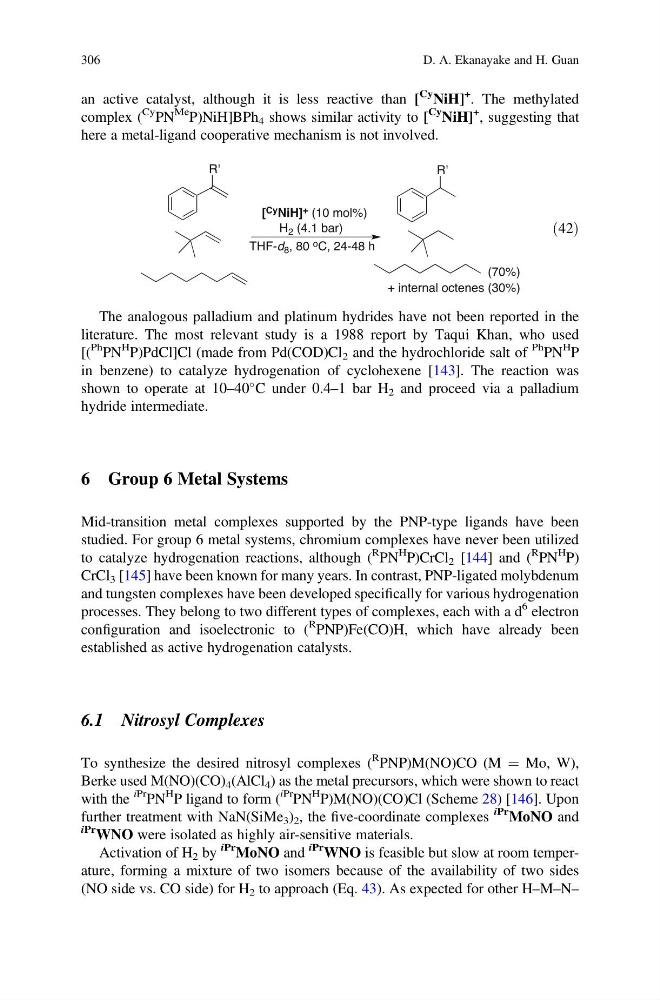
an active catalyst, although it is less reactive than [
Cy NiH]
+
. The methylated
complex (
Cy PN
Me P)NiH]BPh 4 shows similar activity to [
Cy NiH]
+
, suggesting that
here a metal-ligand cooperative mechanism is not involved.
ð42Þ
The analogous palladium and platinum hydrides have not been reported in the
literature. The most relevant study is a 1988 report by Taqui Khan, who used
[(
Ph PN
H P)PdCl]Cl (made from Pd(COD)Cl 2 and the hydrochloride salt of
Ph PN
H P
in benzene) to catalyze hydrogenation of cyclohexene [143]. The reaction was
shown to operate at 10–40
C under 0.4–1 bar H 2 and proceed via a palladium
hydride intermediate.
6 Group 6 Metal Systems
Mid-transition metal complexes supported by the PNP-type ligands have been
studied. For group 6 metal systems, chromium complexes have never been utilized
to catalyze hydrogenation reactions, although (
R PN
H P)CrCl 2 [144] and (
R PN
H P)
CrCl 3 [145] have been known for many years. In contrast, PNP-ligated molybdenum
and tungsten complexes have been developed specifically for various hydrogenation
processes. They belong to two different types of complexes, each with a d
6 electron
configuration and isoelectronic to (
R PNP)Fe(CO)H, which have already been
established as active hydrogenation catalysts.
6.1 Nitrosyl Complexes
To synthesize the desired nitrosyl complexes (
R PNP)M(NO)CO (M ¼ Mo, W),
Berke used M(NO)(CO) 4 (AlCl 4 ) as the metal precursors, which were shown to react
with the
iPr PN
H P ligand to form (
iPr PN
H P)M(NO)(CO)Cl (Scheme 28) [146]. Upon
further treatment with NaN(SiMe 3 ) 2 , the five-coordinate complexes
iPr MoNO and
iPr
WNO were isolated as highly air-sensitive materials.
Activation of H 2 by
iPr
MoNO and
iPr WNO is feasible but slow at room temperature, forming a mixture of two isomers because of the availability of two sides
(NO side vs. CO side) for H 2 to approach (Eq. 43). As expected for other H–M–N–
306
D. A. Ekanayake and H. Guan
Cy NiH]
+
. The methylated
complex (
Cy PN
Me P)NiH]BPh 4 shows similar activity to [
Cy NiH]
+
, suggesting that
here a metal-ligand cooperative mechanism is not involved.
ð42Þ
The analogous palladium and platinum hydrides have not been reported in the
literature. The most relevant study is a 1988 report by Taqui Khan, who used
[(
Ph PN
H P)PdCl]Cl (made from Pd(COD)Cl 2 and the hydrochloride salt of
Ph PN
H P
in benzene) to catalyze hydrogenation of cyclohexene [143]. The reaction was
shown to operate at 10–40
C under 0.4–1 bar H 2 and proceed via a palladium
hydride intermediate.
6 Group 6 Metal Systems
Mid-transition metal complexes supported by the PNP-type ligands have been
studied. For group 6 metal systems, chromium complexes have never been utilized
to catalyze hydrogenation reactions, although (
R PN
H P)CrCl 2 [144] and (
R PN
H P)
CrCl 3 [145] have been known for many years. In contrast, PNP-ligated molybdenum
and tungsten complexes have been developed specifically for various hydrogenation
processes. They belong to two different types of complexes, each with a d
6 electron
configuration and isoelectronic to (
R PNP)Fe(CO)H, which have already been
established as active hydrogenation catalysts.
6.1 Nitrosyl Complexes
To synthesize the desired nitrosyl complexes (
R PNP)M(NO)CO (M ¼ Mo, W),
Berke used M(NO)(CO) 4 (AlCl 4 ) as the metal precursors, which were shown to react
with the
iPr PN
H P ligand to form (
iPr PN
H P)M(NO)(CO)Cl (Scheme 28) [146]. Upon
further treatment with NaN(SiMe 3 ) 2 , the five-coordinate complexes
iPr MoNO and
iPr
WNO were isolated as highly air-sensitive materials.
Activation of H 2 by
iPr
MoNO and
iPr WNO is feasible but slow at room temperature, forming a mixture of two isomers because of the availability of two sides
(NO side vs. CO side) for H 2 to approach (Eq. 43). As expected for other H–M–N–
306
D. A. Ekanayake and H. Guan