

isomeric mixture) reacted with CO 2 (1 bar at room temperature) to form an insertion
product analogous to
iPr
IrH 2 (OCHO) [127]. Hydrogenation of CO 2 in MOH
(M ¼ Li, Na, K) with
Ph IrH 3 or
Ph
IrH 2 Cl produced HCO 2 M with much lower
TONs of 65–144, although the hydrogenation reactions were tested under relatively
low temperatures and pressures. In studying N-formylation of morpholine, Ding also
examined the catalytic activity of
iPr IrH 2 Cl (activated by KO
t Bu), which, under the
conditions shown in Scheme 26, generated the formamide with a TON of
720 [82]. An attempt to use ethylene carbonate as CO 2 surrogate had limited success
with
iPr
IrH 2 Cl/KO
t Bu as the catalyst (0.1 mol%); at 140
C under 50.7 bar H 2 ,
ethylene glycol was obtained with only 10% yield [55]. The ruthenium system
shown in Eq. 23 is far more reactive.
ð41Þ
5 Group 10 Metal Systems
Group 10 metals bearing the PNP-type ligands have been rarely used as hydrogenation catalysts. The only known example of a nickel system is the one developed by
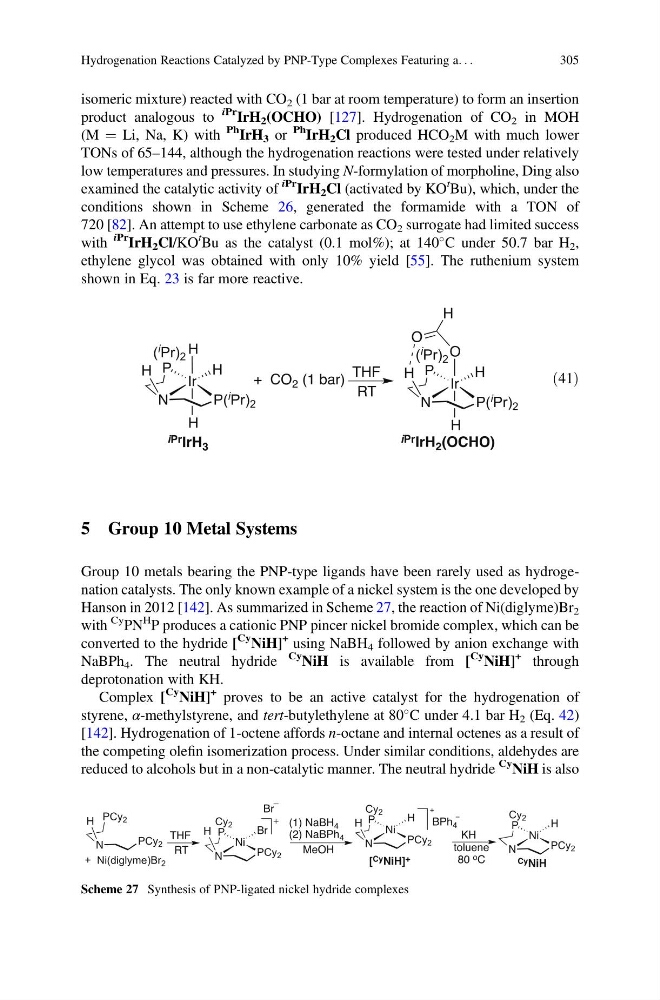
Hanson in 2012 [142]. As summarized in Scheme 27, the reaction of Ni(diglyme)Br 2
with
Cy PN
H P produces a cationic PNP pincer nickel bromide complex, which can be
converted to the hydride [
Cy NiH]
+ using NaBH 4 followed by anion exchange with
NaBPh 4 . The neutral hydride
Cy NiH is available from [
Cy NiH]
+ through
deprotonation with KH.
Complex [
Cy NiH]
+ proves to be an active catalyst for the hydrogenation of
styrene, α-methylstyrene, and tert-butylethylene at 80
C under 4.1 bar H 2 (Eq. 42)
[142]. Hydrogenation of 1-octene affords n-octane and internal octenes as a result of
the competing olefin isomerization process. Under similar conditions, aldehydes are
reduced to alcohols but in a non-catalytic manner. The neutral hydride
Cy NiH is also
Scheme 27 Synthesis of PNP-ligated nickel hydride complexes
Hydrogenation Reactions Catalyzed by PNP-Type Complexes Featuring a. . .
305
product analogous to
iPr
IrH 2 (OCHO) [127]. Hydrogenation of CO 2 in MOH
(M ¼ Li, Na, K) with
Ph IrH 3 or
Ph
IrH 2 Cl produced HCO 2 M with much lower
TONs of 65–144, although the hydrogenation reactions were tested under relatively
low temperatures and pressures. In studying N-formylation of morpholine, Ding also
examined the catalytic activity of
iPr IrH 2 Cl (activated by KO
t Bu), which, under the
conditions shown in Scheme 26, generated the formamide with a TON of
720 [82]. An attempt to use ethylene carbonate as CO 2 surrogate had limited success
with
iPr
IrH 2 Cl/KO
t Bu as the catalyst (0.1 mol%); at 140
C under 50.7 bar H 2 ,
ethylene glycol was obtained with only 10% yield [55]. The ruthenium system
shown in Eq. 23 is far more reactive.
ð41Þ
5 Group 10 Metal Systems
Group 10 metals bearing the PNP-type ligands have been rarely used as hydrogenation catalysts. The only known example of a nickel system is the one developed by
Hanson in 2012 [142]. As summarized in Scheme 27, the reaction of Ni(diglyme)Br 2
with
Cy PN
H P produces a cationic PNP pincer nickel bromide complex, which can be
converted to the hydride [
Cy NiH]
+ using NaBH 4 followed by anion exchange with
NaBPh 4 . The neutral hydride
Cy NiH is available from [
Cy NiH]
+ through
deprotonation with KH.
Complex [
Cy NiH]
+ proves to be an active catalyst for the hydrogenation of
styrene, α-methylstyrene, and tert-butylethylene at 80
C under 4.1 bar H 2 (Eq. 42)
[142]. Hydrogenation of 1-octene affords n-octane and internal octenes as a result of
the competing olefin isomerization process. Under similar conditions, aldehydes are
reduced to alcohols but in a non-catalytic manner. The neutral hydride
Cy NiH is also
Scheme 27 Synthesis of PNP-ligated nickel hydride complexes
Hydrogenation Reactions Catalyzed by PNP-Type Complexes Featuring a. . .
305