

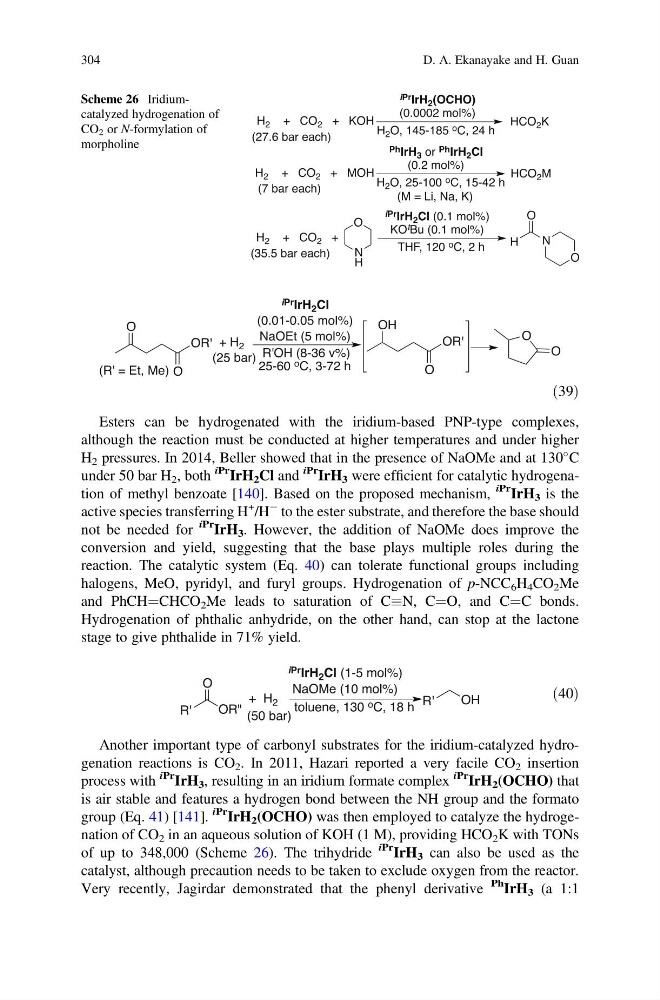
ð39Þ
Esters can be hydrogenated with the iridium-based PNP-type complexes,
although the reaction must be conducted at higher temperatures and under higher
H 2 pressures. In 2014, Beller showed that in the presence of NaOMe and at 130
C
under 50 bar H 2 , both
iPr IrH 2 Cl and
iPr
IrH 3 were efficient for catalytic hydrogenation of methyl benzoate [140]. Based on the proposed mechanism,
iPr IrH 3 is the
active species transferring H
+
/H
À to the ester substrate, and therefore the base should
not be needed for
iPr IrH 3 . However, the addition of NaOMe does improve the
conversion and yield, suggesting that the base plays multiple roles during the
reaction. The catalytic system (Eq. 40) can tolerate functional groups including
halogens, MeO, pyridyl, and furyl groups. Hydrogenation of p-NCC 6 H 4 CO 2 Me
and PhCH¼CHCO 2 Me leads to saturation of CN, C¼O, and C¼C bonds.
Hydrogenation of phthalic anhydride, on the other hand, can stop at the lactone
stage to give phthalide in 71% yield.
ð40Þ
Another important type of carbonyl substrates for the iridium-catalyzed hydrogenation reactions is CO 2 . In 2011, Hazari reported a very facile CO 2 insertion
process with
iPr IrH 3 , resulting in an iridium formate complex
iPr
IrH 2 (OCHO) that
is air stable and features a hydrogen bond between the NH group and the formato
group (Eq. 41) [141].
iPr
IrH 2 (OCHO) was then employed to catalyze the hydrogenation of CO 2 in an aqueous solution of KOH (1 M), providing HCO 2 K with TONs
of up to 348,000 (Scheme 26). The trihydride
iPr
IrH 3 can also be used as the
catalyst, although precaution needs to be taken to exclude oxygen from the reactor.
Very recently, Jagirdar demonstrated that the phenyl derivative
Ph
IrH 3 (a 1:1
Scheme 26 Iridiumcatalyzed hydrogenation of
CO 2 or N-formylation of
morpholine
304
D. A. Ekanayake and H. Guan
Esters can be hydrogenated with the iridium-based PNP-type complexes,
although the reaction must be conducted at higher temperatures and under higher
H 2 pressures. In 2014, Beller showed that in the presence of NaOMe and at 130
C
under 50 bar H 2 , both
iPr IrH 2 Cl and
iPr
IrH 3 were efficient for catalytic hydrogenation of methyl benzoate [140]. Based on the proposed mechanism,
iPr IrH 3 is the
active species transferring H
+
/H
À to the ester substrate, and therefore the base should
not be needed for
iPr IrH 3 . However, the addition of NaOMe does improve the
conversion and yield, suggesting that the base plays multiple roles during the
reaction. The catalytic system (Eq. 40) can tolerate functional groups including
halogens, MeO, pyridyl, and furyl groups. Hydrogenation of p-NCC 6 H 4 CO 2 Me
and PhCH¼CHCO 2 Me leads to saturation of CN, C¼O, and C¼C bonds.
Hydrogenation of phthalic anhydride, on the other hand, can stop at the lactone
stage to give phthalide in 71% yield.
ð40Þ
Another important type of carbonyl substrates for the iridium-catalyzed hydrogenation reactions is CO 2 . In 2011, Hazari reported a very facile CO 2 insertion
process with
iPr IrH 3 , resulting in an iridium formate complex
iPr
IrH 2 (OCHO) that
is air stable and features a hydrogen bond between the NH group and the formato
group (Eq. 41) [141].
iPr
IrH 2 (OCHO) was then employed to catalyze the hydrogenation of CO 2 in an aqueous solution of KOH (1 M), providing HCO 2 K with TONs
of up to 348,000 (Scheme 26). The trihydride
iPr
IrH 3 can also be used as the
catalyst, although precaution needs to be taken to exclude oxygen from the reactor.
Very recently, Jagirdar demonstrated that the phenyl derivative
Ph
IrH 3 (a 1:1
Scheme 26 Iridiumcatalyzed hydrogenation of
CO 2 or N-formylation of
morpholine
304
D. A. Ekanayake and H. Guan