

note that
Ph
IrH 3 exists as a 1:1 isomeric mixture with the PNP ligand adopting either
meridional or facial coordination mode. In contrast, the isopropyl analog
iPr
IrH 3
displays the meridional mode only. This trihydride complex can be prepared from
dehydrochlorination of the dihydride
iPr
IrH 2 Cl followed by dehydrogenation of
i PrOH [138].
iPr
IrH 2 Cl is commercially available but can be made from
iPr PN
H P and
[Ir(COE) 2 Cl] 2 in
i PrOH at 80
C. It is also worth to point out that in the solid form
iPr
IrH 2 Cl is air stable and
iPr IrH 3 is moderately air stable.
4.3.2 Applications for Catalytic Hydrogenation Reactions
The use of iridium-based PNP-type complexes for catalytic hydrogenations reactions can be traced back to 1984, when Taqui Khan studied the hydrogenation of
cyclohexene catalyzed by
Ph
IrCl [122]. This reaction operates over the temperature
range 20–50
C under 0.4–1 bar H 2 and proceeds via an initial H 2 activation to form
Ph IrH 2 Cl [125]. The catalytic system that really takes advantage of metal-ligand
cooperativity is the one developed by Abdur-Rashid in 2009 [139]. It was reported
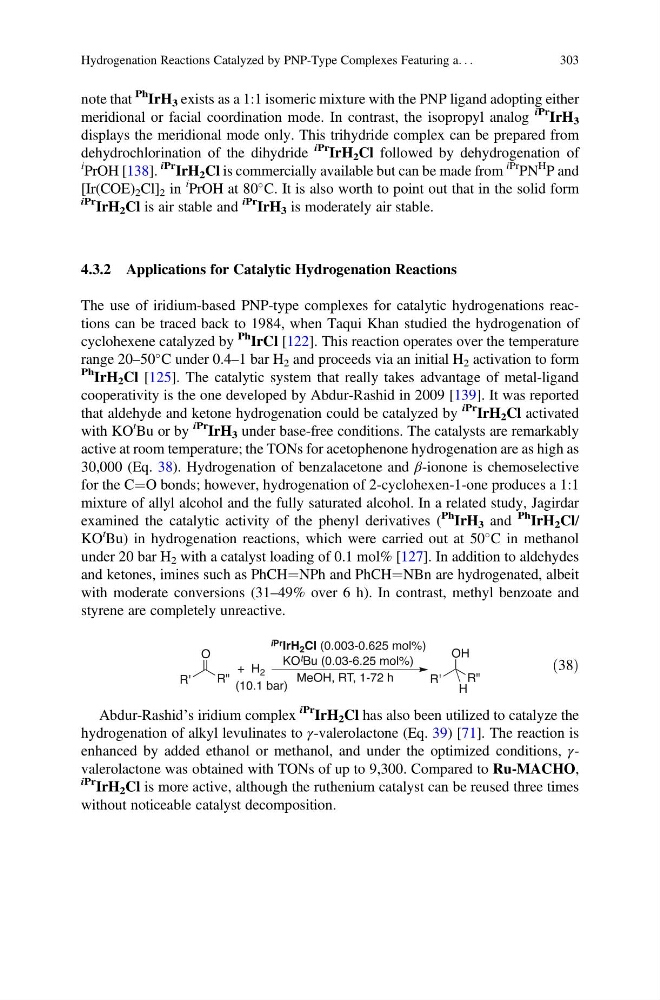
that aldehyde and ketone hydrogenation could be catalyzed by
iPr IrH 2 Cl activated
with KO
t Bu or by
iPr
IrH 3 under base-free conditions. The catalysts are remarkably
active at room temperature; the TONs for acetophenone hydrogenation are as high as
30,000 (Eq. 38). Hydrogenation of benzalacetone and β-ionone is chemoselective
for the C¼O bonds; however, hydrogenation of 2-cyclohexen-1-one produces a 1:1
mixture of allyl alcohol and the fully saturated alcohol. In a related study, Jagirdar
examined the catalytic activity of the phenyl derivatives (
Ph IrH 3 and
Ph
IrH 2 Cl/
KO
t Bu) in hydrogenation reactions, which were carried out at 50
C in methanol
under 20 bar H 2 with a catalyst loading of 0.1 mol% [127]. In addition to aldehydes
and ketones, imines such as PhCH¼NPh and PhCH¼NBn are hydrogenated, albeit
with moderate conversions (31–49% over 6 h). In contrast, methyl benzoate and
styrene are completely unreactive.
ð38Þ
Abdur-Rashid’s iridium complex
iPr
IrH 2 Cl has also been utilized to catalyze the
hydrogenation of alkyl levulinates to γ-valerolactone (Eq. 39) [71]. The reaction is
enhanced by added ethanol or methanol, and under the optimized conditions, γvalerolactone was obtained with TONs of up to 9,300. Compared to Ru-MACHO,
iPr
IrH 2 Cl is more active, although the ruthenium catalyst can be reused three times
without noticeable catalyst decomposition.
Hydrogenation Reactions Catalyzed by PNP-Type Complexes Featuring a. . .
303
Ph
IrH 3 exists as a 1:1 isomeric mixture with the PNP ligand adopting either
meridional or facial coordination mode. In contrast, the isopropyl analog
iPr
IrH 3
displays the meridional mode only. This trihydride complex can be prepared from
dehydrochlorination of the dihydride
iPr
IrH 2 Cl followed by dehydrogenation of
i PrOH [138].
iPr
IrH 2 Cl is commercially available but can be made from
iPr PN
H P and
[Ir(COE) 2 Cl] 2 in
i PrOH at 80
C. It is also worth to point out that in the solid form
iPr
IrH 2 Cl is air stable and
iPr IrH 3 is moderately air stable.
4.3.2 Applications for Catalytic Hydrogenation Reactions
The use of iridium-based PNP-type complexes for catalytic hydrogenations reactions can be traced back to 1984, when Taqui Khan studied the hydrogenation of
cyclohexene catalyzed by
Ph
IrCl [122]. This reaction operates over the temperature
range 20–50
C under 0.4–1 bar H 2 and proceeds via an initial H 2 activation to form
Ph IrH 2 Cl [125]. The catalytic system that really takes advantage of metal-ligand
cooperativity is the one developed by Abdur-Rashid in 2009 [139]. It was reported
that aldehyde and ketone hydrogenation could be catalyzed by
iPr IrH 2 Cl activated
with KO
t Bu or by
iPr
IrH 3 under base-free conditions. The catalysts are remarkably
active at room temperature; the TONs for acetophenone hydrogenation are as high as
30,000 (Eq. 38). Hydrogenation of benzalacetone and β-ionone is chemoselective
for the C¼O bonds; however, hydrogenation of 2-cyclohexen-1-one produces a 1:1
mixture of allyl alcohol and the fully saturated alcohol. In a related study, Jagirdar
examined the catalytic activity of the phenyl derivatives (
Ph IrH 3 and
Ph
IrH 2 Cl/
KO
t Bu) in hydrogenation reactions, which were carried out at 50
C in methanol
under 20 bar H 2 with a catalyst loading of 0.1 mol% [127]. In addition to aldehydes
and ketones, imines such as PhCH¼NPh and PhCH¼NBn are hydrogenated, albeit
with moderate conversions (31–49% over 6 h). In contrast, methyl benzoate and
styrene are completely unreactive.
ð38Þ
Abdur-Rashid’s iridium complex
iPr
IrH 2 Cl has also been utilized to catalyze the
hydrogenation of alkyl levulinates to γ-valerolactone (Eq. 39) [71]. The reaction is
enhanced by added ethanol or methanol, and under the optimized conditions, γvalerolactone was obtained with TONs of up to 9,300. Compared to Ru-MACHO,
iPr
IrH 2 Cl is more active, although the ruthenium catalyst can be reused three times
without noticeable catalyst decomposition.
Hydrogenation Reactions Catalyzed by PNP-Type Complexes Featuring a. . .
303