

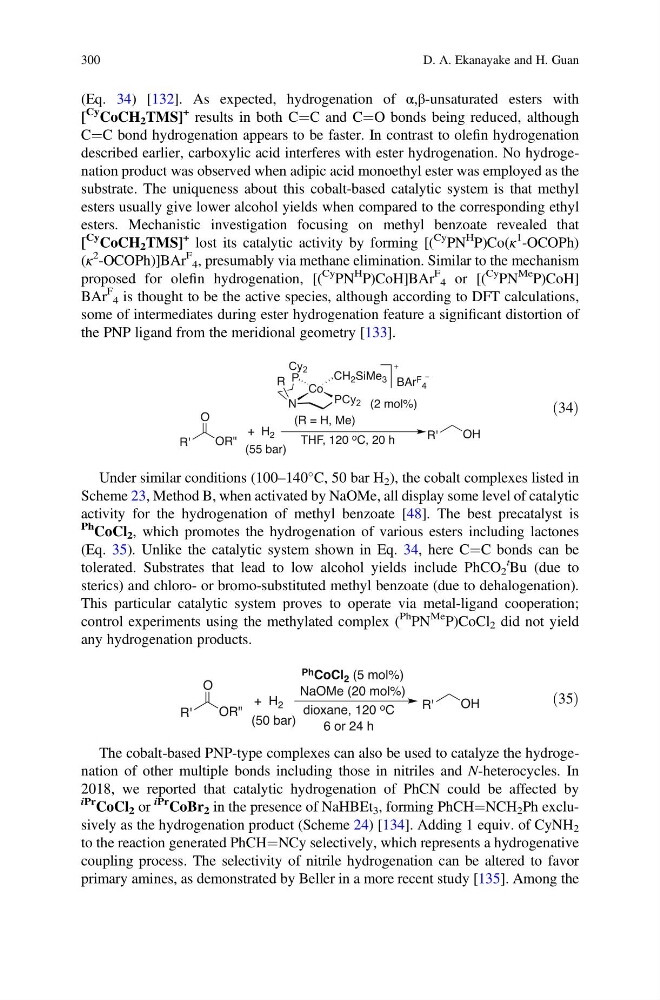
(Eq. 34) [132]. As expected, hydrogenation of α,β-unsaturated esters with
[
Cy CoCH 2 TMS]
+ results in both C¼C and C¼O bonds being reduced, although
C¼C bond hydrogenation appears to be faster. In contrast to olefin hydrogenation
described earlier, carboxylic acid interferes with ester hydrogenation. No hydrogenation product was observed when adipic acid monoethyl ester was employed as the
substrate. The uniqueness about this cobalt-based catalytic system is that methyl
esters usually give lower alcohol yields when compared to the corresponding ethyl
esters. Mechanistic investigation focusing on methyl benzoate revealed that
[
Cy CoCH 2 TMS]
+ lost its catalytic activity by forming [(
Cy PN
H P)Co(κ
1 -OCOPh)
(κ
2 -OCOPh)]BAr
F
4 , presumably via methane elimination. Similar to the mechanism
proposed for olefin hydrogenation, [(
Cy PN
H
P)CoH]BAr
F
4 or [(
Cy PN
Me
P)CoH]
BAr
F
4 is thought to be the active species, although according to DFT calculations,
some of intermediates during ester hydrogenation feature a significant distortion of
the PNP ligand from the meridional geometry [133].
ð34Þ
Under similar conditions (100–140
C, 50 bar H 2 ), the cobalt complexes listed in
Scheme 23, Method B, when activated by NaOMe, all display some level of catalytic
activity for the hydrogenation of methyl benzoate [48]. The best precatalyst is
Ph CoCl 2 , which promotes the hydrogenation of various esters including lactones
(Eq. 35). Unlike the catalytic system shown in Eq. 34, here C¼C bonds can be
tolerated. Substrates that lead to low alcohol yields include PhCO 2
t
Bu (due to
sterics) and chloro- or bromo-substituted methyl benzoate (due to dehalogenation).
This particular catalytic system proves to operate via metal-ligand cooperation;
control experiments using the methylated complex (
Ph
PN
Me P)CoCl 2 did not yield
any hydrogenation products.
ð35Þ
The cobalt-based PNP-type complexes can also be used to catalyze the hydrogenation of other multiple bonds including those in nitriles and N-heterocycles. In
2018, we reported that catalytic hydrogenation of PhCN could be affected by
iPr
CoCl 2 or
iPr CoBr 2 in the presence of NaHBEt 3 , forming PhCH¼NCH 2 Ph exclusively as the hydrogenation product (Scheme 24) [134]. Adding 1 equiv. of CyNH 2
to the reaction generated PhCH¼NCy selectively, which represents a hydrogenative
coupling process. The selectivity of nitrile hydrogenation can be altered to favor
primary amines, as demonstrated by Beller in a more recent study [135]. Among the
300
D. A. Ekanayake and H. Guan
[
Cy CoCH 2 TMS]
+ results in both C¼C and C¼O bonds being reduced, although
C¼C bond hydrogenation appears to be faster. In contrast to olefin hydrogenation
described earlier, carboxylic acid interferes with ester hydrogenation. No hydrogenation product was observed when adipic acid monoethyl ester was employed as the
substrate. The uniqueness about this cobalt-based catalytic system is that methyl
esters usually give lower alcohol yields when compared to the corresponding ethyl
esters. Mechanistic investigation focusing on methyl benzoate revealed that
[
Cy CoCH 2 TMS]
+ lost its catalytic activity by forming [(
Cy PN
H P)Co(κ
1 -OCOPh)
(κ
2 -OCOPh)]BAr
F
4 , presumably via methane elimination. Similar to the mechanism
proposed for olefin hydrogenation, [(
Cy PN
H
P)CoH]BAr
F
4 or [(
Cy PN
Me
P)CoH]
BAr
F
4 is thought to be the active species, although according to DFT calculations,
some of intermediates during ester hydrogenation feature a significant distortion of
the PNP ligand from the meridional geometry [133].
ð34Þ
Under similar conditions (100–140
C, 50 bar H 2 ), the cobalt complexes listed in
Scheme 23, Method B, when activated by NaOMe, all display some level of catalytic
activity for the hydrogenation of methyl benzoate [48]. The best precatalyst is
Ph CoCl 2 , which promotes the hydrogenation of various esters including lactones
(Eq. 35). Unlike the catalytic system shown in Eq. 34, here C¼C bonds can be
tolerated. Substrates that lead to low alcohol yields include PhCO 2
t
Bu (due to
sterics) and chloro- or bromo-substituted methyl benzoate (due to dehalogenation).
This particular catalytic system proves to operate via metal-ligand cooperation;
control experiments using the methylated complex (
Ph
PN
Me P)CoCl 2 did not yield
any hydrogenation products.
ð35Þ
The cobalt-based PNP-type complexes can also be used to catalyze the hydrogenation of other multiple bonds including those in nitriles and N-heterocycles. In
2018, we reported that catalytic hydrogenation of PhCN could be affected by
iPr
CoCl 2 or
iPr CoBr 2 in the presence of NaHBEt 3 , forming PhCH¼NCH 2 Ph exclusively as the hydrogenation product (Scheme 24) [134]. Adding 1 equiv. of CyNH 2
to the reaction generated PhCH¼NCy selectively, which represents a hydrogenative
coupling process. The selectivity of nitrile hydrogenation can be altered to favor
primary amines, as demonstrated by Beller in a more recent study [135]. Among the
300
D. A. Ekanayake and H. Guan