

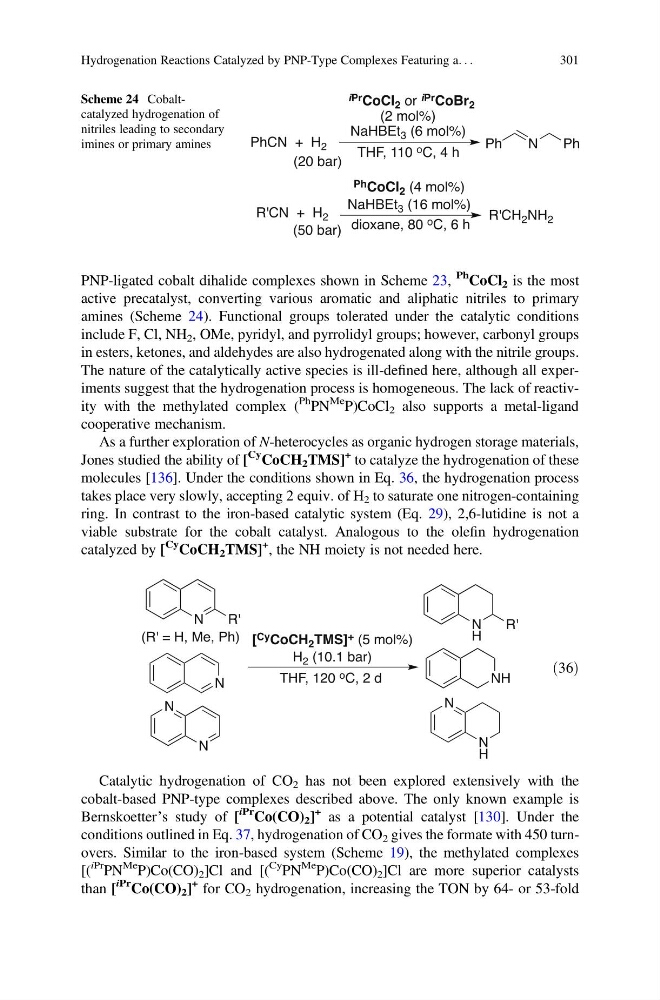
PNP-ligated cobalt dihalide complexes shown in Scheme 23,
Ph
CoCl 2 is the most
active precatalyst, converting various aromatic and aliphatic nitriles to primary
amines (Scheme 24). Functional groups tolerated under the catalytic conditions
include F, Cl, NH 2 , OMe, pyridyl, and pyrrolidyl groups; however, carbonyl groups
in esters, ketones, and aldehydes are also hydrogenated along with the nitrile groups.
The nature of the catalytically active species is ill-defined here, although all experiments suggest that the hydrogenation process is homogeneous. The lack of reactivity with the methylated complex (
Ph PN
Me
P)CoCl 2 also supports a metal-ligand
cooperative mechanism.
As a further exploration of N-heterocycles as organic hydrogen storage materials,
Jones studied the ability of [
Cy CoCH 2 TMS]
+ to catalyze the hydrogenation of these
molecules [136]. Under the conditions shown in Eq. 36, the hydrogenation process
takes place very slowly, accepting 2 equiv. of H 2 to saturate one nitrogen-containing
ring. In contrast to the iron-based catalytic system (Eq. 29), 2,6-lutidine is not a
viable substrate for the cobalt catalyst. Analogous to the olefin hydrogenation
catalyzed by [
Cy CoCH 2 TMS]
+
, the NH moiety is not needed here.
ð36Þ
Catalytic hydrogenation of CO 2 has not been explored extensively with the
cobalt-based PNP-type complexes described above. The only known example is
Bernskoetter’s study of [
iPr
Co(CO) 2 ]
+ as a potential catalyst [130]. Under the
conditions outlined in Eq. 37, hydrogenation of CO 2 gives the formate with 450 turnovers. Similar to the iron-based system (Scheme 19), the methylated complexes
[(
iPr PN
Me
P)Co(CO) 2 ]Cl and [(
Cy PN
Me P)Co(CO) 2 ]Cl are more superior catalysts
than [
iPr
Co(CO) 2 ]
+ for CO 2 hydrogenation, increasing the TON by 64- or 53-fold
Scheme 24 Cobaltcatalyzed hydrogenation of
nitriles leading to secondary
imines or primary amines
Hydrogenation Reactions Catalyzed by PNP-Type Complexes Featuring a. . .
301
Ph
CoCl 2 is the most
active precatalyst, converting various aromatic and aliphatic nitriles to primary
amines (Scheme 24). Functional groups tolerated under the catalytic conditions
include F, Cl, NH 2 , OMe, pyridyl, and pyrrolidyl groups; however, carbonyl groups
in esters, ketones, and aldehydes are also hydrogenated along with the nitrile groups.
The nature of the catalytically active species is ill-defined here, although all experiments suggest that the hydrogenation process is homogeneous. The lack of reactivity with the methylated complex (
Ph PN
Me
P)CoCl 2 also supports a metal-ligand
cooperative mechanism.
As a further exploration of N-heterocycles as organic hydrogen storage materials,
Jones studied the ability of [
Cy CoCH 2 TMS]
+ to catalyze the hydrogenation of these
molecules [136]. Under the conditions shown in Eq. 36, the hydrogenation process
takes place very slowly, accepting 2 equiv. of H 2 to saturate one nitrogen-containing
ring. In contrast to the iron-based catalytic system (Eq. 29), 2,6-lutidine is not a
viable substrate for the cobalt catalyst. Analogous to the olefin hydrogenation
catalyzed by [
Cy CoCH 2 TMS]
+
, the NH moiety is not needed here.
ð36Þ
Catalytic hydrogenation of CO 2 has not been explored extensively with the
cobalt-based PNP-type complexes described above. The only known example is
Bernskoetter’s study of [
iPr
Co(CO) 2 ]
+ as a potential catalyst [130]. Under the
conditions outlined in Eq. 37, hydrogenation of CO 2 gives the formate with 450 turnovers. Similar to the iron-based system (Scheme 19), the methylated complexes
[(
iPr PN
Me
P)Co(CO) 2 ]Cl and [(
Cy PN
Me P)Co(CO) 2 ]Cl are more superior catalysts
than [
iPr
Co(CO) 2 ]
+ for CO 2 hydrogenation, increasing the TON by 64- or 53-fold
Scheme 24 Cobaltcatalyzed hydrogenation of
nitriles leading to secondary
imines or primary amines
Hydrogenation Reactions Catalyzed by PNP-Type Complexes Featuring a. . .
301