

iPr
CoCl 2 with 1 equiv. of NaBH 4 generates a Co(I) species
iPr CoCl [48]. The latter
compound can react with CO to yield a cationic bis(carbonyl) complex [
iPr
Co
(CO) 2 ]
+ [48], which can alternatively be prepared from the reaction of
iPr
PN
H P
with CoCl(PPh 3 ) 3 under CO [130].
4.2.2 Applications for Catalytic Hydrogenation Reactions
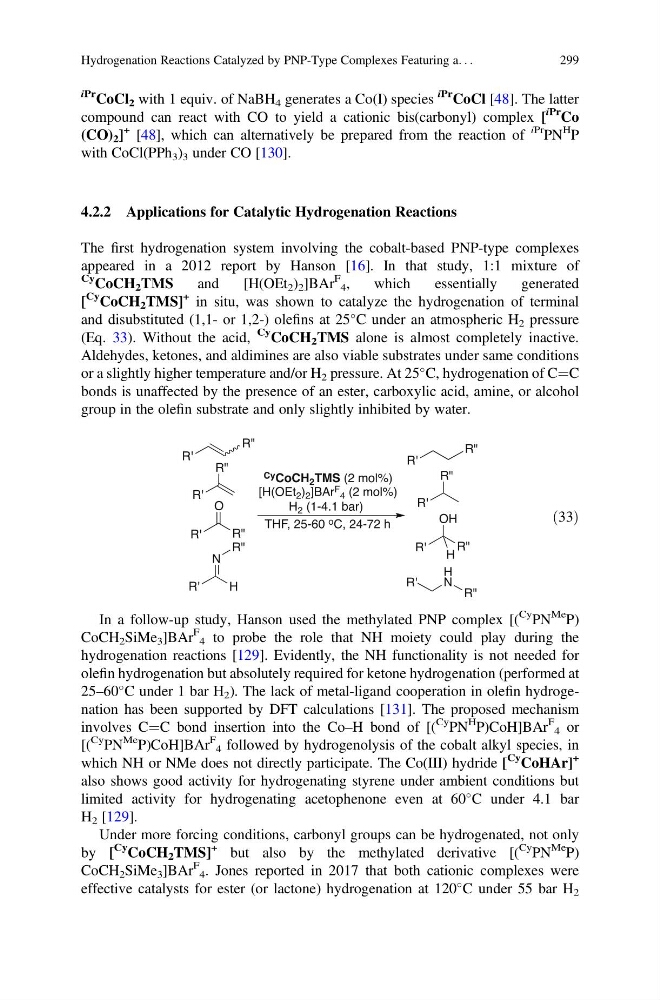
The first hydrogenation system involving the cobalt-based PNP-type complexes
appeared in a 2012 report by Hanson [16]. In that study, 1:1 mixture of
Cy CoCH 2 TMS
and
[H(OEt 2 ) 2 ]BAr
F
4 ,
which
essentially
generated
[
Cy CoCH 2 TMS]
+ in situ, was shown to catalyze the hydrogenation of terminal
and disubstituted (1,1- or 1,2-) olefins at 25
C under an atmospheric H 2 pressure
(Eq. 33). Without the acid,
Cy CoCH 2 TMS alone is almost completely inactive.
Aldehydes, ketones, and aldimines are also viable substrates under same conditions
or a slightly higher temperature and/or H 2 pressure. At 25
C, hydrogenation of C¼C
bonds is unaffected by the presence of an ester, carboxylic acid, amine, or alcohol
group in the olefin substrate and only slightly inhibited by water.
ð33Þ
In a follow-up study, Hanson used the methylated PNP complex [(
Cy PN
Me P)
CoCH 2 SiMe 3 ]BAr
F
4 to probe the role that NH moiety could play during the
hydrogenation reactions [129]. Evidently, the NH functionality is not needed for
olefin hydrogenation but absolutely required for ketone hydrogenation (performed at
25–60
C under 1 bar H 2 ). The lack of metal-ligand cooperation in olefin hydrogenation has been supported by DFT calculations [131]. The proposed mechanism
involves C¼C bond insertion into the Co–H bond of [(
Cy PN
H P)CoH]BAr
F
4 or
[(
Cy PN
Me P)CoH]BAr
F
4 followed by hydrogenolysis of the cobalt alkyl species, in
which NH or NMe does not directly participate. The Co(III) hydride [
Cy CoHAr]
+
also shows good activity for hydrogenating styrene under ambient conditions but
limited activity for hydrogenating acetophenone even at 60
C under 4.1 bar
H 2 [129].
Under more forcing conditions, carbonyl groups can be hydrogenated, not only
by [
Cy CoCH 2 TMS]
+ but also by the methylated derivative [(
Cy PN
Me P)
CoCH 2 SiMe 3 ]BAr
F
4 . Jones reported in 2017 that both cationic complexes were
effective catalysts for ester (or lactone) hydrogenation at 120
C under 55 bar H 2
Hydrogenation Reactions Catalyzed by PNP-Type Complexes Featuring a. . .
299
CoCl 2 with 1 equiv. of NaBH 4 generates a Co(I) species
iPr CoCl [48]. The latter
compound can react with CO to yield a cationic bis(carbonyl) complex [
iPr
Co
(CO) 2 ]
+ [48], which can alternatively be prepared from the reaction of
iPr
PN
H P
with CoCl(PPh 3 ) 3 under CO [130].
4.2.2 Applications for Catalytic Hydrogenation Reactions
The first hydrogenation system involving the cobalt-based PNP-type complexes
appeared in a 2012 report by Hanson [16]. In that study, 1:1 mixture of
Cy CoCH 2 TMS
and
[H(OEt 2 ) 2 ]BAr
F
4 ,
which
essentially
generated
[
Cy CoCH 2 TMS]
+ in situ, was shown to catalyze the hydrogenation of terminal
and disubstituted (1,1- or 1,2-) olefins at 25
C under an atmospheric H 2 pressure
(Eq. 33). Without the acid,
Cy CoCH 2 TMS alone is almost completely inactive.
Aldehydes, ketones, and aldimines are also viable substrates under same conditions
or a slightly higher temperature and/or H 2 pressure. At 25
C, hydrogenation of C¼C
bonds is unaffected by the presence of an ester, carboxylic acid, amine, or alcohol
group in the olefin substrate and only slightly inhibited by water.
ð33Þ
In a follow-up study, Hanson used the methylated PNP complex [(
Cy PN
Me P)
CoCH 2 SiMe 3 ]BAr
F
4 to probe the role that NH moiety could play during the
hydrogenation reactions [129]. Evidently, the NH functionality is not needed for
olefin hydrogenation but absolutely required for ketone hydrogenation (performed at
25–60
C under 1 bar H 2 ). The lack of metal-ligand cooperation in olefin hydrogenation has been supported by DFT calculations [131]. The proposed mechanism
involves C¼C bond insertion into the Co–H bond of [(
Cy PN
H P)CoH]BAr
F
4 or
[(
Cy PN
Me P)CoH]BAr
F
4 followed by hydrogenolysis of the cobalt alkyl species, in
which NH or NMe does not directly participate. The Co(III) hydride [
Cy CoHAr]
+
also shows good activity for hydrogenating styrene under ambient conditions but
limited activity for hydrogenating acetophenone even at 60
C under 4.1 bar
H 2 [129].
Under more forcing conditions, carbonyl groups can be hydrogenated, not only
by [
Cy CoCH 2 TMS]
+ but also by the methylated derivative [(
Cy PN
Me P)
CoCH 2 SiMe 3 ]BAr
F
4 . Jones reported in 2017 that both cationic complexes were
effective catalysts for ester (or lactone) hydrogenation at 120
C under 55 bar H 2
Hydrogenation Reactions Catalyzed by PNP-Type Complexes Featuring a. . .
299