

4.2 Cobalt Catalysts
4.2.1 Synthesis of (Pre)catalysts
In contrast to the limited examples for the PNP-type complexes of rhodium, many
cobalt derivatives have been studied, including spectroscopic observation and crystallographic characterization of (
iPr PN
H
P)CoH 2 Cl and (
iPr PN
H
P)CoH 3 [128]. While
these Co(III) hydrides have yet to be employed for hydrogenation reactions, close to
a dozen cobalt complexes supported by the
R PN
H
P ligands have been prepared
(Scheme 23) and evaluated as hydrogenation catalysts.
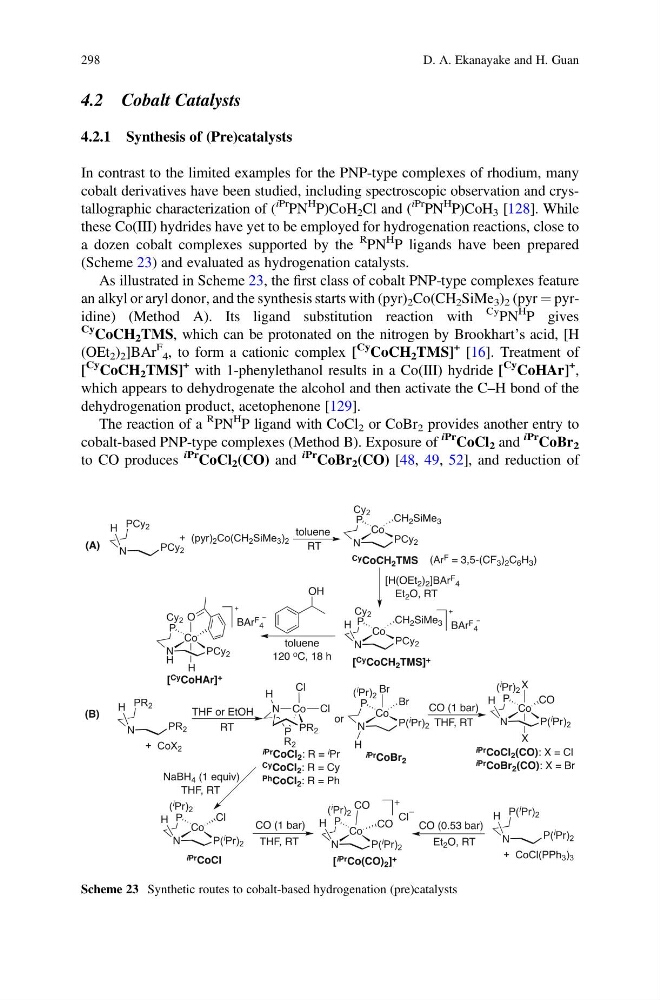
As illustrated in Scheme 23, the first class of cobalt PNP-type complexes feature
an alkyl or aryl donor, and the synthesis starts with (pyr) 2 Co(CH 2 SiMe 3 ) 2 (pyr ¼ pyridine) (Method A). Its ligand substitution reaction with
Cy
PN
H P gives
Cy CoCH 2 TMS, which can be protonated on the nitrogen by Brookhart’s acid, [H
(OEt 2 ) 2 ]BAr
F
4 , to form a cationic complex [
Cy
CoCH 2 TMS]
+ [16]. Treatment of
[
Cy CoCH 2 TMS]
+ with 1-phenylethanol results in a Co(III) hydride [
Cy CoHAr]
+
,
which appears to dehydrogenate the alcohol and then activate the C–H bond of the
dehydrogenation product, acetophenone [129].
The reaction of a
R PN
H P ligand with CoCl 2 or CoBr 2 provides another entry to
cobalt-based PNP-type complexes (Method B). Exposure of
iPr
CoCl 2 and
iPr
CoBr 2
to CO produces
iPr
CoCl 2 (CO) and
iPr CoBr 2 (CO) [48, 49, 52], and reduction of
Scheme 23 Synthetic routes to cobalt-based hydrogenation (pre)catalysts
298
D. A. Ekanayake and H. Guan
4.2.1 Synthesis of (Pre)catalysts
In contrast to the limited examples for the PNP-type complexes of rhodium, many
cobalt derivatives have been studied, including spectroscopic observation and crystallographic characterization of (
iPr PN
H
P)CoH 2 Cl and (
iPr PN
H
P)CoH 3 [128]. While
these Co(III) hydrides have yet to be employed for hydrogenation reactions, close to
a dozen cobalt complexes supported by the
R PN
H
P ligands have been prepared
(Scheme 23) and evaluated as hydrogenation catalysts.
As illustrated in Scheme 23, the first class of cobalt PNP-type complexes feature
an alkyl or aryl donor, and the synthesis starts with (pyr) 2 Co(CH 2 SiMe 3 ) 2 (pyr ¼ pyridine) (Method A). Its ligand substitution reaction with
Cy
PN
H P gives
Cy CoCH 2 TMS, which can be protonated on the nitrogen by Brookhart’s acid, [H
(OEt 2 ) 2 ]BAr
F
4 , to form a cationic complex [
Cy
CoCH 2 TMS]
+ [16]. Treatment of
[
Cy CoCH 2 TMS]
+ with 1-phenylethanol results in a Co(III) hydride [
Cy CoHAr]
+
,
which appears to dehydrogenate the alcohol and then activate the C–H bond of the
dehydrogenation product, acetophenone [129].
The reaction of a
R PN
H P ligand with CoCl 2 or CoBr 2 provides another entry to
cobalt-based PNP-type complexes (Method B). Exposure of
iPr
CoCl 2 and
iPr
CoBr 2
to CO produces
iPr
CoCl 2 (CO) and
iPr CoBr 2 (CO) [48, 49, 52], and reduction of
Scheme 23 Synthetic routes to cobalt-based hydrogenation (pre)catalysts
298
D. A. Ekanayake and H. Guan