

4 Group 9 Metal Systems
4.1 Rhodium Catalysts
As mentioned in Introduction, rhodium holds historical significance in hydrogenation catalysis, particularly for the early efforts to hydrogenate C¼C bonds. It is thus
somewhat surprising that there is very little development of the PNP-ligated rhodium
complexes as catalysts for the modern-day hydrogenation reactions. In 1984, Taqui
Khan reported the synthesis of (
Ph
PN
H P)RhCl from the reaction of [RhCl(COE) 2 ] 2
(COE ¼ cyclooctene) with
Ph PN
H P in benzene [122]. In a series of subsequent
reports, this specific PNP complex was shown to catalyze the hydrogenation of
cyclohexene [122], 1-heptene [123], and 1-pentene [124] at 10–50
C under
0.4–1 bar H 2 . The proposed mechanism is analogous to the one for Wilkinson’s
RhCl(PPh 3 ) 3 catalyst, which involves H 2 activation followed by olefin coordination
[125]. Based on the NMR analysis, oxidative addition of H 2 to (
Ph PN
H P)RhCl
produces thee dihydride complexes with the formula (
Ph PN
H P)RhH 2 Cl. The major
product (90%) is consistent with cis-(
Ph PN
H P)RhH 2 Cl with the
Ph
PN
H P ligand
adopting the meridional configuration [126]. A more recent study by Jagirdar
showed that (
Ph PN
H
P)RhH 2 Cl was unable to catalyze the hydrogenation of aldehydes, ketones, imines, and CO 2 at 50
C under 20 bar H 2 [127]. These results do not
rule out the possibility of using the rhodium-based PNP-type complexes for the
hydrogenation of polar bonds, because the hydrogenation reactions were attempted
under base-free conditions and the active species could be (
Ph PN
H
P)RhH 3 .
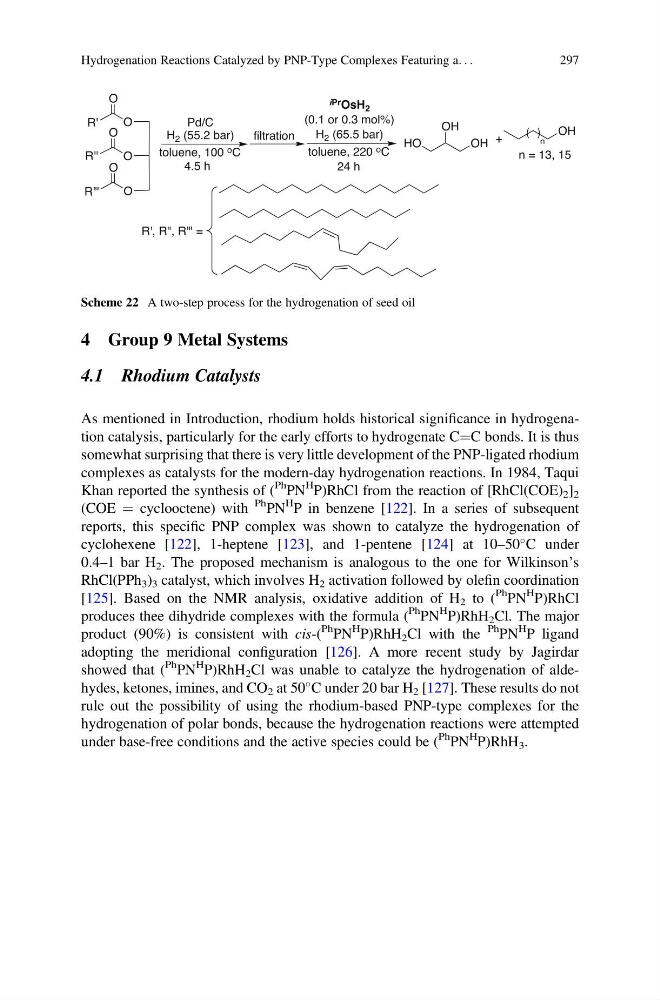
Scheme 22 A two-step process for the hydrogenation of seed oil
Hydrogenation Reactions Catalyzed by PNP-Type Complexes Featuring a. . .
297
4.1 Rhodium Catalysts
As mentioned in Introduction, rhodium holds historical significance in hydrogenation catalysis, particularly for the early efforts to hydrogenate C¼C bonds. It is thus
somewhat surprising that there is very little development of the PNP-ligated rhodium
complexes as catalysts for the modern-day hydrogenation reactions. In 1984, Taqui
Khan reported the synthesis of (
Ph
PN
H P)RhCl from the reaction of [RhCl(COE) 2 ] 2
(COE ¼ cyclooctene) with
Ph PN
H P in benzene [122]. In a series of subsequent
reports, this specific PNP complex was shown to catalyze the hydrogenation of
cyclohexene [122], 1-heptene [123], and 1-pentene [124] at 10–50
C under
0.4–1 bar H 2 . The proposed mechanism is analogous to the one for Wilkinson’s
RhCl(PPh 3 ) 3 catalyst, which involves H 2 activation followed by olefin coordination
[125]. Based on the NMR analysis, oxidative addition of H 2 to (
Ph PN
H P)RhCl
produces thee dihydride complexes with the formula (
Ph PN
H P)RhH 2 Cl. The major
product (90%) is consistent with cis-(
Ph PN
H P)RhH 2 Cl with the
Ph
PN
H P ligand
adopting the meridional configuration [126]. A more recent study by Jagirdar
showed that (
Ph PN
H
P)RhH 2 Cl was unable to catalyze the hydrogenation of aldehydes, ketones, imines, and CO 2 at 50
C under 20 bar H 2 [127]. These results do not
rule out the possibility of using the rhodium-based PNP-type complexes for the
hydrogenation of polar bonds, because the hydrogenation reactions were attempted
under base-free conditions and the active species could be (
Ph PN
H
P)RhH 3 .
Scheme 22 A two-step process for the hydrogenation of seed oil
Hydrogenation Reactions Catalyzed by PNP-Type Complexes Featuring a. . .
297