

of the filtered mixture was then subjected to the second hydrogenation step catalyzed
by
iPr
FeH. This two-step procedure provides methanol with a net TON of 590.
3.3 Osmium Catalysts
Osmium complexes have been rarely explored for hydrogenation reactions. DFT
calculations on trans-(
iPr PN
H P)MH 2 (CO) (M ¼ Fe, Ru, Os) suggest that hydrogenation of MeCN is best catalyzed by iron and ruthenium and hydrogenation of
methyl benzoate is best catalyzed by ruthenium [120]. Such predications have not
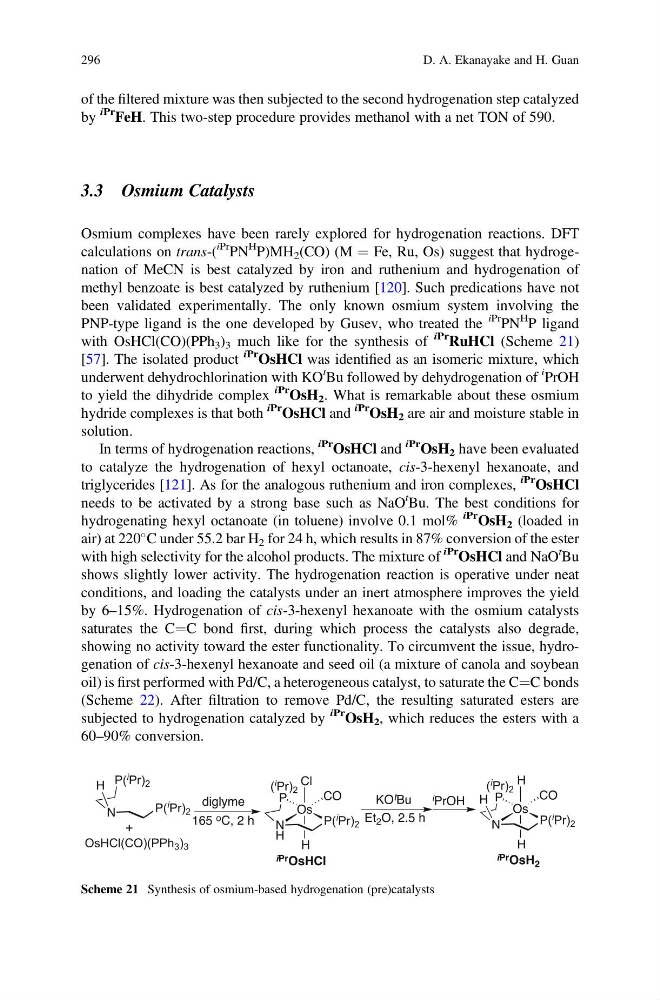
been validated experimentally. The only known osmium system involving the
PNP-type ligand is the one developed by Gusev, who treated the
iPr
PN
H P ligand
with OsHCl(CO)(PPh 3 ) 3 much like for the synthesis of
iPr
RuHCl (Scheme 21)
[57]. The isolated product
iPr
OsHCl was identified as an isomeric mixture, which
underwent dehydrochlorination with KO
t Bu followed by dehydrogenation of
i PrOH
to yield the dihydride complex
iPr
OsH 2 . What is remarkable about these osmium
hydride complexes is that both
iPr OsHCl and
iPr
OsH 2 are air and moisture stable in
solution.
In terms of hydrogenation reactions,
iPr
OsHCl and
iPr
OsH 2 have been evaluated
to catalyze the hydrogenation of hexyl octanoate, cis-3-hexenyl hexanoate, and
triglycerides [121]. As for the analogous ruthenium and iron complexes,
iPr
OsHCl
needs to be activated by a strong base such as NaO
t Bu. The best conditions for
hydrogenating hexyl octanoate (in toluene) involve 0.1 mol%
iPr OsH 2 (loaded in
air) at 220
C under 55.2 bar H 2 for 24 h, which results in 87% conversion of the ester
with high selectivity for the alcohol products. The mixture of
iPr
OsHCl and NaO
t Bu
shows slightly lower activity. The hydrogenation reaction is operative under neat
conditions, and loading the catalysts under an inert atmosphere improves the yield
by 6–15%. Hydrogenation of cis-3-hexenyl hexanoate with the osmium catalysts
saturates the C¼C bond first, during which process the catalysts also degrade,
showing no activity toward the ester functionality. To circumvent the issue, hydrogenation of cis-3-hexenyl hexanoate and seed oil (a mixture of canola and soybean
oil) is first performed with Pd/C, a heterogeneous catalyst, to saturate the C¼C bonds
(Scheme 22). After filtration to remove Pd/C, the resulting saturated esters are
subjected to hydrogenation catalyzed by
iPr
OsH 2 , which reduces the esters with a
60–90% conversion.
Scheme 21 Synthesis of osmium-based hydrogenation (pre)catalysts
296
D. A. Ekanayake and H. Guan
by
iPr
FeH. This two-step procedure provides methanol with a net TON of 590.
3.3 Osmium Catalysts
Osmium complexes have been rarely explored for hydrogenation reactions. DFT
calculations on trans-(
iPr PN
H P)MH 2 (CO) (M ¼ Fe, Ru, Os) suggest that hydrogenation of MeCN is best catalyzed by iron and ruthenium and hydrogenation of
methyl benzoate is best catalyzed by ruthenium [120]. Such predications have not
been validated experimentally. The only known osmium system involving the
PNP-type ligand is the one developed by Gusev, who treated the
iPr
PN
H P ligand
with OsHCl(CO)(PPh 3 ) 3 much like for the synthesis of
iPr
RuHCl (Scheme 21)
[57]. The isolated product
iPr
OsHCl was identified as an isomeric mixture, which
underwent dehydrochlorination with KO
t Bu followed by dehydrogenation of
i PrOH
to yield the dihydride complex
iPr
OsH 2 . What is remarkable about these osmium
hydride complexes is that both
iPr OsHCl and
iPr
OsH 2 are air and moisture stable in
solution.
In terms of hydrogenation reactions,
iPr
OsHCl and
iPr
OsH 2 have been evaluated
to catalyze the hydrogenation of hexyl octanoate, cis-3-hexenyl hexanoate, and
triglycerides [121]. As for the analogous ruthenium and iron complexes,
iPr
OsHCl
needs to be activated by a strong base such as NaO
t Bu. The best conditions for
hydrogenating hexyl octanoate (in toluene) involve 0.1 mol%
iPr OsH 2 (loaded in
air) at 220
C under 55.2 bar H 2 for 24 h, which results in 87% conversion of the ester
with high selectivity for the alcohol products. The mixture of
iPr
OsHCl and NaO
t Bu
shows slightly lower activity. The hydrogenation reaction is operative under neat
conditions, and loading the catalysts under an inert atmosphere improves the yield
by 6–15%. Hydrogenation of cis-3-hexenyl hexanoate with the osmium catalysts
saturates the C¼C bond first, during which process the catalysts also degrade,
showing no activity toward the ester functionality. To circumvent the issue, hydrogenation of cis-3-hexenyl hexanoate and seed oil (a mixture of canola and soybean
oil) is first performed with Pd/C, a heterogeneous catalyst, to saturate the C¼C bonds
(Scheme 22). After filtration to remove Pd/C, the resulting saturated esters are
subjected to hydrogenation catalyzed by
iPr
OsH 2 , which reduces the esters with a
60–90% conversion.
Scheme 21 Synthesis of osmium-based hydrogenation (pre)catalysts
296
D. A. Ekanayake and H. Guan