

ð32Þ
Direct hydrogenation of CO 2 to methanol assisted by amines, which changes the
carbon oxidation state from +4 to À2, is more challenging with iron catalysts due to
their relatively low thermal stability. The ruthenium systems described earlier
operate most efficiently at 140–160
C. A thermal stability study of
iPr FeHBH 4
conducted by Jones showed that at 140
C this compound decomposed completely
in 4 h [100]. Nevertheless, some of the iron-based PNP pincer complexes have been
tested for this transformation. Olah and Prakash’s strategy of using PEHA to capture
CO 2 and
iPr
FeHBr to hydrogenate the captured CO 2 (145
C, 70 bar H 2 , 72 h) failed
to produce any methanol. Instead, formate and formamide were detected with NMR
yields of 20% and 18%, respectively [89]. On the other hand, hydrogenation of the
captured CO 2 in a biphasic mixture (as illustrated in Scheme 15) was successful with
iPr
FeHBr at 55
C under 50 bar H 2 , which, after 10 h, gave formate in 96% yield.
Like the Ru-MACHO-BH system, the iron catalyst can be reused at least four times
without losing the catalytic activity [88].
Given the results in Eq. 31 and the fact that
Cy
FeHBH 4 and
iPr FeH catalyze the
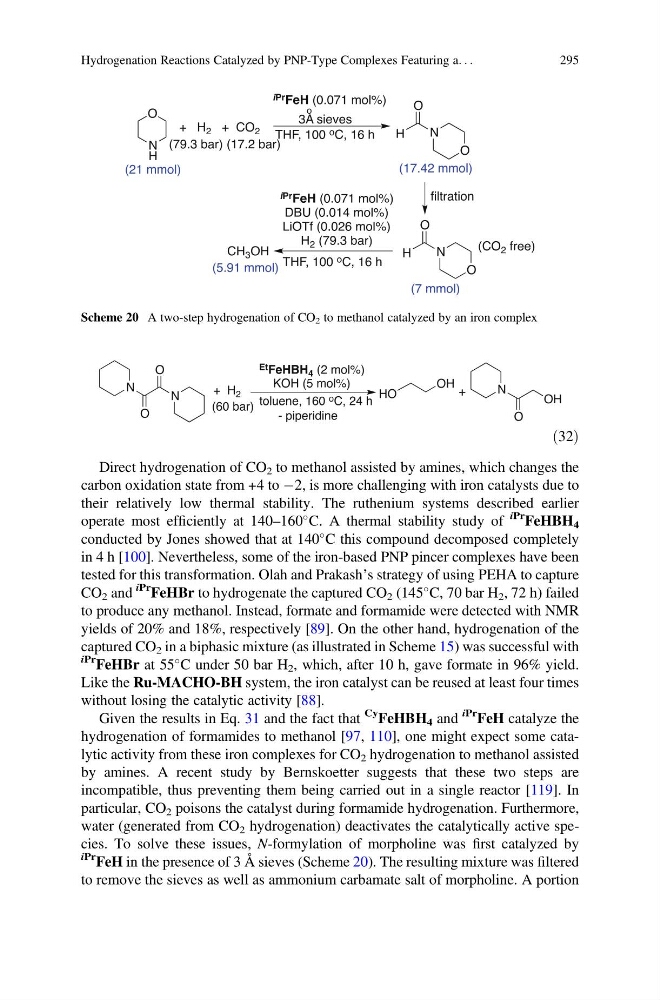
hydrogenation of formamides to methanol [97, 110], one might expect some catalytic activity from these iron complexes for CO 2 hydrogenation to methanol assisted
by amines. A recent study by Bernskoetter suggests that these two steps are
incompatible, thus preventing them being carried out in a single reactor [119]. In
particular, CO 2 poisons the catalyst during formamide hydrogenation. Furthermore,
water (generated from CO 2 hydrogenation) deactivates the catalytically active species. To solve these issues, N-formylation of morpholine was first catalyzed by
iPr
FeH in the presence of 3 Å sieves (Scheme 20). The resulting mixture was filtered
to remove the sieves as well as ammonium carbamate salt of morpholine. A portion
Scheme 20 A two-step hydrogenation of CO 2 to methanol catalyzed by an iron complex
Hydrogenation Reactions Catalyzed by PNP-Type Complexes Featuring a. . .
295
Direct hydrogenation of CO 2 to methanol assisted by amines, which changes the
carbon oxidation state from +4 to À2, is more challenging with iron catalysts due to
their relatively low thermal stability. The ruthenium systems described earlier
operate most efficiently at 140–160
C. A thermal stability study of
iPr FeHBH 4
conducted by Jones showed that at 140
C this compound decomposed completely
in 4 h [100]. Nevertheless, some of the iron-based PNP pincer complexes have been
tested for this transformation. Olah and Prakash’s strategy of using PEHA to capture
CO 2 and
iPr
FeHBr to hydrogenate the captured CO 2 (145
C, 70 bar H 2 , 72 h) failed
to produce any methanol. Instead, formate and formamide were detected with NMR
yields of 20% and 18%, respectively [89]. On the other hand, hydrogenation of the
captured CO 2 in a biphasic mixture (as illustrated in Scheme 15) was successful with
iPr
FeHBr at 55
C under 50 bar H 2 , which, after 10 h, gave formate in 96% yield.
Like the Ru-MACHO-BH system, the iron catalyst can be reused at least four times
without losing the catalytic activity [88].
Given the results in Eq. 31 and the fact that
Cy
FeHBH 4 and
iPr FeH catalyze the
hydrogenation of formamides to methanol [97, 110], one might expect some catalytic activity from these iron complexes for CO 2 hydrogenation to methanol assisted
by amines. A recent study by Bernskoetter suggests that these two steps are
incompatible, thus preventing them being carried out in a single reactor [119]. In
particular, CO 2 poisons the catalyst during formamide hydrogenation. Furthermore,
water (generated from CO 2 hydrogenation) deactivates the catalytically active species. To solve these issues, N-formylation of morpholine was first catalyzed by
iPr
FeH in the presence of 3 Å sieves (Scheme 20). The resulting mixture was filtered
to remove the sieves as well as ammonium carbamate salt of morpholine. A portion
Scheme 20 A two-step hydrogenation of CO 2 to methanol catalyzed by an iron complex
Hydrogenation Reactions Catalyzed by PNP-Type Complexes Featuring a. . .
295