

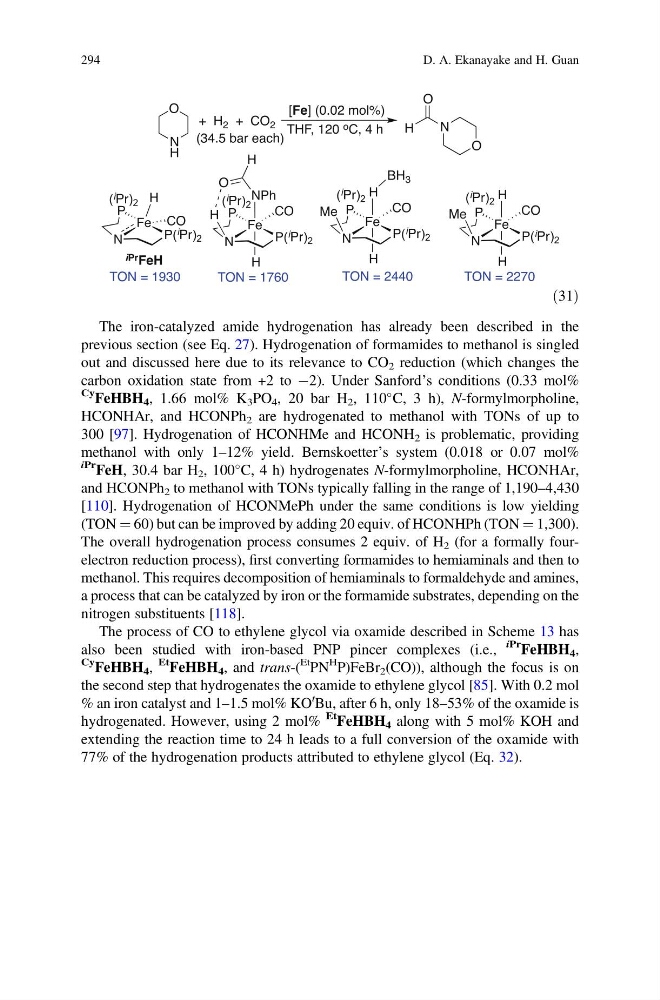
ð31Þ
The iron-catalyzed amide hydrogenation has already been described in the
previous section (see Eq. 27). Hydrogenation of formamides to methanol is singled
out and discussed here due to its relevance to CO 2 reduction (which changes the
carbon oxidation state from +2 to À2). Under Sanford’s conditions (0.33 mol%
Cy FeHBH 4 , 1.66 mol% K 3 PO 4 , 20 bar H 2 , 110
C, 3 h), N-formylmorpholine,
HCONHAr, and HCONPh 2 are hydrogenated to methanol with TONs of up to
300 [97]. Hydrogenation of HCONHMe and HCONH 2 is problematic, providing
methanol with only 1–12% yield. Bernskoetter’s system (0.018 or 0.07 mol%
iPr
FeH, 30.4 bar H 2 , 100
C, 4 h) hydrogenates N-formylmorpholine, HCONHAr,
and HCONPh 2 to methanol with TONs typically falling in the range of 1,190–4,430
[110]. Hydrogenation of HCONMePh under the same conditions is low yielding
(TON ¼ 60) but can be improved by adding 20 equiv. of HCONHPh (TON ¼ 1,300).
The overall hydrogenation process consumes 2 equiv. of H 2 (for a formally fourelectron reduction process), first converting formamides to hemiaminals and then to
methanol. This requires decomposition of hemiaminals to formaldehyde and amines,
a process that can be catalyzed by iron or the formamide substrates, depending on the
nitrogen substituents [118].
The process of CO to ethylene glycol via oxamide described in Scheme 13 has
also been studied with iron-based PNP pincer complexes (i.e.,
iPr FeHBH 4 ,
Cy FeHBH 4 ,
Et FeHBH 4 , and trans-(
Et PN
H P)FeBr 2 (CO)), although the focus is on
the second step that hydrogenates the oxamide to ethylene glycol [85]. With 0.2 mol
% an iron catalyst and 1–1.5 mol% KO
t Bu, after 6 h, only 18–53% of the oxamide is
hydrogenated. However, using 2 mol%
Et
FeHBH 4 along with 5 mol% KOH and
extending the reaction time to 24 h leads to a full conversion of the oxamide with
77% of the hydrogenation products attributed to ethylene glycol (Eq. 32).
294
D. A. Ekanayake and H. Guan
The iron-catalyzed amide hydrogenation has already been described in the
previous section (see Eq. 27). Hydrogenation of formamides to methanol is singled
out and discussed here due to its relevance to CO 2 reduction (which changes the
carbon oxidation state from +2 to À2). Under Sanford’s conditions (0.33 mol%
Cy FeHBH 4 , 1.66 mol% K 3 PO 4 , 20 bar H 2 , 110
C, 3 h), N-formylmorpholine,
HCONHAr, and HCONPh 2 are hydrogenated to methanol with TONs of up to
300 [97]. Hydrogenation of HCONHMe and HCONH 2 is problematic, providing
methanol with only 1–12% yield. Bernskoetter’s system (0.018 or 0.07 mol%
iPr
FeH, 30.4 bar H 2 , 100
C, 4 h) hydrogenates N-formylmorpholine, HCONHAr,
and HCONPh 2 to methanol with TONs typically falling in the range of 1,190–4,430
[110]. Hydrogenation of HCONMePh under the same conditions is low yielding
(TON ¼ 60) but can be improved by adding 20 equiv. of HCONHPh (TON ¼ 1,300).
The overall hydrogenation process consumes 2 equiv. of H 2 (for a formally fourelectron reduction process), first converting formamides to hemiaminals and then to
methanol. This requires decomposition of hemiaminals to formaldehyde and amines,
a process that can be catalyzed by iron or the formamide substrates, depending on the
nitrogen substituents [118].
The process of CO to ethylene glycol via oxamide described in Scheme 13 has
also been studied with iron-based PNP pincer complexes (i.e.,
iPr FeHBH 4 ,
Cy FeHBH 4 ,
Et FeHBH 4 , and trans-(
Et PN
H P)FeBr 2 (CO)), although the focus is on
the second step that hydrogenates the oxamide to ethylene glycol [85]. With 0.2 mol
% an iron catalyst and 1–1.5 mol% KO
t Bu, after 6 h, only 18–53% of the oxamide is
hydrogenated. However, using 2 mol%
Et
FeHBH 4 along with 5 mol% KOH and
extending the reaction time to 24 h leads to a full conversion of the oxamide with
77% of the hydrogenation products attributed to ethylene glycol (Eq. 32).
294
D. A. Ekanayake and H. Guan