

iPr
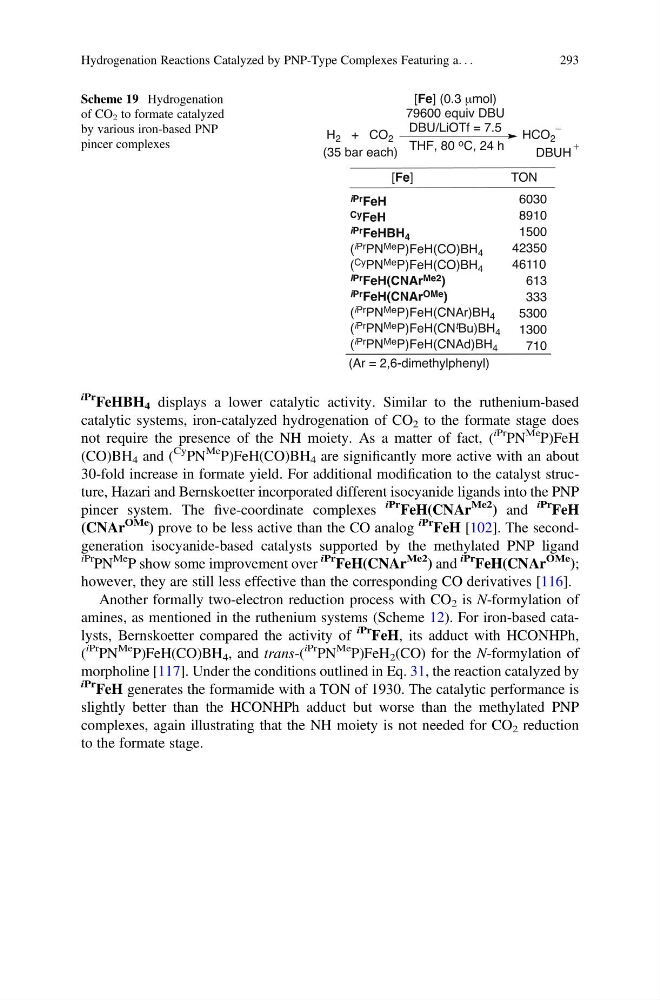
FeHBH 4 displays a lower catalytic activity. Similar to the ruthenium-based
catalytic systems, iron-catalyzed hydrogenation of CO 2 to the formate stage does
not require the presence of the NH moiety. As a matter of fact, (
iPr PN
Me
P)FeH
(CO)BH 4 and (
Cy PN
Me
P)FeH(CO)BH 4 are significantly more active with an about
30-fold increase in formate yield. For additional modification to the catalyst structure, Hazari and Bernskoetter incorporated different isocyanide ligands into the PNP
pincer system. The five-coordinate complexes
iPr FeH(CNAr
Me2 ) and
iPr FeH
(CNAr
OMe ) prove to be less active than the CO analog
iPr FeH [102]. The secondgeneration isocyanide-based catalysts supported by the methylated PNP ligand
iPr
PN
Me
P show some improvement over
iPr
FeH(CNAr
Me2 ) and
iPr FeH(CNAr
OMe );
however, they are still less effective than the corresponding CO derivatives [116].
Another formally two-electron reduction process with CO 2 is N-formylation of
amines, as mentioned in the ruthenium systems (Scheme 12). For iron-based catalysts, Bernskoetter compared the activity of
iPr FeH, its adduct with HCONHPh,
(
iPr
PN
Me
P)FeH(CO)BH 4 , and trans-(
iPr PN
Me
P)FeH 2 (CO) for the N-formylation of
morpholine [117]. Under the conditions outlined in Eq. 31, the reaction catalyzed by
iPr
FeH generates the formamide with a TON of 1930. The catalytic performance is
slightly better than the HCONHPh adduct but worse than the methylated PNP
complexes, again illustrating that the NH moiety is not needed for CO 2 reduction
to the formate stage.
Scheme 19 Hydrogenation
of CO 2 to formate catalyzed
by various iron-based PNP
pincer complexes
Hydrogenation Reactions Catalyzed by PNP-Type Complexes Featuring a. . .
293
FeHBH 4 displays a lower catalytic activity. Similar to the ruthenium-based
catalytic systems, iron-catalyzed hydrogenation of CO 2 to the formate stage does
not require the presence of the NH moiety. As a matter of fact, (
iPr PN
Me
P)FeH
(CO)BH 4 and (
Cy PN
Me
P)FeH(CO)BH 4 are significantly more active with an about
30-fold increase in formate yield. For additional modification to the catalyst structure, Hazari and Bernskoetter incorporated different isocyanide ligands into the PNP
pincer system. The five-coordinate complexes
iPr FeH(CNAr
Me2 ) and
iPr FeH
(CNAr
OMe ) prove to be less active than the CO analog
iPr FeH [102]. The secondgeneration isocyanide-based catalysts supported by the methylated PNP ligand
iPr
PN
Me
P show some improvement over
iPr
FeH(CNAr
Me2 ) and
iPr FeH(CNAr
OMe );
however, they are still less effective than the corresponding CO derivatives [116].
Another formally two-electron reduction process with CO 2 is N-formylation of
amines, as mentioned in the ruthenium systems (Scheme 12). For iron-based catalysts, Bernskoetter compared the activity of
iPr FeH, its adduct with HCONHPh,
(
iPr
PN
Me
P)FeH(CO)BH 4 , and trans-(
iPr PN
Me
P)FeH 2 (CO) for the N-formylation of
morpholine [117]. Under the conditions outlined in Eq. 31, the reaction catalyzed by
iPr
FeH generates the formamide with a TON of 1930. The catalytic performance is
slightly better than the HCONHPh adduct but worse than the methylated PNP
complexes, again illustrating that the NH moiety is not needed for CO 2 reduction
to the formate stage.
Scheme 19 Hydrogenation
of CO 2 to formate catalyzed
by various iron-based PNP
pincer complexes
Hydrogenation Reactions Catalyzed by PNP-Type Complexes Featuring a. . .
293