

concept in studying iron-catalyzed hydrogenation of styrene and its derivatives
[113]. At room temperature under an atmospheric H 2 pressure, styrene is converted
to ethylbenzene quantitatively in 24 h when
iPr FeHBr (5 mol%) mixed with KO
t Bu
(15 mol%) or
iPr FeH (5 mol%) is employed as the catalyst. The borohydride
complex
iPr FeHBH 4 is significantly less active due to the need to remove BH 3 ,
which is usually favored at elevated temperatures. Under the optimized conditions
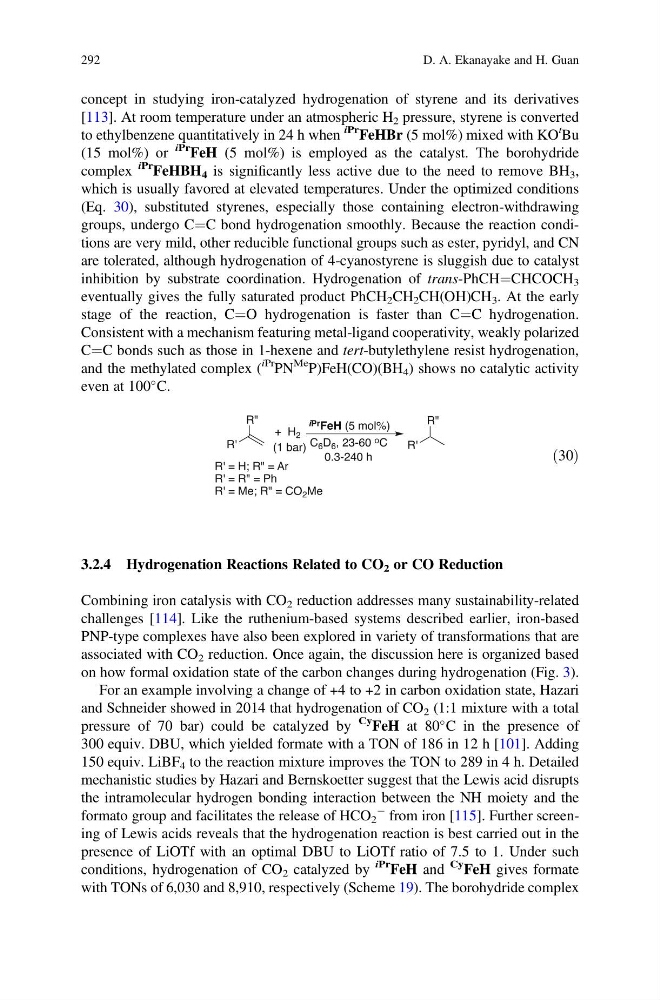
(Eq. 30), substituted styrenes, especially those containing electron-withdrawing
groups, undergo C¼C bond hydrogenation smoothly. Because the reaction conditions are very mild, other reducible functional groups such as ester, pyridyl, and CN
are tolerated, although hydrogenation of 4-cyanostyrene is sluggish due to catalyst
inhibition by substrate coordination. Hydrogenation of trans-PhCH¼CHCOCH 3
eventually gives the fully saturated product PhCH 2 CH 2 CH(OH)CH 3 . At the early
stage of the reaction, C¼O hydrogenation is faster than C¼C hydrogenation.
Consistent with a mechanism featuring metal-ligand cooperativity, weakly polarized
C¼C bonds such as those in 1-hexene and tert-butylethylene resist hydrogenation,
and the methylated complex (
iPr
PN
Me P)FeH(CO)(BH 4 ) shows no catalytic activity
even at 100
C.
ð30Þ
3.2.4 Hydrogenation Reactions Related to CO 2 or CO Reduction
Combining iron catalysis with CO 2 reduction addresses many sustainability-related
challenges [114]. Like the ruthenium-based systems described earlier, iron-based
PNP-type complexes have also been explored in variety of transformations that are
associated with CO 2 reduction. Once again, the discussion here is organized based
on how formal oxidation state of the carbon changes during hydrogenation (Fig. 3).
For an example involving a change of +4 to +2 in carbon oxidation state, Hazari
and Schneider showed in 2014 that hydrogenation of CO 2 (1:1 mixture with a total
pressure of 70 bar) could be catalyzed by
Cy FeH at 80
C in the presence of
300 equiv. DBU, which yielded formate with a TON of 186 in 12 h [101]. Adding
150 equiv. LiBF 4 to the reaction mixture improves the TON to 289 in 4 h. Detailed
mechanistic studies by Hazari and Bernskoetter suggest that the Lewis acid disrupts
the intramolecular hydrogen bonding interaction between the NH moiety and the
formato group and facilitates the release of HCO 2
À from iron [115]. Further screening of Lewis acids reveals that the hydrogenation reaction is best carried out in the
presence of LiOTf with an optimal DBU to LiOTf ratio of 7.5 to 1. Under such
conditions, hydrogenation of CO 2 catalyzed by
iPr
FeH and
Cy FeH gives formate
with TONs of 6,030 and 8,910, respectively (Scheme 19). The borohydride complex
292
D. A. Ekanayake and H. Guan
[113]. At room temperature under an atmospheric H 2 pressure, styrene is converted
to ethylbenzene quantitatively in 24 h when
iPr FeHBr (5 mol%) mixed with KO
t Bu
(15 mol%) or
iPr FeH (5 mol%) is employed as the catalyst. The borohydride
complex
iPr FeHBH 4 is significantly less active due to the need to remove BH 3 ,
which is usually favored at elevated temperatures. Under the optimized conditions
(Eq. 30), substituted styrenes, especially those containing electron-withdrawing
groups, undergo C¼C bond hydrogenation smoothly. Because the reaction conditions are very mild, other reducible functional groups such as ester, pyridyl, and CN
are tolerated, although hydrogenation of 4-cyanostyrene is sluggish due to catalyst
inhibition by substrate coordination. Hydrogenation of trans-PhCH¼CHCOCH 3
eventually gives the fully saturated product PhCH 2 CH 2 CH(OH)CH 3 . At the early
stage of the reaction, C¼O hydrogenation is faster than C¼C hydrogenation.
Consistent with a mechanism featuring metal-ligand cooperativity, weakly polarized
C¼C bonds such as those in 1-hexene and tert-butylethylene resist hydrogenation,
and the methylated complex (
iPr
PN
Me P)FeH(CO)(BH 4 ) shows no catalytic activity
even at 100
C.
ð30Þ
3.2.4 Hydrogenation Reactions Related to CO 2 or CO Reduction
Combining iron catalysis with CO 2 reduction addresses many sustainability-related
challenges [114]. Like the ruthenium-based systems described earlier, iron-based
PNP-type complexes have also been explored in variety of transformations that are
associated with CO 2 reduction. Once again, the discussion here is organized based
on how formal oxidation state of the carbon changes during hydrogenation (Fig. 3).
For an example involving a change of +4 to +2 in carbon oxidation state, Hazari
and Schneider showed in 2014 that hydrogenation of CO 2 (1:1 mixture with a total
pressure of 70 bar) could be catalyzed by
Cy FeH at 80
C in the presence of
300 equiv. DBU, which yielded formate with a TON of 186 in 12 h [101]. Adding
150 equiv. LiBF 4 to the reaction mixture improves the TON to 289 in 4 h. Detailed
mechanistic studies by Hazari and Bernskoetter suggest that the Lewis acid disrupts
the intramolecular hydrogen bonding interaction between the NH moiety and the
formato group and facilitates the release of HCO 2
À from iron [115]. Further screening of Lewis acids reveals that the hydrogenation reaction is best carried out in the
presence of LiOTf with an optimal DBU to LiOTf ratio of 7.5 to 1. Under such
conditions, hydrogenation of CO 2 catalyzed by
iPr
FeH and
Cy FeH gives formate
with TONs of 6,030 and 8,910, respectively (Scheme 19). The borohydride complex
292
D. A. Ekanayake and H. Guan