

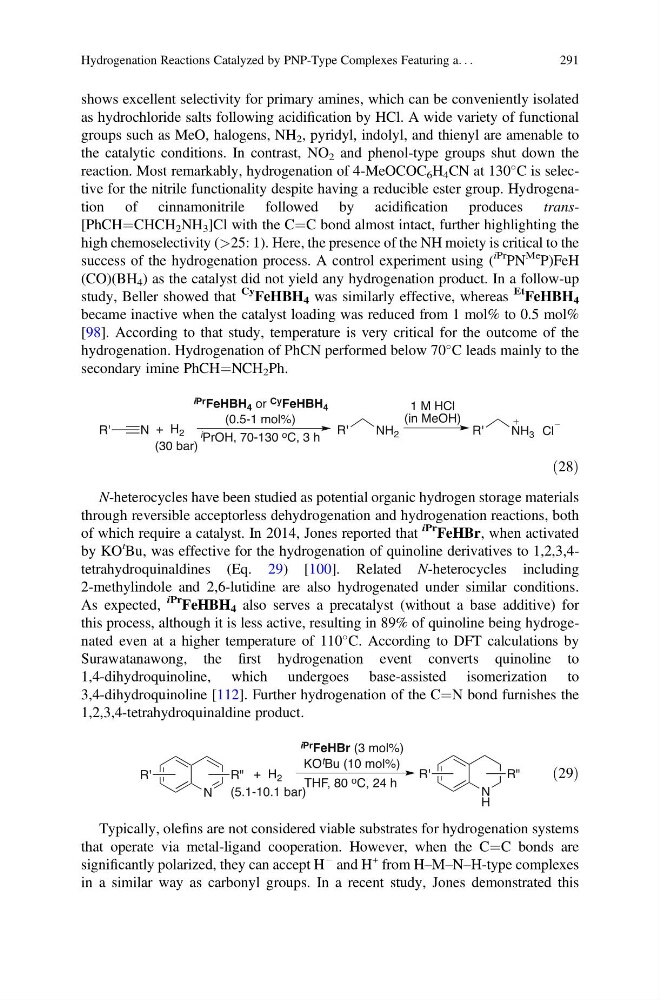
shows excellent selectivity for primary amines, which can be conveniently isolated
as hydrochloride salts following acidification by HCl. A wide variety of functional
groups such as MeO, halogens, NH 2 , pyridyl, indolyl, and thienyl are amenable to
the catalytic conditions. In contrast, NO 2 and phenol-type groups shut down the
reaction. Most remarkably, hydrogenation of 4-MeOCOC 6 H 4 CN at 130
C is selective for the nitrile functionality despite having a reducible ester group. Hydrogenation of cinnamonitrile followed by acidification produces trans[PhCH¼CHCH 2 NH 3 ]Cl with the C¼C bond almost intact, further highlighting the
high chemoselectivity (>25: 1). Here, the presence of the NH moiety is critical to the
success of the hydrogenation process. A control experiment using (
iPr PN
Me
P)FeH
(CO)(BH 4 ) as the catalyst did not yield any hydrogenation product. In a follow-up
study, Beller showed that
Cy
FeHBH 4 was similarly effective, whereas
Et FeHBH 4
became inactive when the catalyst loading was reduced from 1 mol% to 0.5 mol%
[98]. According to that study, temperature is very critical for the outcome of the
hydrogenation. Hydrogenation of PhCN performed below 70
C leads mainly to the
secondary imine PhCH¼NCH 2 Ph.
ð28Þ
N-heterocycles have been studied as potential organic hydrogen storage materials
through reversible acceptorless dehydrogenation and hydrogenation reactions, both
of which require a catalyst. In 2014, Jones reported that
iPr FeHBr, when activated
by KO
t
Bu, was effective for the hydrogenation of quinoline derivatives to 1,2,3,4tetrahydroquinaldines (Eq. 29) [100]. Related N-heterocycles including
2-methylindole and 2,6-lutidine are also hydrogenated under similar conditions.
As expected,
iPr
FeHBH 4 also serves a precatalyst (without a base additive) for
this process, although it is less active, resulting in 89% of quinoline being hydrogenated even at a higher temperature of 110
C. According to DFT calculations by
Surawatanawong, the first hydrogenation event converts quinoline to
1,4-dihydroquinoline, which undergoes base-assisted isomerization to
3,4-dihydroquinoline [112]. Further hydrogenation of the C¼N bond furnishes the
1,2,3,4-tetrahydroquinaldine product.
ð29Þ
Typically, olefins are not considered viable substrates for hydrogenation systems
that operate via metal-ligand cooperation. However, when the C¼C bonds are
significantly polarized, they can accept H
À and H
+ from H–M–N–H-type complexes
in a similar way as carbonyl groups. In a recent study, Jones demonstrated this
Hydrogenation Reactions Catalyzed by PNP-Type Complexes Featuring a. . .
291
as hydrochloride salts following acidification by HCl. A wide variety of functional
groups such as MeO, halogens, NH 2 , pyridyl, indolyl, and thienyl are amenable to
the catalytic conditions. In contrast, NO 2 and phenol-type groups shut down the
reaction. Most remarkably, hydrogenation of 4-MeOCOC 6 H 4 CN at 130
C is selective for the nitrile functionality despite having a reducible ester group. Hydrogenation of cinnamonitrile followed by acidification produces trans[PhCH¼CHCH 2 NH 3 ]Cl with the C¼C bond almost intact, further highlighting the
high chemoselectivity (>25: 1). Here, the presence of the NH moiety is critical to the
success of the hydrogenation process. A control experiment using (
iPr PN
Me
P)FeH
(CO)(BH 4 ) as the catalyst did not yield any hydrogenation product. In a follow-up
study, Beller showed that
Cy
FeHBH 4 was similarly effective, whereas
Et FeHBH 4
became inactive when the catalyst loading was reduced from 1 mol% to 0.5 mol%
[98]. According to that study, temperature is very critical for the outcome of the
hydrogenation. Hydrogenation of PhCN performed below 70
C leads mainly to the
secondary imine PhCH¼NCH 2 Ph.
ð28Þ
N-heterocycles have been studied as potential organic hydrogen storage materials
through reversible acceptorless dehydrogenation and hydrogenation reactions, both
of which require a catalyst. In 2014, Jones reported that
iPr FeHBr, when activated
by KO
t
Bu, was effective for the hydrogenation of quinoline derivatives to 1,2,3,4tetrahydroquinaldines (Eq. 29) [100]. Related N-heterocycles including
2-methylindole and 2,6-lutidine are also hydrogenated under similar conditions.
As expected,
iPr
FeHBH 4 also serves a precatalyst (without a base additive) for
this process, although it is less active, resulting in 89% of quinoline being hydrogenated even at a higher temperature of 110
C. According to DFT calculations by
Surawatanawong, the first hydrogenation event converts quinoline to
1,4-dihydroquinoline, which undergoes base-assisted isomerization to
3,4-dihydroquinoline [112]. Further hydrogenation of the C¼N bond furnishes the
1,2,3,4-tetrahydroquinaldine product.
ð29Þ
Typically, olefins are not considered viable substrates for hydrogenation systems
that operate via metal-ligand cooperation. However, when the C¼C bonds are
significantly polarized, they can accept H
À and H
+ from H–M–N–H-type complexes
in a similar way as carbonyl groups. In a recent study, Jones demonstrated this
Hydrogenation Reactions Catalyzed by PNP-Type Complexes Featuring a. . .
291