

more selective iron-based catalysts for ketone (and imine) hydrogenation are those
developed by Morris with chirality built between nitrogen and phosphorus donors.
These unsymmetrical P-N
H
-P
0 -type ligand systems are beyond the scope of this
review. Interested readers are directed to several recent papers for more details [106–
109].
For other carbonyl-based substrates, three research groups have independently
investigated iron-catalyzed hydrogenation of amides, which generates amines and
alcohols via C–N bond cleavage. In 2016, Langer demonstrated that
Et FeHBH 4 was
effective for the hydrogenation of PhCONHR
00 (R
00
¼ Ar, Me), CF 3 CONHPh,
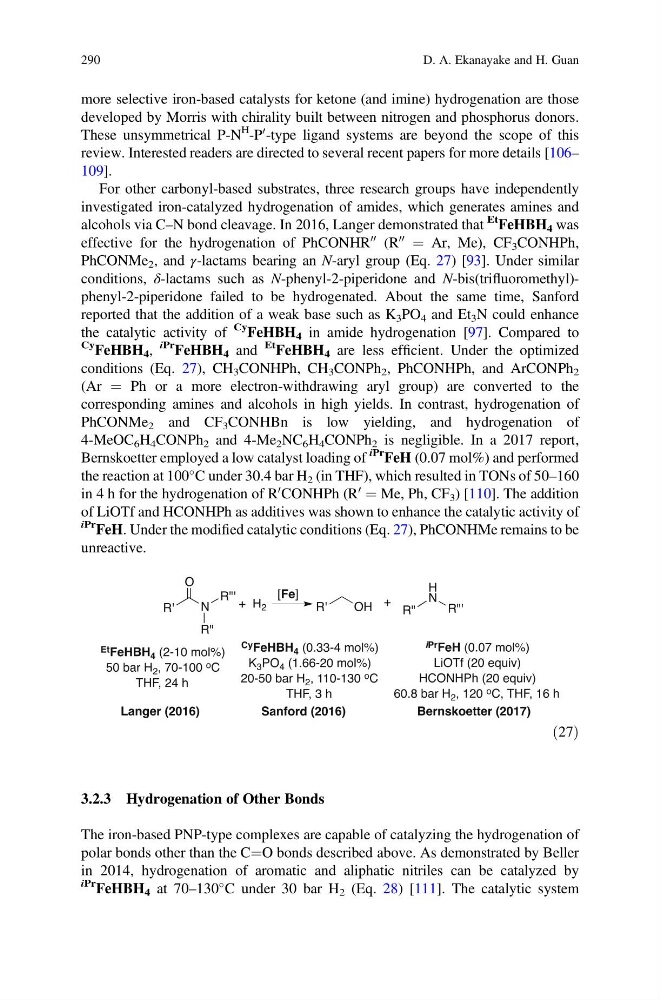
PhCONMe 2 , and γ-lactams bearing an N-aryl group (Eq. 27) [93]. Under similar
conditions, δ-lactams such as N-phenyl-2-piperidone and N-bis(trifluoromethyl)phenyl-2-piperidone failed to be hydrogenated. About the same time, Sanford
reported that the addition of a weak base such as K 3 PO 4 and Et 3 N could enhance
the catalytic activity of
Cy FeHBH 4 in amide hydrogenation [97]. Compared to
Cy FeHBH 4 ,
iPr FeHBH 4 and
Et FeHBH 4 are less efficient. Under the optimized
conditions (Eq. 27), CH 3 CONHPh, CH 3 CONPh 2 , PhCONHPh, and ArCONPh 2
(Ar ¼ Ph or a more electron-withdrawing aryl group) are converted to the
corresponding amines and alcohols in high yields. In contrast, hydrogenation of
PhCONMe 2 and CF 3 CONHBn is low yielding, and hydrogenation of
4-MeOC 6 H 4 CONPh 2 and 4-Me 2 NC 6 H 4 CONPh 2 is negligible. In a 2017 report,
Bernskoetter employed a low catalyst loading of
iPr
FeH (0.07 mol%) and performed
the reaction at 100
C under 30.4 bar H 2 (in THF), which resulted in TONs of 50–160
in 4 h for the hydrogenation of R
0 CONHPh (R
0
¼ Me, Ph, CF 3 ) [110]. The addition
of LiOTf and HCONHPh as additives was shown to enhance the catalytic activity of
iPr
FeH. Under the modified catalytic conditions (Eq. 27), PhCONHMe remains to be
unreactive.
ð27Þ
3.2.3 Hydrogenation of Other Bonds
The iron-based PNP-type complexes are capable of catalyzing the hydrogenation of
polar bonds other than the C¼O bonds described above. As demonstrated by Beller
in 2014, hydrogenation of aromatic and aliphatic nitriles can be catalyzed by
iPr
FeHBH 4 at 70–130
C under 30 bar H 2 (Eq. 28) [111]. The catalytic system
290
D. A. Ekanayake and H. Guan
developed by Morris with chirality built between nitrogen and phosphorus donors.
These unsymmetrical P-N
H
-P
0 -type ligand systems are beyond the scope of this
review. Interested readers are directed to several recent papers for more details [106–
109].
For other carbonyl-based substrates, three research groups have independently
investigated iron-catalyzed hydrogenation of amides, which generates amines and
alcohols via C–N bond cleavage. In 2016, Langer demonstrated that
Et FeHBH 4 was
effective for the hydrogenation of PhCONHR
00 (R
00
¼ Ar, Me), CF 3 CONHPh,
PhCONMe 2 , and γ-lactams bearing an N-aryl group (Eq. 27) [93]. Under similar
conditions, δ-lactams such as N-phenyl-2-piperidone and N-bis(trifluoromethyl)phenyl-2-piperidone failed to be hydrogenated. About the same time, Sanford
reported that the addition of a weak base such as K 3 PO 4 and Et 3 N could enhance
the catalytic activity of
Cy FeHBH 4 in amide hydrogenation [97]. Compared to
Cy FeHBH 4 ,
iPr FeHBH 4 and
Et FeHBH 4 are less efficient. Under the optimized
conditions (Eq. 27), CH 3 CONHPh, CH 3 CONPh 2 , PhCONHPh, and ArCONPh 2
(Ar ¼ Ph or a more electron-withdrawing aryl group) are converted to the
corresponding amines and alcohols in high yields. In contrast, hydrogenation of
PhCONMe 2 and CF 3 CONHBn is low yielding, and hydrogenation of
4-MeOC 6 H 4 CONPh 2 and 4-Me 2 NC 6 H 4 CONPh 2 is negligible. In a 2017 report,
Bernskoetter employed a low catalyst loading of
iPr
FeH (0.07 mol%) and performed
the reaction at 100
C under 30.4 bar H 2 (in THF), which resulted in TONs of 50–160
in 4 h for the hydrogenation of R
0 CONHPh (R
0
¼ Me, Ph, CF 3 ) [110]. The addition
of LiOTf and HCONHPh as additives was shown to enhance the catalytic activity of
iPr
FeH. Under the modified catalytic conditions (Eq. 27), PhCONHMe remains to be
unreactive.
ð27Þ
3.2.3 Hydrogenation of Other Bonds
The iron-based PNP-type complexes are capable of catalyzing the hydrogenation of
polar bonds other than the C¼O bonds described above. As demonstrated by Beller
in 2014, hydrogenation of aromatic and aliphatic nitriles can be catalyzed by
iPr
FeHBH 4 at 70–130
C under 30 bar H 2 (Eq. 28) [111]. The catalytic system
290
D. A. Ekanayake and H. Guan