

Ph
OMe
O
+ H 2
Ph
OH
p H2 = 30 bar, 60
o
C
THF, 6 h
PR 2
Fe
N
P
CO
H
H
H
H 3 B
Et FeHBH 4 > iPr FeHBH 4 > CyFeHBH 4
p H2 = 10 bar, 100
o
C iPr FeHBH 4 > CyFeHBH 4 > Et FeHBH 4
cat.
R 2
ð26Þ
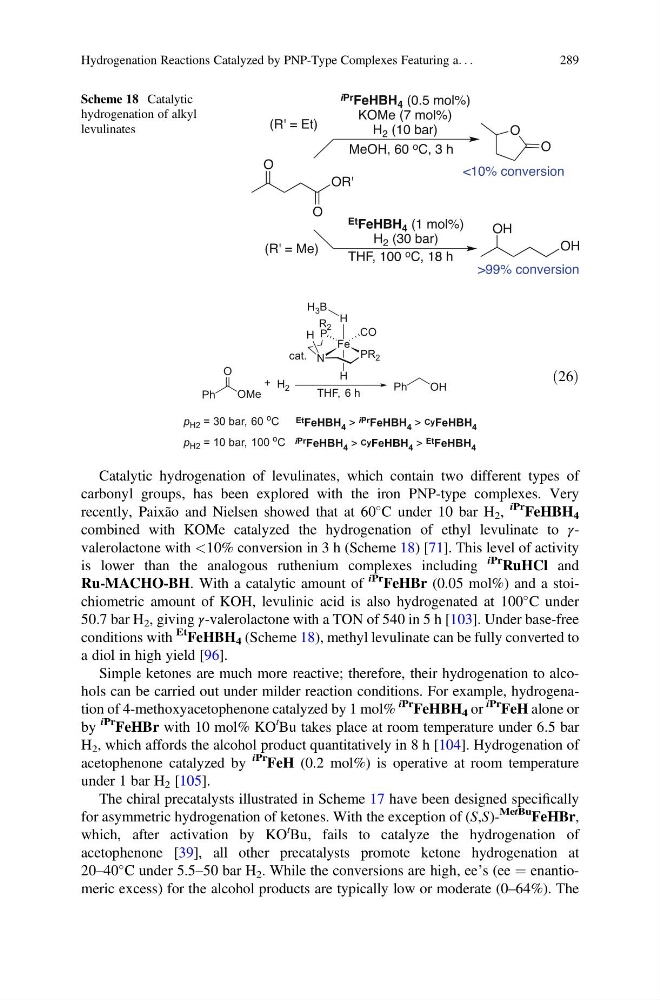
Catalytic hydrogenation of levulinates, which contain two different types of
carbonyl groups, has been explored with the iron PNP-type complexes. Very
recently, Paixão and Nielsen showed that at 60
C under 10 bar H 2 ,
iPr FeHBH 4
combined with KOMe catalyzed the hydrogenation of ethyl levulinate to γvalerolactone with <10% conversion in 3 h (Scheme 18) [71]. This level of activity
is lower than the analogous ruthenium complexes including
iPr
RuHCl and
Ru-MACHO-BH. With a catalytic amount of
iPr FeHBr (0.05 mol%) and a stoichiometric amount of KOH, levulinic acid is also hydrogenated at 100
C under
50.7 bar H 2 , giving γ-valerolactone with a TON of 540 in 5 h [103]. Under base-free
conditions with
Et FeHBH 4 (Scheme 18), methyl levulinate can be fully converted to
a diol in high yield [96].
Simple ketones are much more reactive; therefore, their hydrogenation to alcohols can be carried out under milder reaction conditions. For example, hydrogenation of 4-methoxyacetophenone catalyzed by 1 mol%
iPr
FeHBH 4 or
iPr
FeH alone or
by
iPr
FeHBr with 10 mol% KO
t Bu takes place at room temperature under 6.5 bar
H 2 , which affords the alcohol product quantitatively in 8 h [104]. Hydrogenation of
acetophenone catalyzed by
iPr
FeH (0.2 mol%) is operative at room temperature
under 1 bar H 2 [105].
The chiral precatalysts illustrated in Scheme 17 have been designed specifically
for asymmetric hydrogenation of ketones. With the exception of (S,S)MetBu
FeHBr,
which, after activation by KO
t Bu, fails to catalyze the hydrogenation of
acetophenone [39], all other precatalysts promote ketone hydrogenation at
20–40
C under 5.5–50 bar H 2 . While the conversions are high, ee’s (ee ¼ enantiomeric excess) for the alcohol products are typically low or moderate (0–64%). The
Scheme 18 Catalytic
hydrogenation of alkyl
levulinates
Hydrogenation Reactions Catalyzed by PNP-Type Complexes Featuring a. . .
289
OMe
O
+ H 2
Ph
OH
p H2 = 30 bar, 60
o
C
THF, 6 h
PR 2
Fe
N
P
CO
H
H
H
H 3 B
Et FeHBH 4 > iPr FeHBH 4 > CyFeHBH 4
p H2 = 10 bar, 100
o
C iPr FeHBH 4 > CyFeHBH 4 > Et FeHBH 4
cat.
R 2
ð26Þ
Catalytic hydrogenation of levulinates, which contain two different types of
carbonyl groups, has been explored with the iron PNP-type complexes. Very
recently, Paixão and Nielsen showed that at 60
C under 10 bar H 2 ,
iPr FeHBH 4
combined with KOMe catalyzed the hydrogenation of ethyl levulinate to γvalerolactone with <10% conversion in 3 h (Scheme 18) [71]. This level of activity
is lower than the analogous ruthenium complexes including
iPr
RuHCl and
Ru-MACHO-BH. With a catalytic amount of
iPr FeHBr (0.05 mol%) and a stoichiometric amount of KOH, levulinic acid is also hydrogenated at 100
C under
50.7 bar H 2 , giving γ-valerolactone with a TON of 540 in 5 h [103]. Under base-free
conditions with
Et FeHBH 4 (Scheme 18), methyl levulinate can be fully converted to
a diol in high yield [96].
Simple ketones are much more reactive; therefore, their hydrogenation to alcohols can be carried out under milder reaction conditions. For example, hydrogenation of 4-methoxyacetophenone catalyzed by 1 mol%
iPr
FeHBH 4 or
iPr
FeH alone or
by
iPr
FeHBr with 10 mol% KO
t Bu takes place at room temperature under 6.5 bar
H 2 , which affords the alcohol product quantitatively in 8 h [104]. Hydrogenation of
acetophenone catalyzed by
iPr
FeH (0.2 mol%) is operative at room temperature
under 1 bar H 2 [105].
The chiral precatalysts illustrated in Scheme 17 have been designed specifically
for asymmetric hydrogenation of ketones. With the exception of (S,S)MetBu
FeHBr,
which, after activation by KO
t Bu, fails to catalyze the hydrogenation of
acetophenone [39], all other precatalysts promote ketone hydrogenation at
20–40
C under 5.5–50 bar H 2 . While the conversions are high, ee’s (ee ¼ enantiomeric excess) for the alcohol products are typically low or moderate (0–64%). The
Scheme 18 Catalytic
hydrogenation of alkyl
levulinates
Hydrogenation Reactions Catalyzed by PNP-Type Complexes Featuring a. . .
289