

low (12%) due to the low thermal stability of the catalyst as well as its sensitivity
toward impurities [66].
ð25Þ
The complex
iPr FeHBH 4 is a precatalyst; under heating, it releases BH 3 to
generate the active species trans-(
iPr
PN
H P)FeH 2 (CO) [22, 24]. This process can be
facilitated by the addition of Et 3 N to trap BH 3 , resulting in a more efficient catalytic
system [22]. However, using other bases such as KO
t Bu and Na 2 CO 3 can reduce the
alcohol yield [24]. In the presence of KO
t Bu (or NaOMe) and under H 2 ,
iPr FeHBr is
also converted to trans-(
iPr PN
H P)FeH 2 (CO), thus catalyzing ester hydrogenation,
although it can be complicated by base-promoted transesterification with the alcohol
products [95].
To understand the substituent effects, Beller replaced the isopropyl groups in
iPr
FeHBH 4 with ethyl or cyclohexyl groups and studied the catalytic performance of
these new borohydride complexes [96]. Consistent with the steric argument, at a
relatively low temperature of 60
C,
Et
FeHBH 4 performs better than
iPr FeHBH 4 ,
which is in turn more reactive than
Cy
FeHBH 4 for the hydrogenation of methyl
benzoate. Notably, Me 2 NCH 2 CH 2 CO 2 Me, which is not a viable substrate for the
Ru-MACHO system, can be smoothly hydrogenated to Me 2 N(CH 2 ) 3 OH at 100
C
under 30 bar H 2 using
Et
FeHBH 4 as the precatalyst (1 mol%). It should be emphasized here that temperature and H 2 pressure play profound roles in controlling the
activation, stability, and reactivity of the borohydride complexes and ultimately their
catalytic efficiency. A closely related study by Langer showed a decreasing reactivity order of
iPr FeHBH 4 >
Cy FeHBH 4 >
Et FeHBH 4 when the hydrogenation of
methyl benzoate was conducted as 100
C under 10 bar H 2 (Eq. 26) [93].
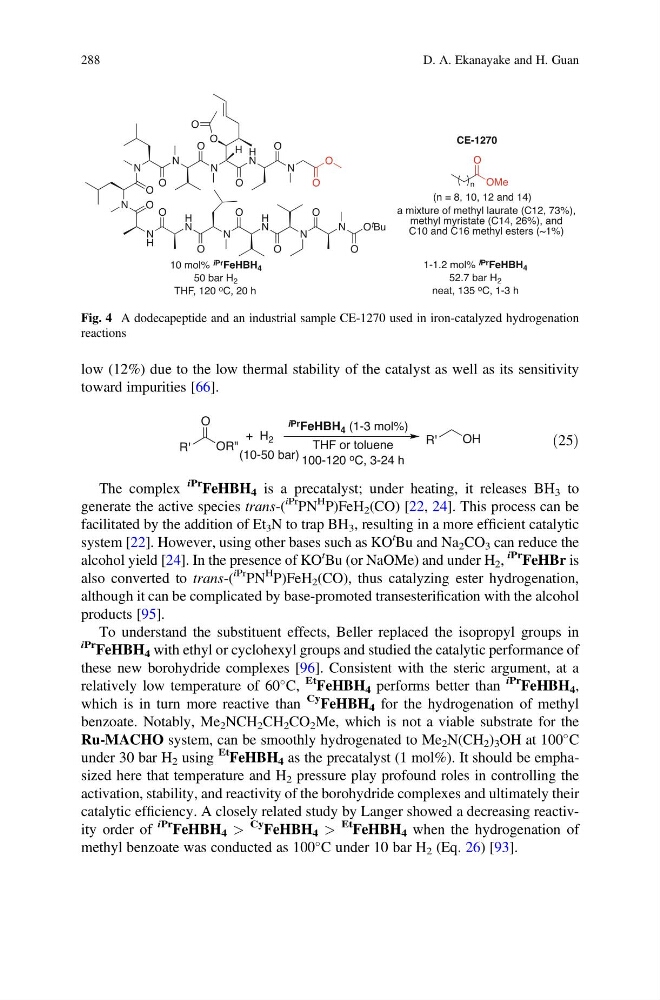
Fig. 4 A dodecapeptide and an industrial sample CE-1270 used in iron-catalyzed hydrogenation
reactions
288
D. A. Ekanayake and H. Guan
toward impurities [66].
ð25Þ
The complex
iPr FeHBH 4 is a precatalyst; under heating, it releases BH 3 to
generate the active species trans-(
iPr
PN
H P)FeH 2 (CO) [22, 24]. This process can be
facilitated by the addition of Et 3 N to trap BH 3 , resulting in a more efficient catalytic
system [22]. However, using other bases such as KO
t Bu and Na 2 CO 3 can reduce the
alcohol yield [24]. In the presence of KO
t Bu (or NaOMe) and under H 2 ,
iPr FeHBr is
also converted to trans-(
iPr PN
H P)FeH 2 (CO), thus catalyzing ester hydrogenation,
although it can be complicated by base-promoted transesterification with the alcohol
products [95].
To understand the substituent effects, Beller replaced the isopropyl groups in
iPr
FeHBH 4 with ethyl or cyclohexyl groups and studied the catalytic performance of
these new borohydride complexes [96]. Consistent with the steric argument, at a
relatively low temperature of 60
C,
Et
FeHBH 4 performs better than
iPr FeHBH 4 ,
which is in turn more reactive than
Cy
FeHBH 4 for the hydrogenation of methyl
benzoate. Notably, Me 2 NCH 2 CH 2 CO 2 Me, which is not a viable substrate for the
Ru-MACHO system, can be smoothly hydrogenated to Me 2 N(CH 2 ) 3 OH at 100
C
under 30 bar H 2 using
Et
FeHBH 4 as the precatalyst (1 mol%). It should be emphasized here that temperature and H 2 pressure play profound roles in controlling the
activation, stability, and reactivity of the borohydride complexes and ultimately their
catalytic efficiency. A closely related study by Langer showed a decreasing reactivity order of
iPr FeHBH 4 >
Cy FeHBH 4 >
Et FeHBH 4 when the hydrogenation of
methyl benzoate was conducted as 100
C under 10 bar H 2 (Eq. 26) [93].
Fig. 4 A dodecapeptide and an industrial sample CE-1270 used in iron-catalyzed hydrogenation
reactions
288
D. A. Ekanayake and H. Guan