

PEHA and then subjected to hydrogenation conditions (155
C, 50 bar H 2 ,
Ru-MACHO-BH as the catalyst, 55 h), which provides methanol in 79% yield.
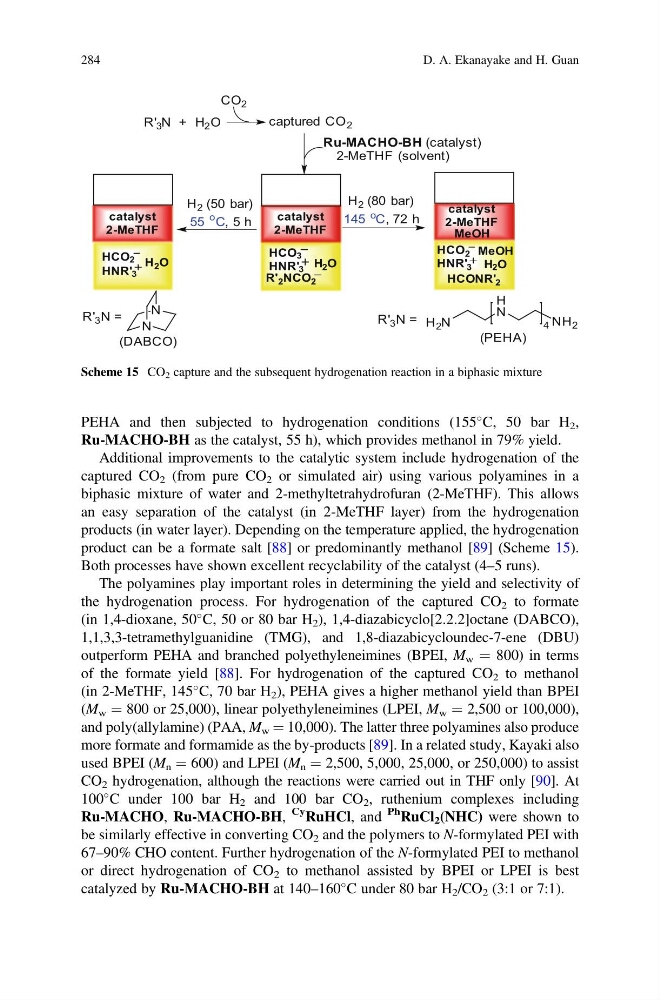
Additional improvements to the catalytic system include hydrogenation of the
captured CO 2 (from pure CO 2 or simulated air) using various polyamines in a
biphasic mixture of water and 2-methyltetrahydrofuran (2-MeTHF). This allows
an easy separation of the catalyst (in 2-MeTHF layer) from the hydrogenation
products (in water layer). Depending on the temperature applied, the hydrogenation
product can be a formate salt [88] or predominantly methanol [89] (Scheme 15).
Both processes have shown excellent recyclability of the catalyst (4–5 runs).
The polyamines play important roles in determining the yield and selectivity of
the hydrogenation process. For hydrogenation of the captured CO 2 to formate
(in 1,4-dioxane, 50
C, 50 or 80 bar H 2 ), 1,4-diazabicyclo[2.2.2]octane (DABCO),
1,1,3,3-tetramethylguanidine (TMG), and 1,8-diazabicycloundec-7-ene (DBU)
outperform PEHA and branched polyethyleneimines (BPEI, M w ¼ 800) in terms
of the formate yield [88]. For hydrogenation of the captured CO 2 to methanol
(in 2-MeTHF, 145
C, 70 bar H 2 ), PEHA gives a higher methanol yield than BPEI
(M w ¼ 800 or 25,000), linear polyethyleneimines (LPEI, M w ¼ 2,500 or 100,000),
and poly(allylamine) (PAA, M w ¼ 10,000). The latter three polyamines also produce
more formate and formamide as the by-products [89]. In a related study, Kayaki also
used BPEI (M n ¼ 600) and LPEI (M n ¼ 2,500, 5,000, 25,000, or 250,000) to assist
CO 2 hydrogenation, although the reactions were carried out in THF only [90]. At
100
C under 100 bar H 2 and 100 bar CO 2 , ruthenium complexes including
Ru-MACHO, Ru-MACHO-BH,
Cy RuHCl, and
Ph RuCl 2 (NHC) were shown to
be similarly effective in converting CO 2 and the polymers to N-formylated PEI with
67–90% CHO content. Further hydrogenation of the N-formylated PEI to methanol
or direct hydrogenation of CO 2 to methanol assisted by BPEI or LPEI is best
catalyzed by Ru-MACHO-BH at 140–160
C under 80 bar H 2 /CO 2 (3:1 or 7:1).
H
N
NH 2
H 2 N
4
(PEHA)
CO 2
R' 3 N + H 2 O
captured CO 2
Ru-MACHO-BH (catalyst)
2-MeTHF (solvent)
HCO 3
HNR' 3 H 2 O
HCO 2
HNR' 3
H 2 O
H 2 (50 bar)
55
o C, 5 h
catalyst
2-MeTHF
catalyst
2-MeTHF
catalyst
2-MeTHF
HCO 2
HNR' 3 H 2 O
MeOH
H 2 (80 bar)
145 o C, 72 h
R' 3 N =
R' 3 N =
N
N
(DABCO)
MeOH
R' 2 NCO 2
HCONR' 2
Scheme 15 CO 2 capture and the subsequent hydrogenation reaction in a biphasic mixture
284
D. A. Ekanayake and H. Guan
C, 50 bar H 2 ,
Ru-MACHO-BH as the catalyst, 55 h), which provides methanol in 79% yield.
Additional improvements to the catalytic system include hydrogenation of the
captured CO 2 (from pure CO 2 or simulated air) using various polyamines in a
biphasic mixture of water and 2-methyltetrahydrofuran (2-MeTHF). This allows
an easy separation of the catalyst (in 2-MeTHF layer) from the hydrogenation
products (in water layer). Depending on the temperature applied, the hydrogenation
product can be a formate salt [88] or predominantly methanol [89] (Scheme 15).
Both processes have shown excellent recyclability of the catalyst (4–5 runs).
The polyamines play important roles in determining the yield and selectivity of
the hydrogenation process. For hydrogenation of the captured CO 2 to formate
(in 1,4-dioxane, 50
C, 50 or 80 bar H 2 ), 1,4-diazabicyclo[2.2.2]octane (DABCO),
1,1,3,3-tetramethylguanidine (TMG), and 1,8-diazabicycloundec-7-ene (DBU)
outperform PEHA and branched polyethyleneimines (BPEI, M w ¼ 800) in terms
of the formate yield [88]. For hydrogenation of the captured CO 2 to methanol
(in 2-MeTHF, 145
C, 70 bar H 2 ), PEHA gives a higher methanol yield than BPEI
(M w ¼ 800 or 25,000), linear polyethyleneimines (LPEI, M w ¼ 2,500 or 100,000),
and poly(allylamine) (PAA, M w ¼ 10,000). The latter three polyamines also produce
more formate and formamide as the by-products [89]. In a related study, Kayaki also
used BPEI (M n ¼ 600) and LPEI (M n ¼ 2,500, 5,000, 25,000, or 250,000) to assist
CO 2 hydrogenation, although the reactions were carried out in THF only [90]. At
100
C under 100 bar H 2 and 100 bar CO 2 , ruthenium complexes including
Ru-MACHO, Ru-MACHO-BH,
Cy RuHCl, and
Ph RuCl 2 (NHC) were shown to
be similarly effective in converting CO 2 and the polymers to N-formylated PEI with
67–90% CHO content. Further hydrogenation of the N-formylated PEI to methanol
or direct hydrogenation of CO 2 to methanol assisted by BPEI or LPEI is best
catalyzed by Ru-MACHO-BH at 140–160
C under 80 bar H 2 /CO 2 (3:1 or 7:1).
H
N
NH 2
H 2 N
4
(PEHA)
CO 2
R' 3 N + H 2 O
captured CO 2
Ru-MACHO-BH (catalyst)
2-MeTHF (solvent)
HCO 3
HNR' 3 H 2 O
HCO 2
HNR' 3
H 2 O
H 2 (50 bar)
55
o C, 5 h
catalyst
2-MeTHF
catalyst
2-MeTHF
catalyst
2-MeTHF
HCO 2
HNR' 3 H 2 O
MeOH
H 2 (80 bar)
145 o C, 72 h
R' 3 N =
R' 3 N =
N
N
(DABCO)
MeOH
R' 2 NCO 2
HCONR' 2
Scheme 15 CO 2 capture and the subsequent hydrogenation reaction in a biphasic mixture
284
D. A. Ekanayake and H. Guan