

The nature of the phosphorus substituents also plays critical roles in determining
the catalytic efficiency. Although Ru-MACHO,
iPr
RuHCl, and
Cy RuHCl (in the
presence of K 3 PO 4 ) all prove to be active precatalysts for the hydrogenation of
formamides to methanol [91, 92], for polyamine-assisted CO 2 hydrogenation,
Ru-MACHO (or Ru-MACHO-BH) appears to be the best choice for maximizing
methanol yield [89, 92]. A recent mechanistic study by Prakash offered very
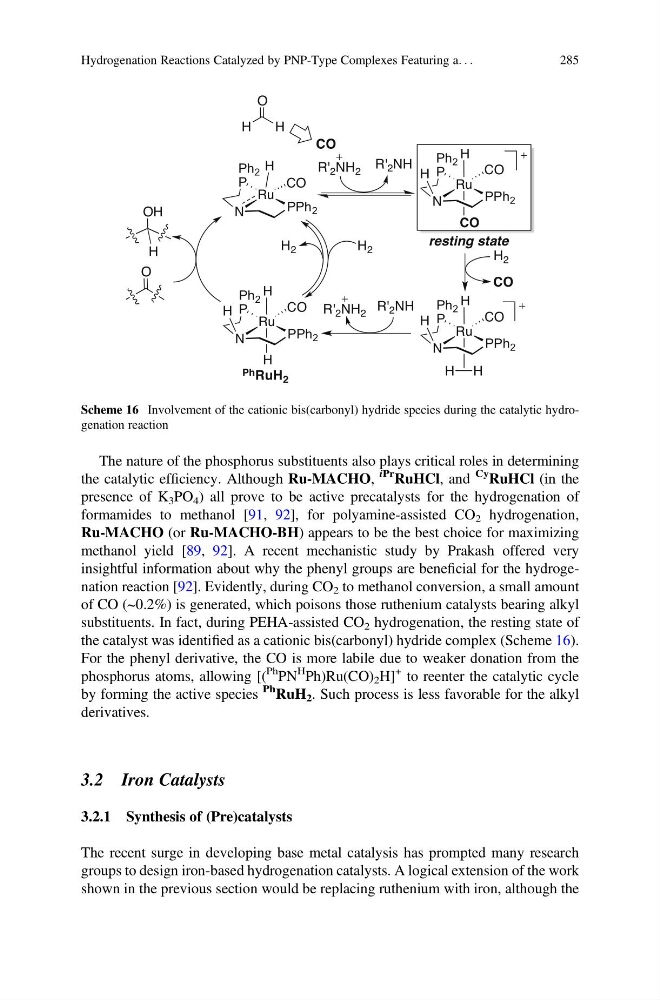
insightful information about why the phenyl groups are beneficial for the hydrogenation reaction [92]. Evidently, during CO 2 to methanol conversion, a small amount
of CO (~0.2%) is generated, which poisons those ruthenium catalysts bearing alkyl
substituents. In fact, during PEHA-assisted CO 2 hydrogenation, the resting state of
the catalyst was identified as a cationic bis(carbonyl) hydride complex (Scheme 16).
For the phenyl derivative, the CO is more labile due to weaker donation from the
phosphorus atoms, allowing [(
Ph PN
H Ph)Ru(CO) 2 H]
+ to reenter the catalytic cycle
by forming the active species
Ph RuH 2 . Such process is less favorable for the alkyl
derivatives.
3.2 Iron Catalysts
3.2.1 Synthesis of (Pre)catalysts
The recent surge in developing base metal catalysis has prompted many research
groups to design iron-based hydrogenation catalysts. A logical extension of the work
shown in the previous section would be replacing ruthenium with iron, although the
PPh 2
Ru
N
P
CO
H
Ph 2
CO
H
PPh 2
Ru
N
P
CO
H
Ph 2
R' 2 NH 2
CO
R' 2 NH
O
H
H
PPh 2
Ru
N
P
CO
H
Ph 2
H
H H
H 2
CO
R' 2 NH
R' 2 NH 2
PPh 2
Ru
N
P
CO
H
Ph 2
H
H
resting state
O
OH
H
H 2
H 2
Ph RuH 2
Scheme 16 Involvement of the cationic bis(carbonyl) hydride species during the catalytic hydrogenation reaction
Hydrogenation Reactions Catalyzed by PNP-Type Complexes Featuring a. . .
285
the catalytic efficiency. Although Ru-MACHO,
iPr
RuHCl, and
Cy RuHCl (in the
presence of K 3 PO 4 ) all prove to be active precatalysts for the hydrogenation of
formamides to methanol [91, 92], for polyamine-assisted CO 2 hydrogenation,
Ru-MACHO (or Ru-MACHO-BH) appears to be the best choice for maximizing
methanol yield [89, 92]. A recent mechanistic study by Prakash offered very
insightful information about why the phenyl groups are beneficial for the hydrogenation reaction [92]. Evidently, during CO 2 to methanol conversion, a small amount
of CO (~0.2%) is generated, which poisons those ruthenium catalysts bearing alkyl
substituents. In fact, during PEHA-assisted CO 2 hydrogenation, the resting state of
the catalyst was identified as a cationic bis(carbonyl) hydride complex (Scheme 16).
For the phenyl derivative, the CO is more labile due to weaker donation from the
phosphorus atoms, allowing [(
Ph PN
H Ph)Ru(CO) 2 H]
+ to reenter the catalytic cycle
by forming the active species
Ph RuH 2 . Such process is less favorable for the alkyl
derivatives.
3.2 Iron Catalysts
3.2.1 Synthesis of (Pre)catalysts
The recent surge in developing base metal catalysis has prompted many research
groups to design iron-based hydrogenation catalysts. A logical extension of the work
shown in the previous section would be replacing ruthenium with iron, although the
PPh 2
Ru
N
P
CO
H
Ph 2
CO
H
PPh 2
Ru
N
P
CO
H
Ph 2
R' 2 NH 2
CO
R' 2 NH
O
H
H
PPh 2
Ru
N
P
CO
H
Ph 2
H
H H
H 2
CO
R' 2 NH
R' 2 NH 2
PPh 2
Ru
N
P
CO
H
Ph 2
H
H
resting state
O
OH
H
H 2
H 2
Ph RuH 2
Scheme 16 Involvement of the cationic bis(carbonyl) hydride species during the catalytic hydrogenation reaction
Hydrogenation Reactions Catalyzed by PNP-Type Complexes Featuring a. . .
285