

ð24Þ
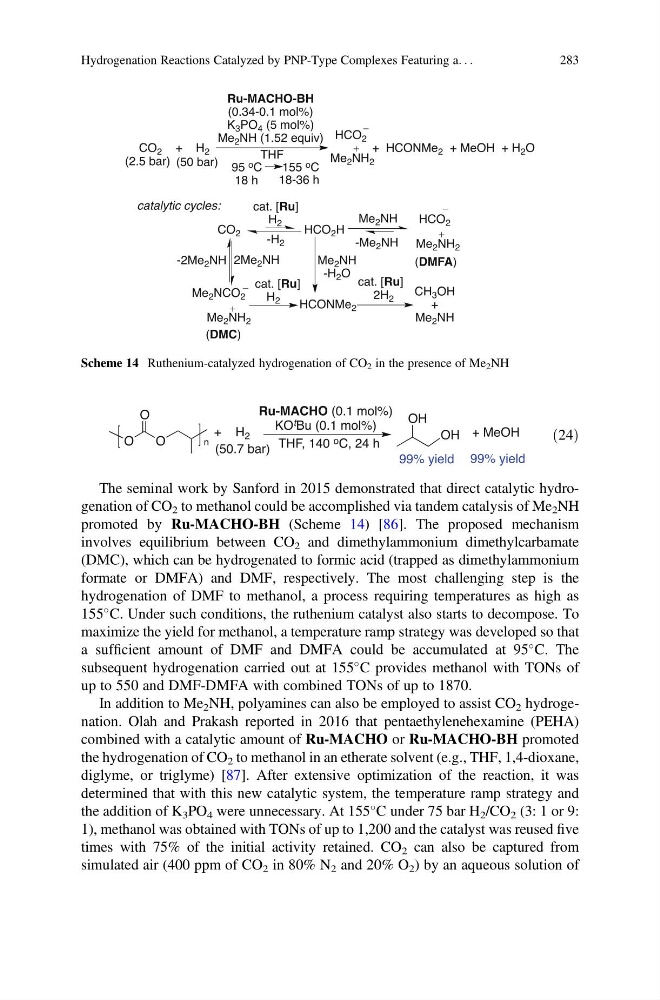
The seminal work by Sanford in 2015 demonstrated that direct catalytic hydrogenation of CO 2 to methanol could be accomplished via tandem catalysis of Me 2 NH
promoted by Ru-MACHO-BH (Scheme 14) [86]. The proposed mechanism
involves equilibrium between CO 2 and dimethylammonium dimethylcarbamate
(DMC), which can be hydrogenated to formic acid (trapped as dimethylammonium
formate or DMFA) and DMF, respectively. The most challenging step is the
hydrogenation of DMF to methanol, a process requiring temperatures as high as
155
C. Under such conditions, the ruthenium catalyst also starts to decompose. To
maximize the yield for methanol, a temperature ramp strategy was developed so that
a sufficient amount of DMF and DMFA could be accumulated at 95
C. The
subsequent hydrogenation carried out at 155
C provides methanol with TONs of
up to 550 and DMF-DMFA with combined TONs of up to 1870.
In addition to Me 2 NH, polyamines can also be employed to assist CO 2 hydrogenation. Olah and Prakash reported in 2016 that pentaethylenehexamine (PEHA)
combined with a catalytic amount of Ru-MACHO or Ru-MACHO-BH promoted
the hydrogenation of CO 2 to methanol in an etherate solvent (e.g., THF, 1,4-dioxane,
diglyme, or triglyme) [87]. After extensive optimization of the reaction, it was
determined that with this new catalytic system, the temperature ramp strategy and
the addition of K 3 PO 4 were unnecessary. At 155
C under 75 bar H 2 /CO 2 (3: 1 or 9:
1), methanol was obtained with TONs of up to 1,200 and the catalyst was reused five
times with 75% of the initial activity retained. CO 2 can also be captured from
simulated air (400 ppm of CO 2 in 80% N 2 and 20% O 2 ) by an aqueous solution of
Scheme 14 Ruthenium-catalyzed hydrogenation of CO 2 in the presence of Me 2 NH
Hydrogenation Reactions Catalyzed by PNP-Type Complexes Featuring a. . .
283
The seminal work by Sanford in 2015 demonstrated that direct catalytic hydrogenation of CO 2 to methanol could be accomplished via tandem catalysis of Me 2 NH
promoted by Ru-MACHO-BH (Scheme 14) [86]. The proposed mechanism
involves equilibrium between CO 2 and dimethylammonium dimethylcarbamate
(DMC), which can be hydrogenated to formic acid (trapped as dimethylammonium
formate or DMFA) and DMF, respectively. The most challenging step is the
hydrogenation of DMF to methanol, a process requiring temperatures as high as
155
C. Under such conditions, the ruthenium catalyst also starts to decompose. To
maximize the yield for methanol, a temperature ramp strategy was developed so that
a sufficient amount of DMF and DMFA could be accumulated at 95
C. The
subsequent hydrogenation carried out at 155
C provides methanol with TONs of
up to 550 and DMF-DMFA with combined TONs of up to 1870.
In addition to Me 2 NH, polyamines can also be employed to assist CO 2 hydrogenation. Olah and Prakash reported in 2016 that pentaethylenehexamine (PEHA)
combined with a catalytic amount of Ru-MACHO or Ru-MACHO-BH promoted
the hydrogenation of CO 2 to methanol in an etherate solvent (e.g., THF, 1,4-dioxane,
diglyme, or triglyme) [87]. After extensive optimization of the reaction, it was
determined that with this new catalytic system, the temperature ramp strategy and
the addition of K 3 PO 4 were unnecessary. At 155
C under 75 bar H 2 /CO 2 (3: 1 or 9:
1), methanol was obtained with TONs of up to 1,200 and the catalyst was reused five
times with 75% of the initial activity retained. CO 2 can also be captured from
simulated air (400 ppm of CO 2 in 80% N 2 and 20% O 2 ) by an aqueous solution of
Scheme 14 Ruthenium-catalyzed hydrogenation of CO 2 in the presence of Me 2 NH
Hydrogenation Reactions Catalyzed by PNP-Type Complexes Featuring a. . .
283