

For the hydrogenation of CO 2 to methanol (with a change of the carbon formal
oxidation state from +4 to À2), one strategy is to use cyclic carbonates as surrogates
for CO 2 , which can bypass formic acid (incompatible with metal hydrides) or
formate salts (thermodynamic sinks). This was successfully demonstrated in 2012
by Ding who studied ruthenium-catalyzed hydrogenation of ethylene carbonate
[55]. Among the precatalysts screened, Ru-MACHO performs significantly better
than the analogous complexes bearing alkyl groups as the phosphorus substituents
(i.e.,
iPr RuHCl,
Cy RuHCl,
Ad
RuHCl, and
tBu
RuHCl) with TONs as high as 87,000.
In this case, the NH moiety is crucial for the catalysis because the methylated
complex (
Ph PN
Me
P)RuHCl(CO) fails to hydrogenate ethylene carbonate. Under
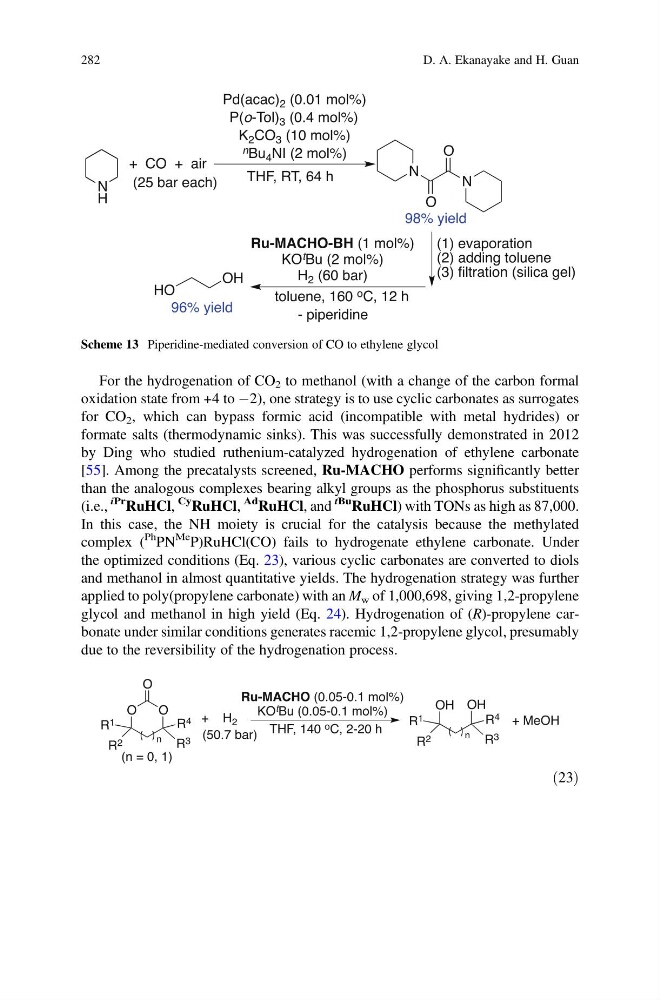
the optimized conditions (Eq. 23), various cyclic carbonates are converted to diols
and methanol in almost quantitative yields. The hydrogenation strategy was further
applied to poly(propylene carbonate) with an M w of 1,000,698, giving 1,2-propylene
glycol and methanol in high yield (Eq. 24). Hydrogenation of (R)-propylene carbonate under similar conditions generates racemic 1,2-propylene glycol, presumably
due to the reversibility of the hydrogenation process.
ð23Þ
Scheme 13 Piperidine-mediated conversion of CO to ethylene glycol
282
D. A. Ekanayake and H. Guan
oxidation state from +4 to À2), one strategy is to use cyclic carbonates as surrogates
for CO 2 , which can bypass formic acid (incompatible with metal hydrides) or
formate salts (thermodynamic sinks). This was successfully demonstrated in 2012
by Ding who studied ruthenium-catalyzed hydrogenation of ethylene carbonate
[55]. Among the precatalysts screened, Ru-MACHO performs significantly better
than the analogous complexes bearing alkyl groups as the phosphorus substituents
(i.e.,
iPr RuHCl,
Cy RuHCl,
Ad
RuHCl, and
tBu
RuHCl) with TONs as high as 87,000.
In this case, the NH moiety is crucial for the catalysis because the methylated
complex (
Ph PN
Me
P)RuHCl(CO) fails to hydrogenate ethylene carbonate. Under
the optimized conditions (Eq. 23), various cyclic carbonates are converted to diols
and methanol in almost quantitative yields. The hydrogenation strategy was further
applied to poly(propylene carbonate) with an M w of 1,000,698, giving 1,2-propylene
glycol and methanol in high yield (Eq. 24). Hydrogenation of (R)-propylene carbonate under similar conditions generates racemic 1,2-propylene glycol, presumably
due to the reversibility of the hydrogenation process.
ð23Þ
Scheme 13 Piperidine-mediated conversion of CO to ethylene glycol
282
D. A. Ekanayake and H. Guan