

or Me 2 ( p-MeC 6 H 4 )Si) under 10 bar H 2 is complicated by the formation of
R
0
3 SiOMe and R
0
3 SiOSiR
0
3 as the by-products. The selectivity for methanol and
silanols can, however, be improved by raising the H 2 pressure to 80 bar or by adding
0.1 equiv. of methanol. For the latter strategy, methanol attacks silyl formates to
yield silanols and methyl formate, which is in turn readily hydrogenated to 2 equiv.
of methanol under the catalytic conditions.
Ru-MACHO-BH
(0.1-5 mol%)
THF, 150
o
C, 12 h
+ H 2 (10-80 bar)
O
OSiR' 3
H
CH 3 OH + R' 3 SiOH
ð21Þ
When K 3 PO 4 is used as the catalyst, secondary amines can react with CO (30 bar)
at 140
C to give formamides. This reaction coupled with formamide hydrogenation
provides an indirect route of hydrogenation of CO to methanol. The challenge lies in
the fact that the carbonylation step is favored by an alcoholic solvent, whereas the
hydrogenation step is favored by a relatively nonpolar solvent such as toluene. To
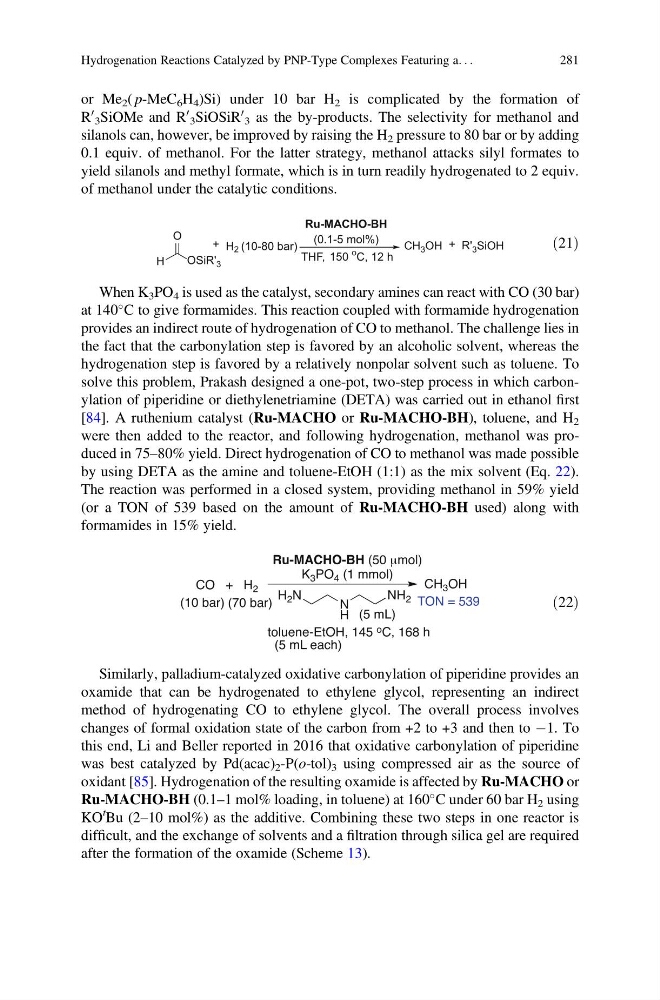
solve this problem, Prakash designed a one-pot, two-step process in which carbonylation of piperidine or diethylenetriamine (DETA) was carried out in ethanol first
[84]. A ruthenium catalyst (Ru-MACHO or Ru-MACHO-BH), toluene, and H 2
were then added to the reactor, and following hydrogenation, methanol was produced in 75–80% yield. Direct hydrogenation of CO to methanol was made possible
by using DETA as the amine and toluene-EtOH (1:1) as the mix solvent (Eq. 22).
The reaction was performed in a closed system, providing methanol in 59% yield
(or a TON of 539 based on the amount of Ru-MACHO-BH used) along with
formamides in 15% yield.
ð22Þ
Similarly, palladium-catalyzed oxidative carbonylation of piperidine provides an
oxamide that can be hydrogenated to ethylene glycol, representing an indirect
method of hydrogenating CO to ethylene glycol. The overall process involves
changes of formal oxidation state of the carbon from +2 to +3 and then to À1. To
this end, Li and Beller reported in 2016 that oxidative carbonylation of piperidine
was best catalyzed by Pd(acac) 2 -P(o-tol) 3 using compressed air as the source of
oxidant [85]. Hydrogenation of the resulting oxamide is affected by Ru-MACHO or
Ru-MACHO-BH (0.1–1 mol% loading, in toluene) at 160
C under 60 bar H 2 using
KO
t Bu (2–10 mol%) as the additive. Combining these two steps in one reactor is
difficult, and the exchange of solvents and a filtration through silica gel are required
after the formation of the oxamide (Scheme 13).
Hydrogenation Reactions Catalyzed by PNP-Type Complexes Featuring a. . .
281
R
0
3 SiOMe and R
0
3 SiOSiR
0
3 as the by-products. The selectivity for methanol and
silanols can, however, be improved by raising the H 2 pressure to 80 bar or by adding
0.1 equiv. of methanol. For the latter strategy, methanol attacks silyl formates to
yield silanols and methyl formate, which is in turn readily hydrogenated to 2 equiv.
of methanol under the catalytic conditions.
Ru-MACHO-BH
(0.1-5 mol%)
THF, 150
o
C, 12 h
+ H 2 (10-80 bar)
O
OSiR' 3
H
CH 3 OH + R' 3 SiOH
ð21Þ
When K 3 PO 4 is used as the catalyst, secondary amines can react with CO (30 bar)
at 140
C to give formamides. This reaction coupled with formamide hydrogenation
provides an indirect route of hydrogenation of CO to methanol. The challenge lies in
the fact that the carbonylation step is favored by an alcoholic solvent, whereas the
hydrogenation step is favored by a relatively nonpolar solvent such as toluene. To
solve this problem, Prakash designed a one-pot, two-step process in which carbonylation of piperidine or diethylenetriamine (DETA) was carried out in ethanol first
[84]. A ruthenium catalyst (Ru-MACHO or Ru-MACHO-BH), toluene, and H 2
were then added to the reactor, and following hydrogenation, methanol was produced in 75–80% yield. Direct hydrogenation of CO to methanol was made possible
by using DETA as the amine and toluene-EtOH (1:1) as the mix solvent (Eq. 22).
The reaction was performed in a closed system, providing methanol in 59% yield
(or a TON of 539 based on the amount of Ru-MACHO-BH used) along with
formamides in 15% yield.
ð22Þ
Similarly, palladium-catalyzed oxidative carbonylation of piperidine provides an
oxamide that can be hydrogenated to ethylene glycol, representing an indirect
method of hydrogenating CO to ethylene glycol. The overall process involves
changes of formal oxidation state of the carbon from +2 to +3 and then to À1. To
this end, Li and Beller reported in 2016 that oxidative carbonylation of piperidine
was best catalyzed by Pd(acac) 2 -P(o-tol) 3 using compressed air as the source of
oxidant [85]. Hydrogenation of the resulting oxamide is affected by Ru-MACHO or
Ru-MACHO-BH (0.1–1 mol% loading, in toluene) at 160
C under 60 bar H 2 using
KO
t Bu (2–10 mol%) as the additive. Combining these two steps in one reactor is
difficult, and the exchange of solvents and a filtration through silica gel are required
after the formation of the oxamide (Scheme 13).
Hydrogenation Reactions Catalyzed by PNP-Type Complexes Featuring a. . .
281