

ð18Þ
ð19Þ
ð20Þ
Hydrogenation of CO 2 along with a primary or secondary amine to generate a
formamide is also a formally two-electron reduction process (+4 to +2 for the change
in formal oxidation state of the carbon). In 2015, Ding reported that in the presence
of KO
t Bu (0.1 mol%), Ru-MACHO,
iPr RuHCl,
Cy RuHCl,
Ad RuHCl,
tBu RuHCl,
and the methylated complex (
Ph PN
Me P)RuHCl(CO) were all effective in catalyzing
N-formylation of morpholine under H 2 and CO 2 (35.5 bar each, 0.1 mol% [Ru],
120
C, in THF) [82]. Using Me 2 NH as the amine (also as a base) and lowering the
catalyst loading of Ru-MACHO to 0.000093 mol% produced DMF with TONs of
up to 599,000. The catalyst showed remarkably high stability under the catalytic
conditions. With a catalyst loading of 0.002 mol%, Ru-MACHO was reused
11 times without the concern for a brief exposure to air between runs. Further
hydrogenation of formamides to methanol (formal oxidation state change from +2
to À2) is possible but needs to be performed under a higher temperature and in the
presence of KO
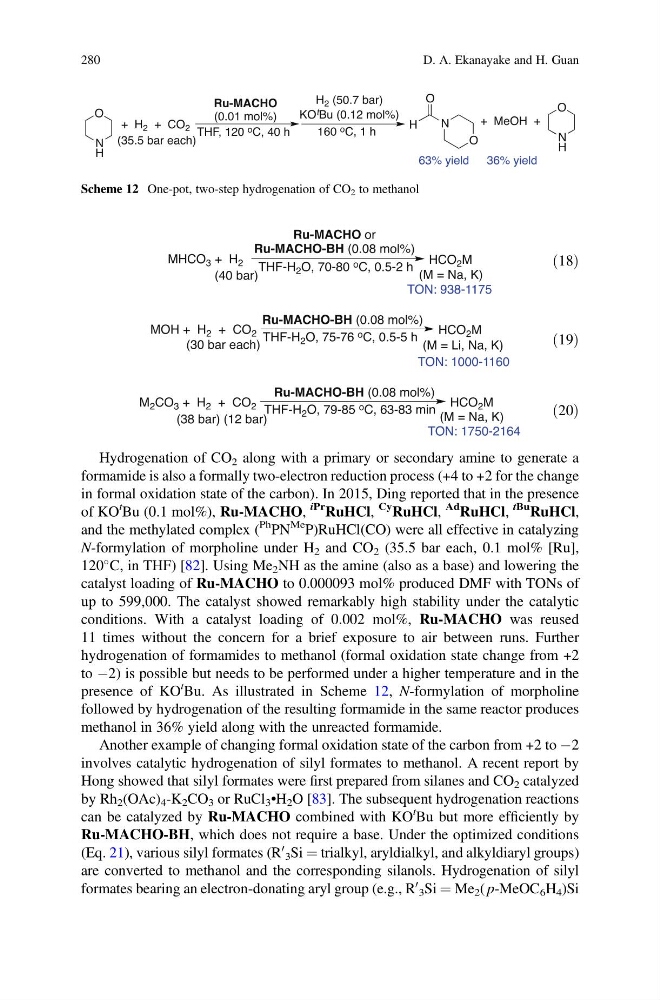
t Bu. As illustrated in Scheme 12, N-formylation of morpholine
followed by hydrogenation of the resulting formamide in the same reactor produces
methanol in 36% yield along with the unreacted formamide.
Another example of changing formal oxidation state of the carbon from +2 to À2
involves catalytic hydrogenation of silyl formates to methanol. A recent report by
Hong showed that silyl formates were first prepared from silanes and CO 2 catalyzed
by Rh 2 (OAc) 4 -K 2 CO 3 or RuCl 3 •H 2 O [83]. The subsequent hydrogenation reactions
can be catalyzed by Ru-MACHO combined with KO
t Bu but more efficiently by
Ru-MACHO-BH, which does not require a base. Under the optimized conditions
(Eq. 21), various silyl formates (R
0
3 Si ¼ trialkyl, aryldialkyl, and alkyldiaryl groups)
are converted to methanol and the corresponding silanols. Hydrogenation of silyl
formates bearing an electron-donating aryl group (e.g., R
0
3 Si ¼ Me 2 ( p-MeOC 6 H 4 )Si
Scheme 12 One-pot, two-step hydrogenation of CO 2 to methanol
280
D. A. Ekanayake and H. Guan
ð19Þ
ð20Þ
Hydrogenation of CO 2 along with a primary or secondary amine to generate a
formamide is also a formally two-electron reduction process (+4 to +2 for the change
in formal oxidation state of the carbon). In 2015, Ding reported that in the presence
of KO
t Bu (0.1 mol%), Ru-MACHO,
iPr RuHCl,
Cy RuHCl,
Ad RuHCl,
tBu RuHCl,
and the methylated complex (
Ph PN
Me P)RuHCl(CO) were all effective in catalyzing
N-formylation of morpholine under H 2 and CO 2 (35.5 bar each, 0.1 mol% [Ru],
120
C, in THF) [82]. Using Me 2 NH as the amine (also as a base) and lowering the
catalyst loading of Ru-MACHO to 0.000093 mol% produced DMF with TONs of
up to 599,000. The catalyst showed remarkably high stability under the catalytic
conditions. With a catalyst loading of 0.002 mol%, Ru-MACHO was reused
11 times without the concern for a brief exposure to air between runs. Further
hydrogenation of formamides to methanol (formal oxidation state change from +2
to À2) is possible but needs to be performed under a higher temperature and in the
presence of KO
t Bu. As illustrated in Scheme 12, N-formylation of morpholine
followed by hydrogenation of the resulting formamide in the same reactor produces
methanol in 36% yield along with the unreacted formamide.
Another example of changing formal oxidation state of the carbon from +2 to À2
involves catalytic hydrogenation of silyl formates to methanol. A recent report by
Hong showed that silyl formates were first prepared from silanes and CO 2 catalyzed
by Rh 2 (OAc) 4 -K 2 CO 3 or RuCl 3 •H 2 O [83]. The subsequent hydrogenation reactions
can be catalyzed by Ru-MACHO combined with KO
t Bu but more efficiently by
Ru-MACHO-BH, which does not require a base. Under the optimized conditions
(Eq. 21), various silyl formates (R
0
3 Si ¼ trialkyl, aryldialkyl, and alkyldiaryl groups)
are converted to methanol and the corresponding silanols. Hydrogenation of silyl
formates bearing an electron-donating aryl group (e.g., R
0
3 Si ¼ Me 2 ( p-MeOC 6 H 4 )Si
Scheme 12 One-pot, two-step hydrogenation of CO 2 to methanol
280
D. A. Ekanayake and H. Guan