

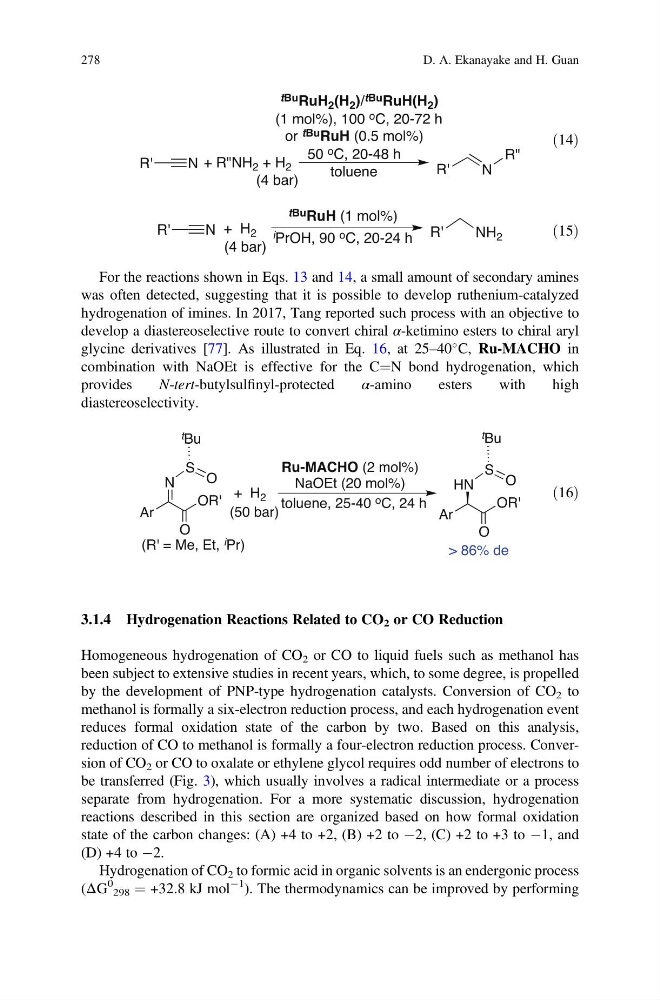
ð14Þ
ð15Þ
For the reactions shown in Eqs. 13 and 14, a small amount of secondary amines
was often detected, suggesting that it is possible to develop ruthenium-catalyzed
hydrogenation of imines. In 2017, Tang reported such process with an objective to
develop a diastereoselective route to convert chiral α-ketimino esters to chiral aryl
glycine derivatives [77]. As illustrated in Eq. 16, at 25–40
C, Ru-MACHO in
combination with NaOEt is effective for the C¼N bond hydrogenation, which
provides
N-tert-butylsulfinyl-protected
α-amino
esters
with
high
diastereoselectivity.
ð16Þ
3.1.4 Hydrogenation Reactions Related to CO 2 or CO Reduction
Homogeneous hydrogenation of CO 2 or CO to liquid fuels such as methanol has
been subject to extensive studies in recent years, which, to some degree, is propelled
by the development of PNP-type hydrogenation catalysts. Conversion of CO 2 to
methanol is formally a six-electron reduction process, and each hydrogenation event
reduces formal oxidation state of the carbon by two. Based on this analysis,
reduction of CO to methanol is formally a four-electron reduction process. Conversion of CO 2 or CO to oxalate or ethylene glycol requires odd number of electrons to
be transferred (Fig. 3), which usually involves a radical intermediate or a process
separate from hydrogenation. For a more systematic discussion, hydrogenation
reactions described in this section are organized based on how formal oxidation
state of the carbon changes: (A) +4 to +2, (B) +2 to À2, (C) +2 to +3 to À1, and
(D) +4 to À2.
Hydrogenation of CO 2 to formic acid in organic solvents is an endergonic process
(ΔG
0
298 ¼ +32.8 kJ mol
À1 ). The thermodynamics can be improved by performing
278
D. A. Ekanayake and H. Guan
ð15Þ
For the reactions shown in Eqs. 13 and 14, a small amount of secondary amines
was often detected, suggesting that it is possible to develop ruthenium-catalyzed
hydrogenation of imines. In 2017, Tang reported such process with an objective to
develop a diastereoselective route to convert chiral α-ketimino esters to chiral aryl
glycine derivatives [77]. As illustrated in Eq. 16, at 25–40
C, Ru-MACHO in
combination with NaOEt is effective for the C¼N bond hydrogenation, which
provides
N-tert-butylsulfinyl-protected
α-amino
esters
with
high
diastereoselectivity.
ð16Þ
3.1.4 Hydrogenation Reactions Related to CO 2 or CO Reduction
Homogeneous hydrogenation of CO 2 or CO to liquid fuels such as methanol has
been subject to extensive studies in recent years, which, to some degree, is propelled
by the development of PNP-type hydrogenation catalysts. Conversion of CO 2 to
methanol is formally a six-electron reduction process, and each hydrogenation event
reduces formal oxidation state of the carbon by two. Based on this analysis,
reduction of CO to methanol is formally a four-electron reduction process. Conversion of CO 2 or CO to oxalate or ethylene glycol requires odd number of electrons to
be transferred (Fig. 3), which usually involves a radical intermediate or a process
separate from hydrogenation. For a more systematic discussion, hydrogenation
reactions described in this section are organized based on how formal oxidation
state of the carbon changes: (A) +4 to +2, (B) +2 to À2, (C) +2 to +3 to À1, and
(D) +4 to À2.
Hydrogenation of CO 2 to formic acid in organic solvents is an endergonic process
(ΔG
0
298 ¼ +32.8 kJ mol
À1 ). The thermodynamics can be improved by performing
278
D. A. Ekanayake and H. Guan