

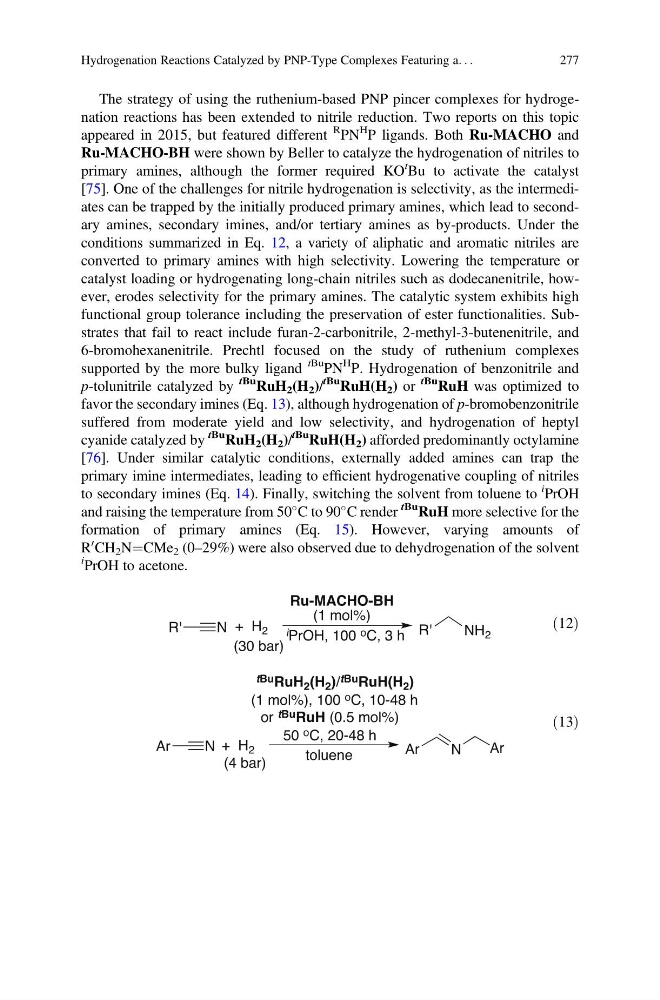
The strategy of using the ruthenium-based PNP pincer complexes for hydrogenation reactions has been extended to nitrile reduction. Two reports on this topic
appeared in 2015, but featured different
R PN
H P ligands. Both Ru-MACHO and
Ru-MACHO-BH were shown by Beller to catalyze the hydrogenation of nitriles to
primary amines, although the former required KO
t Bu to activate the catalyst
[75]. One of the challenges for nitrile hydrogenation is selectivity, as the intermediates can be trapped by the initially produced primary amines, which lead to secondary amines, secondary imines, and/or tertiary amines as by-products. Under the
conditions summarized in Eq. 12, a variety of aliphatic and aromatic nitriles are
converted to primary amines with high selectivity. Lowering the temperature or
catalyst loading or hydrogenating long-chain nitriles such as dodecanenitrile, however, erodes selectivity for the primary amines. The catalytic system exhibits high
functional group tolerance including the preservation of ester functionalities. Substrates that fail to react include furan-2-carbonitrile, 2-methyl-3-butenenitrile, and
6-bromohexanenitrile. Prechtl focused on the study of ruthenium complexes
supported by the more bulky ligand
tBu PN
H P. Hydrogenation of benzonitrile and
p-tolunitrile catalyzed by
tBu RuH 2 (H 2 )/
tBu RuH(H 2 ) or
tBu RuH was optimized to
favor the secondary imines (Eq. 13), although hydrogenation of p-bromobenzonitrile
suffered from moderate yield and low selectivity, and hydrogenation of heptyl
cyanide catalyzed by
tBu RuH 2 (H 2 )/
tBu RuH(H 2 ) afforded predominantly octylamine
[76]. Under similar catalytic conditions, externally added amines can trap the
primary imine intermediates, leading to efficient hydrogenative coupling of nitriles
to secondary imines (Eq. 14). Finally, switching the solvent from toluene to
i PrOH
and raising the temperature from 50
C to 90
C render
tBu RuH more selective for the
formation of primary amines (Eq. 15). However, varying amounts of
R
0 CH 2 N¼CMe 2 (0–29%) were also observed due to dehydrogenation of the solvent
i PrOH to acetone.
ð12Þ
ð13Þ
Hydrogenation Reactions Catalyzed by PNP-Type Complexes Featuring a. . .
277
appeared in 2015, but featured different
R PN
H P ligands. Both Ru-MACHO and
Ru-MACHO-BH were shown by Beller to catalyze the hydrogenation of nitriles to
primary amines, although the former required KO
t Bu to activate the catalyst
[75]. One of the challenges for nitrile hydrogenation is selectivity, as the intermediates can be trapped by the initially produced primary amines, which lead to secondary amines, secondary imines, and/or tertiary amines as by-products. Under the
conditions summarized in Eq. 12, a variety of aliphatic and aromatic nitriles are
converted to primary amines with high selectivity. Lowering the temperature or
catalyst loading or hydrogenating long-chain nitriles such as dodecanenitrile, however, erodes selectivity for the primary amines. The catalytic system exhibits high
functional group tolerance including the preservation of ester functionalities. Substrates that fail to react include furan-2-carbonitrile, 2-methyl-3-butenenitrile, and
6-bromohexanenitrile. Prechtl focused on the study of ruthenium complexes
supported by the more bulky ligand
tBu PN
H P. Hydrogenation of benzonitrile and
p-tolunitrile catalyzed by
tBu RuH 2 (H 2 )/
tBu RuH(H 2 ) or
tBu RuH was optimized to
favor the secondary imines (Eq. 13), although hydrogenation of p-bromobenzonitrile
suffered from moderate yield and low selectivity, and hydrogenation of heptyl
cyanide catalyzed by
tBu RuH 2 (H 2 )/
tBu RuH(H 2 ) afforded predominantly octylamine
[76]. Under similar catalytic conditions, externally added amines can trap the
primary imine intermediates, leading to efficient hydrogenative coupling of nitriles
to secondary imines (Eq. 14). Finally, switching the solvent from toluene to
i PrOH
and raising the temperature from 50
C to 90
C render
tBu RuH more selective for the
formation of primary amines (Eq. 15). However, varying amounts of
R
0 CH 2 N¼CMe 2 (0–29%) were also observed due to dehydrogenation of the solvent
i PrOH to acetone.
ð12Þ
ð13Þ
Hydrogenation Reactions Catalyzed by PNP-Type Complexes Featuring a. . .
277