

temperature of 150
C is critical to the success of the hydrogenation process.
According to the catalyst activation mechanism (Scheme 3), a base additive is
normally not needed for Ru-MACHO-BH to be catalytically active. In fact,
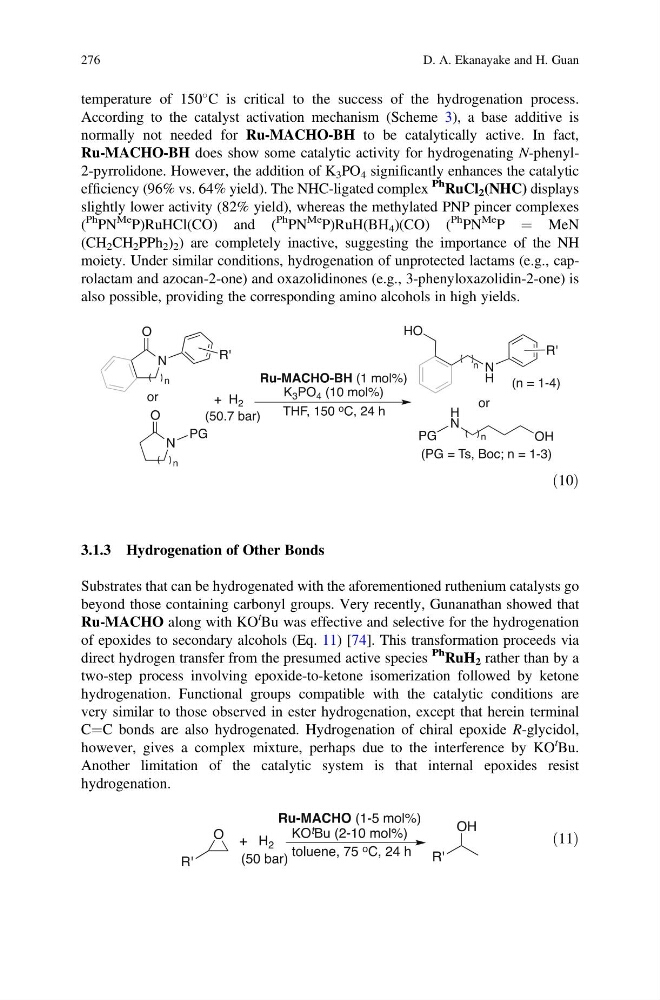
Ru-MACHO-BH does show some catalytic activity for hydrogenating N-phenyl2-pyrrolidone. However, the addition of K 3 PO 4 significantly enhances the catalytic
efficiency (96% vs. 64% yield). The NHC-ligated complex
Ph
RuCl 2 (NHC) displays
slightly lower activity (82% yield), whereas the methylated PNP pincer complexes
(
Ph PN
Me P)RuHCl(CO) and (
Ph PN
Me
P)RuH(BH 4 )(CO) (
Ph PN
Me P ¼ MeN
(CH 2 CH 2 PPh 2 ) 2 ) are completely inactive, suggesting the importance of the NH
moiety. Under similar conditions, hydrogenation of unprotected lactams (e.g., caprolactam and azocan-2-one) and oxazolidinones (e.g., 3-phenyloxazolidin-2-one) is
also possible, providing the corresponding amino alcohols in high yields.
ð10Þ
3.1.3 Hydrogenation of Other Bonds
Substrates that can be hydrogenated with the aforementioned ruthenium catalysts go
beyond those containing carbonyl groups. Very recently, Gunanathan showed that
Ru-MACHO along with KO
t
Bu was effective and selective for the hydrogenation
of epoxides to secondary alcohols (Eq. 11) [74]. This transformation proceeds via
direct hydrogen transfer from the presumed active species
Ph
RuH 2 rather than by a
two-step process involving epoxide-to-ketone isomerization followed by ketone
hydrogenation. Functional groups compatible with the catalytic conditions are
very similar to those observed in ester hydrogenation, except that herein terminal
C¼C bonds are also hydrogenated. Hydrogenation of chiral epoxide R-glycidol,
however, gives a complex mixture, perhaps due to the interference by KO
t
Bu.
Another limitation of the catalytic system is that internal epoxides resist
hydrogenation.
ð11Þ
276
D. A. Ekanayake and H. Guan
C is critical to the success of the hydrogenation process.
According to the catalyst activation mechanism (Scheme 3), a base additive is
normally not needed for Ru-MACHO-BH to be catalytically active. In fact,
Ru-MACHO-BH does show some catalytic activity for hydrogenating N-phenyl2-pyrrolidone. However, the addition of K 3 PO 4 significantly enhances the catalytic
efficiency (96% vs. 64% yield). The NHC-ligated complex
Ph
RuCl 2 (NHC) displays
slightly lower activity (82% yield), whereas the methylated PNP pincer complexes
(
Ph PN
Me P)RuHCl(CO) and (
Ph PN
Me
P)RuH(BH 4 )(CO) (
Ph PN
Me P ¼ MeN
(CH 2 CH 2 PPh 2 ) 2 ) are completely inactive, suggesting the importance of the NH
moiety. Under similar conditions, hydrogenation of unprotected lactams (e.g., caprolactam and azocan-2-one) and oxazolidinones (e.g., 3-phenyloxazolidin-2-one) is
also possible, providing the corresponding amino alcohols in high yields.
ð10Þ
3.1.3 Hydrogenation of Other Bonds
Substrates that can be hydrogenated with the aforementioned ruthenium catalysts go
beyond those containing carbonyl groups. Very recently, Gunanathan showed that
Ru-MACHO along with KO
t
Bu was effective and selective for the hydrogenation
of epoxides to secondary alcohols (Eq. 11) [74]. This transformation proceeds via
direct hydrogen transfer from the presumed active species
Ph
RuH 2 rather than by a
two-step process involving epoxide-to-ketone isomerization followed by ketone
hydrogenation. Functional groups compatible with the catalytic conditions are
very similar to those observed in ester hydrogenation, except that herein terminal
C¼C bonds are also hydrogenated. Hydrogenation of chiral epoxide R-glycidol,
however, gives a complex mixture, perhaps due to the interference by KO
t
Bu.
Another limitation of the catalytic system is that internal epoxides resist
hydrogenation.
ð11Þ
276
D. A. Ekanayake and H. Guan