

Incorporating a chiral
R PN
H P ligand into the catalyst structure should allow
ketones to be hydrogenated enantioselectively. In a recent report, Junge and Beller
tested the catalytic activities of
R* RuHCl (syn/anti mixture or pure anti isomer) in
hydrogenation of acetophenone and cyclohexyl methyl ketone (Eq. 9) [58]. While
the conversion is quantitative, the enantioselectivity is low, suggesting room for
improvement in future ligand screening.
ð9Þ
Since hemiacetals and aldehydes are intermediates during ester hydrogenation,
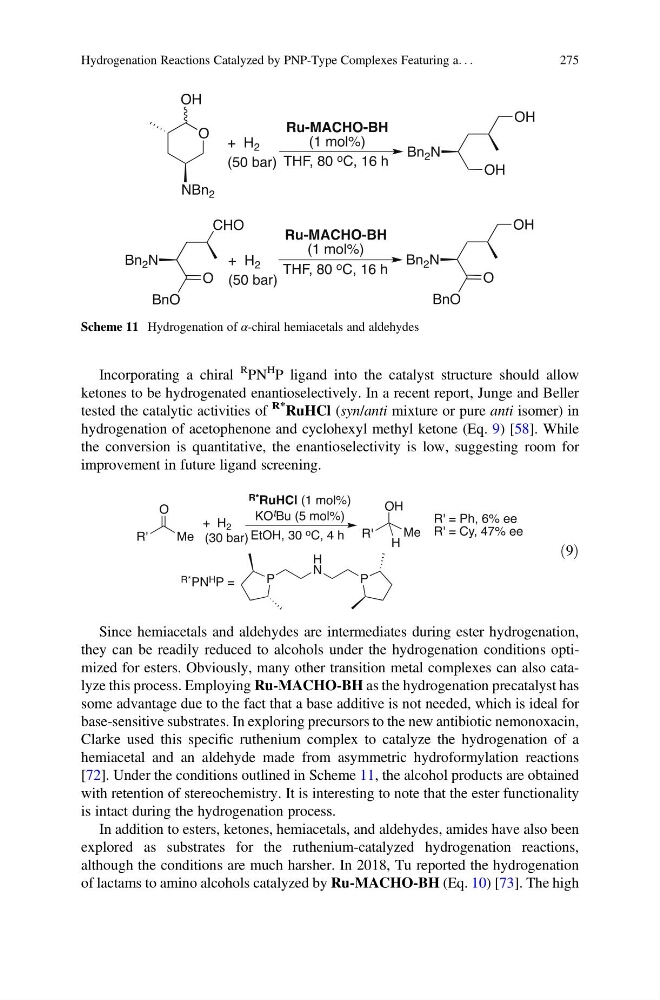
they can be readily reduced to alcohols under the hydrogenation conditions optimized for esters. Obviously, many other transition metal complexes can also catalyze this process. Employing Ru-MACHO-BH as the hydrogenation precatalyst has
some advantage due to the fact that a base additive is not needed, which is ideal for
base-sensitive substrates. In exploring precursors to the new antibiotic nemonoxacin,
Clarke used this specific ruthenium complex to catalyze the hydrogenation of a
hemiacetal and an aldehyde made from asymmetric hydroformylation reactions
[72]. Under the conditions outlined in Scheme 11, the alcohol products are obtained
with retention of stereochemistry. It is interesting to note that the ester functionality
is intact during the hydrogenation process.
In addition to esters, ketones, hemiacetals, and aldehydes, amides have also been
explored as substrates for the ruthenium-catalyzed hydrogenation reactions,
although the conditions are much harsher. In 2018, Tu reported the hydrogenation
of lactams to amino alcohols catalyzed by Ru-MACHO-BH (Eq. 10) [73]. The high
Scheme 11 Hydrogenation of α-chiral hemiacetals and aldehydes
Hydrogenation Reactions Catalyzed by PNP-Type Complexes Featuring a. . .
275
R PN
H P ligand into the catalyst structure should allow
ketones to be hydrogenated enantioselectively. In a recent report, Junge and Beller
tested the catalytic activities of
R* RuHCl (syn/anti mixture or pure anti isomer) in
hydrogenation of acetophenone and cyclohexyl methyl ketone (Eq. 9) [58]. While
the conversion is quantitative, the enantioselectivity is low, suggesting room for
improvement in future ligand screening.
ð9Þ
Since hemiacetals and aldehydes are intermediates during ester hydrogenation,
they can be readily reduced to alcohols under the hydrogenation conditions optimized for esters. Obviously, many other transition metal complexes can also catalyze this process. Employing Ru-MACHO-BH as the hydrogenation precatalyst has
some advantage due to the fact that a base additive is not needed, which is ideal for
base-sensitive substrates. In exploring precursors to the new antibiotic nemonoxacin,
Clarke used this specific ruthenium complex to catalyze the hydrogenation of a
hemiacetal and an aldehyde made from asymmetric hydroformylation reactions
[72]. Under the conditions outlined in Scheme 11, the alcohol products are obtained
with retention of stereochemistry. It is interesting to note that the ester functionality
is intact during the hydrogenation process.
In addition to esters, ketones, hemiacetals, and aldehydes, amides have also been
explored as substrates for the ruthenium-catalyzed hydrogenation reactions,
although the conditions are much harsher. In 2018, Tu reported the hydrogenation
of lactams to amino alcohols catalyzed by Ru-MACHO-BH (Eq. 10) [73]. The high
Scheme 11 Hydrogenation of α-chiral hemiacetals and aldehydes
Hydrogenation Reactions Catalyzed by PNP-Type Complexes Featuring a. . .
275