

unreacted (i.e., HOCH 2 CH 2 CO 2
t Bu as the product) [68]. A closely related substrate
is the oxamate illustrated in Eq. 7. The hydrogenation reaction was carried out under
more demanding conditions, which unsurprisingly led to complete hydrogenation to
ethylene glycol [69].
ð7Þ
Given the higher electrophilicity of the carbonyl carbons, ketones should be more
readily hydrogenated than esters. Thus, for molecules containing both ketone and
ester functionalities, it is possible to fine-tune the reaction conditions so that one or
both carbonyl groups are hydrogenated. This was demonstrated by Tang and Xiao in
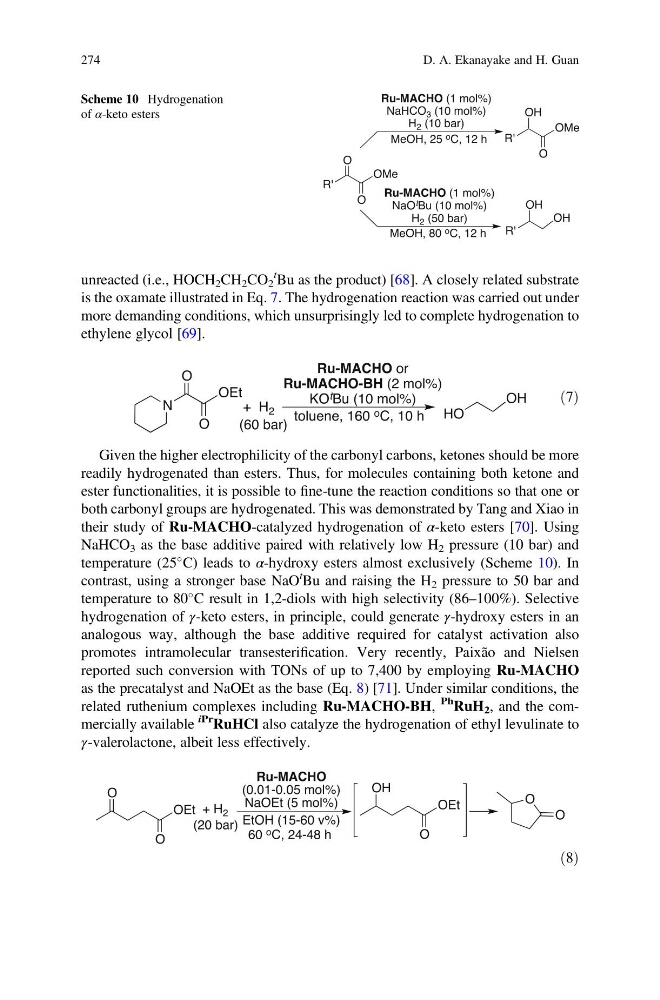
their study of Ru-MACHO-catalyzed hydrogenation of α-keto esters [70]. Using
NaHCO 3 as the base additive paired with relatively low H 2 pressure (10 bar) and
temperature (25
C) leads to α-hydroxy esters almost exclusively (Scheme 10). In
contrast, using a stronger base NaO
t Bu and raising the H 2 pressure to 50 bar and
temperature to 80
C result in 1,2-diols with high selectivity (86–100%). Selective
hydrogenation of γ-keto esters, in principle, could generate γ-hydroxy esters in an
analogous way, although the base additive required for catalyst activation also
promotes intramolecular transesterification. Very recently, Paixão and Nielsen
reported such conversion with TONs of up to 7,400 by employing Ru-MACHO
as the precatalyst and NaOEt as the base (Eq. 8) [71]. Under similar conditions, the
related ruthenium complexes including Ru-MACHO-BH,
Ph
RuH 2 , and the commercially available
iPr RuHCl also catalyze the hydrogenation of ethyl levulinate to
γ-valerolactone, albeit less effectively.
ð8Þ
Scheme 10 Hydrogenation
of α-keto esters
274
D. A. Ekanayake and H. Guan
t Bu as the product) [68]. A closely related substrate
is the oxamate illustrated in Eq. 7. The hydrogenation reaction was carried out under
more demanding conditions, which unsurprisingly led to complete hydrogenation to
ethylene glycol [69].
ð7Þ
Given the higher electrophilicity of the carbonyl carbons, ketones should be more
readily hydrogenated than esters. Thus, for molecules containing both ketone and
ester functionalities, it is possible to fine-tune the reaction conditions so that one or
both carbonyl groups are hydrogenated. This was demonstrated by Tang and Xiao in
their study of Ru-MACHO-catalyzed hydrogenation of α-keto esters [70]. Using
NaHCO 3 as the base additive paired with relatively low H 2 pressure (10 bar) and
temperature (25
C) leads to α-hydroxy esters almost exclusively (Scheme 10). In
contrast, using a stronger base NaO
t Bu and raising the H 2 pressure to 50 bar and
temperature to 80
C result in 1,2-diols with high selectivity (86–100%). Selective
hydrogenation of γ-keto esters, in principle, could generate γ-hydroxy esters in an
analogous way, although the base additive required for catalyst activation also
promotes intramolecular transesterification. Very recently, Paixão and Nielsen
reported such conversion with TONs of up to 7,400 by employing Ru-MACHO
as the precatalyst and NaOEt as the base (Eq. 8) [71]. Under similar conditions, the
related ruthenium complexes including Ru-MACHO-BH,
Ph
RuH 2 , and the commercially available
iPr RuHCl also catalyze the hydrogenation of ethyl levulinate to
γ-valerolactone, albeit less effectively.
ð8Þ
Scheme 10 Hydrogenation
of α-keto esters
274
D. A. Ekanayake and H. Guan