

ð5Þ
In 2016, Ogata and Kayaki developed a series of NHC-ligated ruthenium
PNP-type catalysts for ester hydrogenation that operate under milder conditions
[63]. In particular, complexes
Ph RuCl 2 (NHC) and
Ar
RuCl 2 (NHC) outperform
Ru-MACHO in hydrogenating methyl benzoate at 80
C under 10 bar H 2 . Further
optimization of the catalytic conditions showed that in the presence of KO
t
Bu or
NaOMe,
Ph RuCl 2 (NHC) was active at 50
C even under a balloon pressure of H 2 ,
converting various esters to the corresponding alcohols (Eq. 6).
ð6Þ
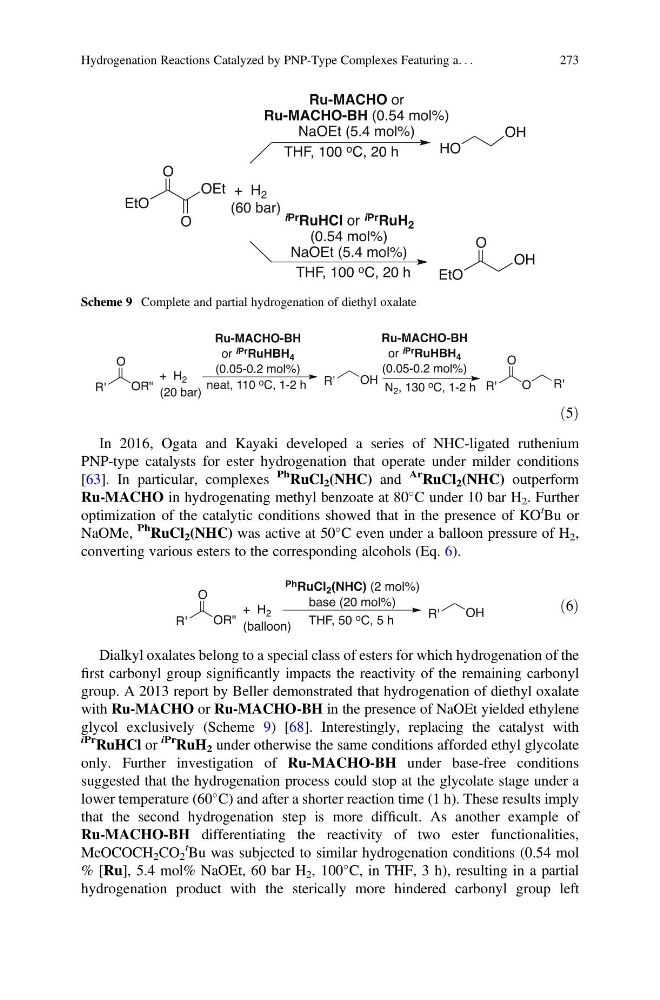
Dialkyl oxalates belong to a special class of esters for which hydrogenation of the
first carbonyl group significantly impacts the reactivity of the remaining carbonyl
group. A 2013 report by Beller demonstrated that hydrogenation of diethyl oxalate
with Ru-MACHO or Ru-MACHO-BH in the presence of NaOEt yielded ethylene
glycol exclusively (Scheme 9) [68]. Interestingly, replacing the catalyst with
iPr
RuHCl or
iPr
RuH 2 under otherwise the same conditions afforded ethyl glycolate
only. Further investigation of Ru-MACHO-BH under base-free conditions
suggested that the hydrogenation process could stop at the glycolate stage under a
lower temperature (60
C) and after a shorter reaction time (1 h). These results imply
that the second hydrogenation step is more difficult. As another example of
Ru-MACHO-BH differentiating the reactivity of two ester functionalities,
MeOCOCH 2 CO 2
t Bu was subjected to similar hydrogenation conditions (0.54 mol
% [Ru], 5.4 mol% NaOEt, 60 bar H 2 , 100
C, in THF, 3 h), resulting in a partial
hydrogenation product with the sterically more hindered carbonyl group left
Scheme 9 Complete and partial hydrogenation of diethyl oxalate
Hydrogenation Reactions Catalyzed by PNP-Type Complexes Featuring a. . .
273
In 2016, Ogata and Kayaki developed a series of NHC-ligated ruthenium
PNP-type catalysts for ester hydrogenation that operate under milder conditions
[63]. In particular, complexes
Ph RuCl 2 (NHC) and
Ar
RuCl 2 (NHC) outperform
Ru-MACHO in hydrogenating methyl benzoate at 80
C under 10 bar H 2 . Further
optimization of the catalytic conditions showed that in the presence of KO
t
Bu or
NaOMe,
Ph RuCl 2 (NHC) was active at 50
C even under a balloon pressure of H 2 ,
converting various esters to the corresponding alcohols (Eq. 6).
ð6Þ
Dialkyl oxalates belong to a special class of esters for which hydrogenation of the
first carbonyl group significantly impacts the reactivity of the remaining carbonyl
group. A 2013 report by Beller demonstrated that hydrogenation of diethyl oxalate
with Ru-MACHO or Ru-MACHO-BH in the presence of NaOEt yielded ethylene
glycol exclusively (Scheme 9) [68]. Interestingly, replacing the catalyst with
iPr
RuHCl or
iPr
RuH 2 under otherwise the same conditions afforded ethyl glycolate
only. Further investigation of Ru-MACHO-BH under base-free conditions
suggested that the hydrogenation process could stop at the glycolate stage under a
lower temperature (60
C) and after a shorter reaction time (1 h). These results imply
that the second hydrogenation step is more difficult. As another example of
Ru-MACHO-BH differentiating the reactivity of two ester functionalities,
MeOCOCH 2 CO 2
t Bu was subjected to similar hydrogenation conditions (0.54 mol
% [Ru], 5.4 mol% NaOEt, 60 bar H 2 , 100
C, in THF, 3 h), resulting in a partial
hydrogenation product with the sterically more hindered carbonyl group left
Scheme 9 Complete and partial hydrogenation of diethyl oxalate
Hydrogenation Reactions Catalyzed by PNP-Type Complexes Featuring a. . .
273