

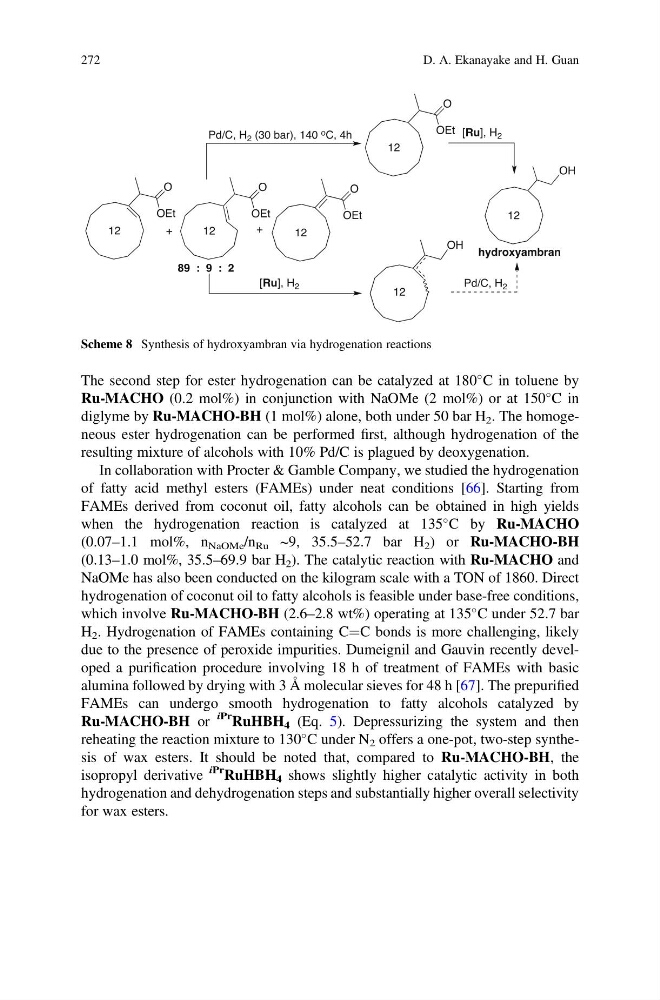
The second step for ester hydrogenation can be catalyzed at 180
C in toluene by
Ru-MACHO (0.2 mol%) in conjunction with NaOMe (2 mol%) or at 150
C in
diglyme by Ru-MACHO-BH (1 mol%) alone, both under 50 bar H 2 . The homogeneous ester hydrogenation can be performed first, although hydrogenation of the
resulting mixture of alcohols with 10% Pd/C is plagued by deoxygenation.
In collaboration with Procter & Gamble Company, we studied the hydrogenation
of fatty acid methyl esters (FAMEs) under neat conditions [66]. Starting from
FAMEs derived from coconut oil, fatty alcohols can be obtained in high yields
when the hydrogenation reaction is catalyzed at 135
C by Ru-MACHO
(0.07–1.1 mol%, n NaOMe /n Ru ~9, 35.5–52.7 bar H 2 ) or Ru-MACHO-BH
(0.13–1.0 mol%, 35.5–69.9 bar H 2 ). The catalytic reaction with Ru-MACHO and
NaOMe has also been conducted on the kilogram scale with a TON of 1860. Direct
hydrogenation of coconut oil to fatty alcohols is feasible under base-free conditions,
which involve Ru-MACHO-BH (2.6–2.8 wt%) operating at 135
C under 52.7 bar
H 2 . Hydrogenation of FAMEs containing C¼C bonds is more challenging, likely
due to the presence of peroxide impurities. Dumeignil and Gauvin recently developed a purification procedure involving 18 h of treatment of FAMEs with basic
alumina followed by drying with 3 Å molecular sieves for 48 h [67]. The prepurified
FAMEs can undergo smooth hydrogenation to fatty alcohols catalyzed by
Ru-MACHO-BH or
iPr
RuHBH 4 (Eq. 5). Depressurizing the system and then
reheating the reaction mixture to 130
C under N 2 offers a one-pot, two-step synthesis of wax esters. It should be noted that, compared to Ru-MACHO-BH, the
isopropyl derivative
iPr RuHBH 4 shows slightly higher catalytic activity in both
hydrogenation and dehydrogenation steps and substantially higher overall selectivity
for wax esters.
Scheme 8 Synthesis of hydroxyambran via hydrogenation reactions
272
D. A. Ekanayake and H. Guan
C in toluene by
Ru-MACHO (0.2 mol%) in conjunction with NaOMe (2 mol%) or at 150
C in
diglyme by Ru-MACHO-BH (1 mol%) alone, both under 50 bar H 2 . The homogeneous ester hydrogenation can be performed first, although hydrogenation of the
resulting mixture of alcohols with 10% Pd/C is plagued by deoxygenation.
In collaboration with Procter & Gamble Company, we studied the hydrogenation
of fatty acid methyl esters (FAMEs) under neat conditions [66]. Starting from
FAMEs derived from coconut oil, fatty alcohols can be obtained in high yields
when the hydrogenation reaction is catalyzed at 135
C by Ru-MACHO
(0.07–1.1 mol%, n NaOMe /n Ru ~9, 35.5–52.7 bar H 2 ) or Ru-MACHO-BH
(0.13–1.0 mol%, 35.5–69.9 bar H 2 ). The catalytic reaction with Ru-MACHO and
NaOMe has also been conducted on the kilogram scale with a TON of 1860. Direct
hydrogenation of coconut oil to fatty alcohols is feasible under base-free conditions,
which involve Ru-MACHO-BH (2.6–2.8 wt%) operating at 135
C under 52.7 bar
H 2 . Hydrogenation of FAMEs containing C¼C bonds is more challenging, likely
due to the presence of peroxide impurities. Dumeignil and Gauvin recently developed a purification procedure involving 18 h of treatment of FAMEs with basic
alumina followed by drying with 3 Å molecular sieves for 48 h [67]. The prepurified
FAMEs can undergo smooth hydrogenation to fatty alcohols catalyzed by
Ru-MACHO-BH or
iPr
RuHBH 4 (Eq. 5). Depressurizing the system and then
reheating the reaction mixture to 130
C under N 2 offers a one-pot, two-step synthesis of wax esters. It should be noted that, compared to Ru-MACHO-BH, the
isopropyl derivative
iPr RuHBH 4 shows slightly higher catalytic activity in both
hydrogenation and dehydrogenation steps and substantially higher overall selectivity
for wax esters.
Scheme 8 Synthesis of hydroxyambran via hydrogenation reactions
272
D. A. Ekanayake and H. Guan