

piperidinyl, or l-menthoxy group at the α-position but problematic with methoxy or
dimethylamino group at the β-position (e.g., MeOCH 2 CH 2 CO 2 Me and
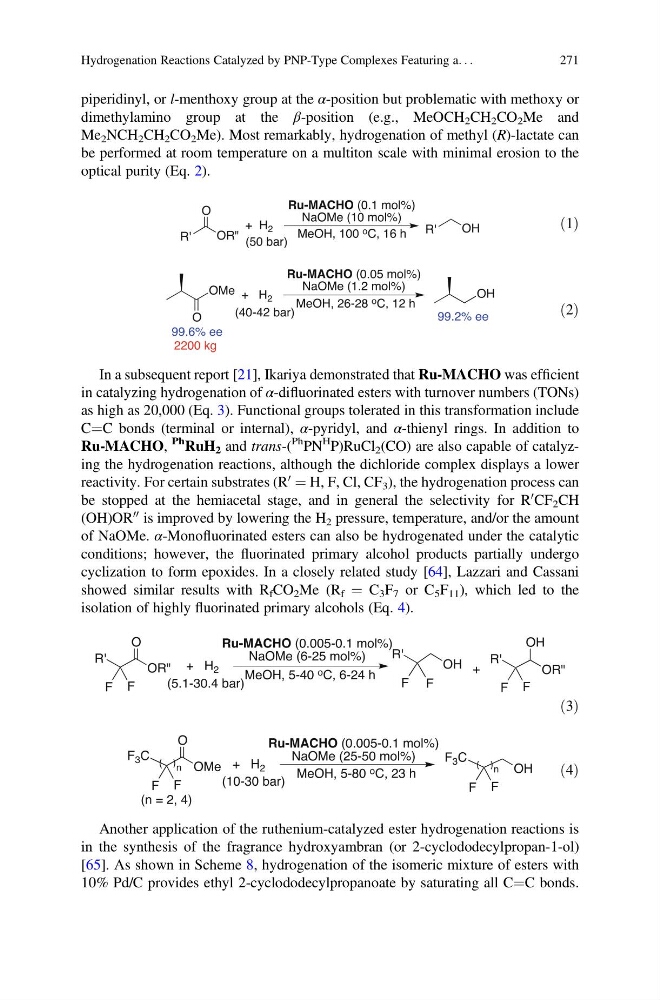
Me 2 NCH 2 CH 2 CO 2 Me). Most remarkably, hydrogenation of methyl (R)-lactate can
be performed at room temperature on a multiton scale with minimal erosion to the
optical purity (Eq. 2).
ð1Þ
ð2Þ
In a subsequent report [21], Ikariya demonstrated that Ru-MACHO was efficient
in catalyzing hydrogenation of α-difluorinated esters with turnover numbers (TONs)
as high as 20,000 (Eq. 3). Functional groups tolerated in this transformation include
C¼C bonds (terminal or internal), α-pyridyl, and α-thienyl rings. In addition to
Ru-MACHO,
Ph RuH 2 and trans-(
Ph PN
H
P)RuCl 2 (CO) are also capable of catalyzing the hydrogenation reactions, although the dichloride complex displays a lower
reactivity. For certain substrates (R
0
¼ H, F, Cl, CF 3 ), the hydrogenation process can
be stopped at the hemiacetal stage, and in general the selectivity for R
0 CF 2 CH
(OH)OR
00 is improved by lowering the H 2 pressure, temperature, and/or the amount
of NaOMe. α-Monofluorinated esters can also be hydrogenated under the catalytic
conditions; however, the fluorinated primary alcohol products partially undergo
cyclization to form epoxides. In a closely related study [64], Lazzari and Cassani
showed similar results with R f CO 2 Me (R f ¼ C 3 F 7 or C 5 F 11 ), which led to the
isolation of highly fluorinated primary alcohols (Eq. 4).
ð3Þ
ð4Þ
Another application of the ruthenium-catalyzed ester hydrogenation reactions is
in the synthesis of the fragrance hydroxyambran (or 2-cyclododecylpropan-1-ol)
[65]. As shown in Scheme 8, hydrogenation of the isomeric mixture of esters with
10% Pd/C provides ethyl 2-cyclododecylpropanoate by saturating all C¼C bonds.
Hydrogenation Reactions Catalyzed by PNP-Type Complexes Featuring a. . .
271
dimethylamino group at the β-position (e.g., MeOCH 2 CH 2 CO 2 Me and
Me 2 NCH 2 CH 2 CO 2 Me). Most remarkably, hydrogenation of methyl (R)-lactate can
be performed at room temperature on a multiton scale with minimal erosion to the
optical purity (Eq. 2).
ð1Þ
ð2Þ
In a subsequent report [21], Ikariya demonstrated that Ru-MACHO was efficient
in catalyzing hydrogenation of α-difluorinated esters with turnover numbers (TONs)
as high as 20,000 (Eq. 3). Functional groups tolerated in this transformation include
C¼C bonds (terminal or internal), α-pyridyl, and α-thienyl rings. In addition to
Ru-MACHO,
Ph RuH 2 and trans-(
Ph PN
H
P)RuCl 2 (CO) are also capable of catalyzing the hydrogenation reactions, although the dichloride complex displays a lower
reactivity. For certain substrates (R
0
¼ H, F, Cl, CF 3 ), the hydrogenation process can
be stopped at the hemiacetal stage, and in general the selectivity for R
0 CF 2 CH
(OH)OR
00 is improved by lowering the H 2 pressure, temperature, and/or the amount
of NaOMe. α-Monofluorinated esters can also be hydrogenated under the catalytic
conditions; however, the fluorinated primary alcohol products partially undergo
cyclization to form epoxides. In a closely related study [64], Lazzari and Cassani
showed similar results with R f CO 2 Me (R f ¼ C 3 F 7 or C 5 F 11 ), which led to the
isolation of highly fluorinated primary alcohols (Eq. 4).
ð3Þ
ð4Þ
Another application of the ruthenium-catalyzed ester hydrogenation reactions is
in the synthesis of the fragrance hydroxyambran (or 2-cyclododecylpropan-1-ol)
[65]. As shown in Scheme 8, hydrogenation of the isomeric mixture of esters with
10% Pd/C provides ethyl 2-cyclododecylpropanoate by saturating all C¼C bonds.
Hydrogenation Reactions Catalyzed by PNP-Type Complexes Featuring a. . .
271