

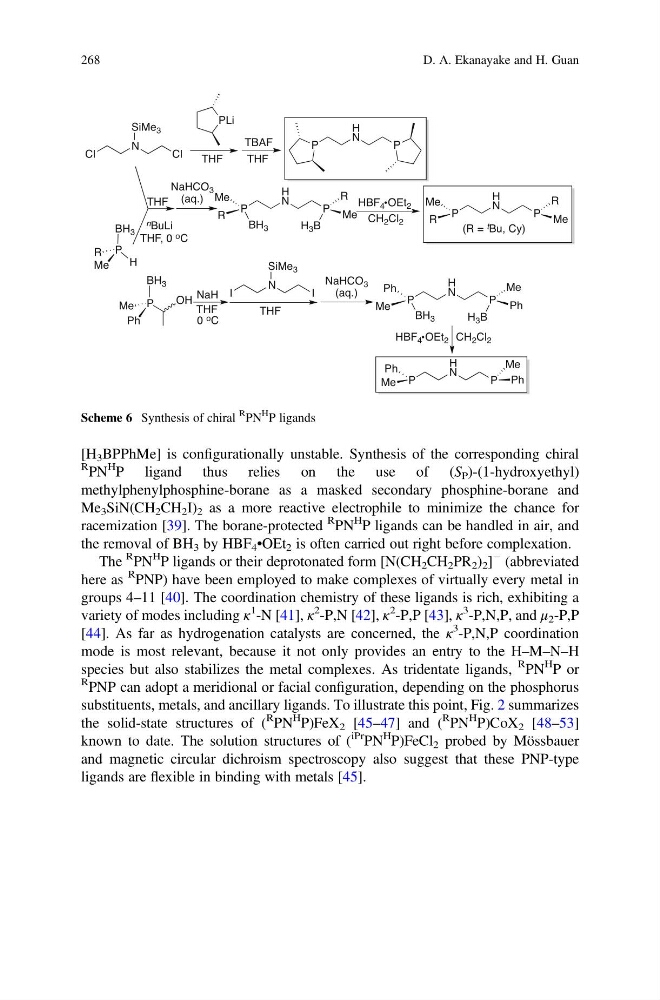
[H 3 BPPhMe] is configurationally unstable. Synthesis of the corresponding chiral
R PN
H P ligand thus relies on the use of (S P )-(1-hydroxyethyl)
methylphenylphosphine-borane as a masked secondary phosphine-borane and
Me 3 SiN(CH 2 CH 2 I) 2 as a more reactive electrophile to minimize the chance for
racemization [39]. The borane-protected
R PN
H P ligands can be handled in air, and
the removal of BH 3 by HBF 4 •OEt 2 is often carried out right before complexation.
The
R PN
H
P ligands or their deprotonated form [N(CH 2 CH 2 PR 2 ) 2 ]
À (abbreviated
here as
R PNP) have been employed to make complexes of virtually every metal in
groups 4–11 [40]. The coordination chemistry of these ligands is rich, exhibiting a
variety of modes including κ
1
-N [41], κ
2 -P,N [42], κ
2 -P,P [43], κ
3 -P,N,P, and μ 2 -P,P
[44]. As far as hydrogenation catalysts are concerned, the κ
3 -P,N,P coordination
mode is most relevant, because it not only provides an entry to the H–M–N–H
species but also stabilizes the metal complexes. As tridentate ligands,
R PN
H P or
R PNP can adopt a meridional or facial configuration, depending on the phosphorus
substituents, metals, and ancillary ligands. To illustrate this point, Fig. 2 summarizes
the solid-state structures of (
R PN
H P)FeX 2 [45–47] and (
R
PN
H P)CoX 2 [48–53]
known to date. The solution structures of (
iPr PN
H P)FeCl 2 probed by Mössbauer
and magnetic circular dichroism spectroscopy also suggest that these PNP-type
ligands are flexible in binding with metals [45].
P
H
Me
R
BH 3
n BuLi
THF
HBF 4 OEt 2
CH 2 Cl 2
(R = t Bu, Cy)
P
Ph
Me
BH 3
NaH
THF
0 o C
THF
OH
THF
TBAF
PLi
THF
Cl
N
Cl
SiMe 3
P
H
N
P
P
H
N
P Me
R
Me
R
BH 3
H 3 B
P
H
N
P Me
R
Me
R
THF, 0 o C
I
N
I
SiMe 3
P
H
N
P Ph
Me
Ph
Me
BH 3
H 3 B
P
H
N
P Ph
Me
Ph
Me
HBF 4 OEt 2 CH 2 Cl 2
NaHCO 3
(aq.)
NaHCO 3
(aq.)
Scheme 6 Synthesis of chiral
R PN
H P ligands
268
D. A. Ekanayake and H. Guan
R PN
H P ligand thus relies on the use of (S P )-(1-hydroxyethyl)
methylphenylphosphine-borane as a masked secondary phosphine-borane and
Me 3 SiN(CH 2 CH 2 I) 2 as a more reactive electrophile to minimize the chance for
racemization [39]. The borane-protected
R PN
H P ligands can be handled in air, and
the removal of BH 3 by HBF 4 •OEt 2 is often carried out right before complexation.
The
R PN
H
P ligands or their deprotonated form [N(CH 2 CH 2 PR 2 ) 2 ]
À (abbreviated
here as
R PNP) have been employed to make complexes of virtually every metal in
groups 4–11 [40]. The coordination chemistry of these ligands is rich, exhibiting a
variety of modes including κ
1
-N [41], κ
2 -P,N [42], κ
2 -P,P [43], κ
3 -P,N,P, and μ 2 -P,P
[44]. As far as hydrogenation catalysts are concerned, the κ
3 -P,N,P coordination
mode is most relevant, because it not only provides an entry to the H–M–N–H
species but also stabilizes the metal complexes. As tridentate ligands,
R PN
H P or
R PNP can adopt a meridional or facial configuration, depending on the phosphorus
substituents, metals, and ancillary ligands. To illustrate this point, Fig. 2 summarizes
the solid-state structures of (
R PN
H P)FeX 2 [45–47] and (
R
PN
H P)CoX 2 [48–53]
known to date. The solution structures of (
iPr PN
H P)FeCl 2 probed by Mössbauer
and magnetic circular dichroism spectroscopy also suggest that these PNP-type
ligands are flexible in binding with metals [45].
P
H
Me
R
BH 3
n BuLi
THF
HBF 4 OEt 2
CH 2 Cl 2
(R = t Bu, Cy)
P
Ph
Me
BH 3
NaH
THF
0 o C
THF
OH
THF
TBAF
PLi
THF
Cl
N
Cl
SiMe 3
P
H
N
P
P
H
N
P Me
R
Me
R
BH 3
H 3 B
P
H
N
P Me
R
Me
R
THF, 0 o C
I
N
I
SiMe 3
P
H
N
P Ph
Me
Ph
Me
BH 3
H 3 B
P
H
N
P Ph
Me
Ph
Me
HBF 4 OEt 2 CH 2 Cl 2
NaHCO 3
(aq.)
NaHCO 3
(aq.)
Scheme 6 Synthesis of chiral
R PN
H P ligands
268
D. A. Ekanayake and H. Guan