

This chapter focuses specifically on complexes supported by ligands of the type
HN(CH 2 CH 2 PR 2 ) 2 (
R PN
H P for short), which are arguably among the most extensively studied hydrogenation catalysts in recent years [29]. Our discussion starts
with how these ligands are made and how they are used to prepare the PNP-type
complexes. The subsequent overview of hydrogenation catalysis is organized based
on the metals, starting from the more popular group 8 elements, transitioning to those
in groups 9 and 10, and concluding with mid-transition metals.
2 Ligand Synthesis and Coordination Modes
The more frequently used
R PN
H P ligands (R ¼
i Pr, Cy, Ad or 1-adamantyl,
t Bu) are
commercially available in the neat form or as a THF solution, whereas
Ph PN
H P is
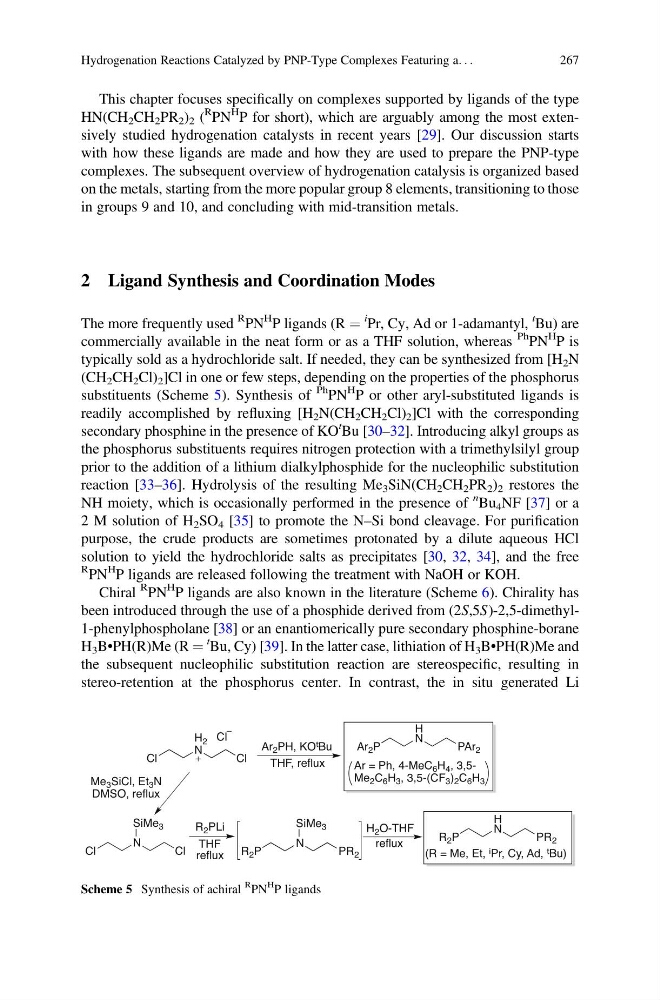
typically sold as a hydrochloride salt. If needed, they can be synthesized from [H 2 N
(CH 2 CH 2 Cl) 2 ]Cl in one or few steps, depending on the properties of the phosphorus
substituents (Scheme 5). Synthesis of
Ph PN
H P or other aryl-substituted ligands is
readily accomplished by refluxing [H 2 N(CH 2 CH 2 Cl) 2 ]Cl with the corresponding
secondary phosphine in the presence of KO
t Bu [30–32]. Introducing alkyl groups as
the phosphorus substituents requires nitrogen protection with a trimethylsilyl group
prior to the addition of a lithium dialkylphosphide for the nucleophilic substitution
reaction [33–36]. Hydrolysis of the resulting Me 3 SiN(CH 2 CH 2 PR 2 ) 2 restores the
NH moiety, which is occasionally performed in the presence of
n Bu 4 NF [37] or a
2 M solution of H 2 SO 4 [35] to promote the N–Si bond cleavage. For purification
purpose, the crude products are sometimes protonated by a dilute aqueous HCl
solution to yield the hydrochloride salts as precipitates [30, 32, 34], and the free
R PN
H P ligands are released following the treatment with NaOH or KOH.
Chiral
R PN
H P ligands are also known in the literature (Scheme 6). Chirality has
been introduced through the use of a phosphide derived from (2S,5S)-2,5-dimethyl1-phenylphospholane [38] or an enantiomerically pure secondary phosphine-borane
H 3 B•PH(R)Me (R ¼
t Bu, Cy) [39]. In the latter case, lithiation of H 3 B•PH(R)Me and
the subsequent nucleophilic substitution reaction are stereospecific, resulting in
stereo-retention at the phosphorus center. In contrast, the in situ generated Li
Cl
Ar 2 PH, KO t Bu
THF, reflux
THF
reflux
R 2 PLi
H 2 O-THF
reflux
(R = Me, Et, i Pr, Cy, Ad, t Bu)
Ar = Ph, 4-MeC 6 H 4 , 3,5Me 2 C 6 H 3 , 3,5-(CF 3 ) 2 C 6 H 3
Cl
H 2
N
Cl
R 2 P
H
N
PR 2
Ar 2 P
H
N
PAr 2
R 2 P
N
PR 2
SiMe 3
Cl
N
Cl
SiMe 3
Me 3 SiCl, Et 3 N
DMSO, reflux
Scheme 5 Synthesis of achiral
R PN
H
P ligands
Hydrogenation Reactions Catalyzed by PNP-Type Complexes Featuring a. . .
267
HN(CH 2 CH 2 PR 2 ) 2 (
R PN
H P for short), which are arguably among the most extensively studied hydrogenation catalysts in recent years [29]. Our discussion starts
with how these ligands are made and how they are used to prepare the PNP-type
complexes. The subsequent overview of hydrogenation catalysis is organized based
on the metals, starting from the more popular group 8 elements, transitioning to those
in groups 9 and 10, and concluding with mid-transition metals.
2 Ligand Synthesis and Coordination Modes
The more frequently used
R PN
H P ligands (R ¼
i Pr, Cy, Ad or 1-adamantyl,
t Bu) are
commercially available in the neat form or as a THF solution, whereas
Ph PN
H P is
typically sold as a hydrochloride salt. If needed, they can be synthesized from [H 2 N
(CH 2 CH 2 Cl) 2 ]Cl in one or few steps, depending on the properties of the phosphorus
substituents (Scheme 5). Synthesis of
Ph PN
H P or other aryl-substituted ligands is
readily accomplished by refluxing [H 2 N(CH 2 CH 2 Cl) 2 ]Cl with the corresponding
secondary phosphine in the presence of KO
t Bu [30–32]. Introducing alkyl groups as
the phosphorus substituents requires nitrogen protection with a trimethylsilyl group
prior to the addition of a lithium dialkylphosphide for the nucleophilic substitution
reaction [33–36]. Hydrolysis of the resulting Me 3 SiN(CH 2 CH 2 PR 2 ) 2 restores the
NH moiety, which is occasionally performed in the presence of
n Bu 4 NF [37] or a
2 M solution of H 2 SO 4 [35] to promote the N–Si bond cleavage. For purification
purpose, the crude products are sometimes protonated by a dilute aqueous HCl
solution to yield the hydrochloride salts as precipitates [30, 32, 34], and the free
R PN
H P ligands are released following the treatment with NaOH or KOH.
Chiral
R PN
H P ligands are also known in the literature (Scheme 6). Chirality has
been introduced through the use of a phosphide derived from (2S,5S)-2,5-dimethyl1-phenylphospholane [38] or an enantiomerically pure secondary phosphine-borane
H 3 B•PH(R)Me (R ¼
t Bu, Cy) [39]. In the latter case, lithiation of H 3 B•PH(R)Me and
the subsequent nucleophilic substitution reaction are stereospecific, resulting in
stereo-retention at the phosphorus center. In contrast, the in situ generated Li
Cl
Ar 2 PH, KO t Bu
THF, reflux
THF
reflux
R 2 PLi
H 2 O-THF
reflux
(R = Me, Et, i Pr, Cy, Ad, t Bu)
Ar = Ph, 4-MeC 6 H 4 , 3,5Me 2 C 6 H 3 , 3,5-(CF 3 ) 2 C 6 H 3
Cl
H 2
N
Cl
R 2 P
H
N
PR 2
Ar 2 P
H
N
PAr 2
R 2 P
N
PR 2
SiMe 3
Cl
N
Cl
SiMe 3
Me 3 SiCl, Et 3 N
DMSO, reflux
Scheme 5 Synthesis of achiral
R PN
H
P ligands
Hydrogenation Reactions Catalyzed by PNP-Type Complexes Featuring a. . .
267