

complexation or formed under hydrogenation conditions (e.g., hydrogenation of
ligand C¼N bonds) [20]. Although occasionally it is possible to synthesize the H–
M–N–H-type complex first [21], most catalytic systems generate this active species
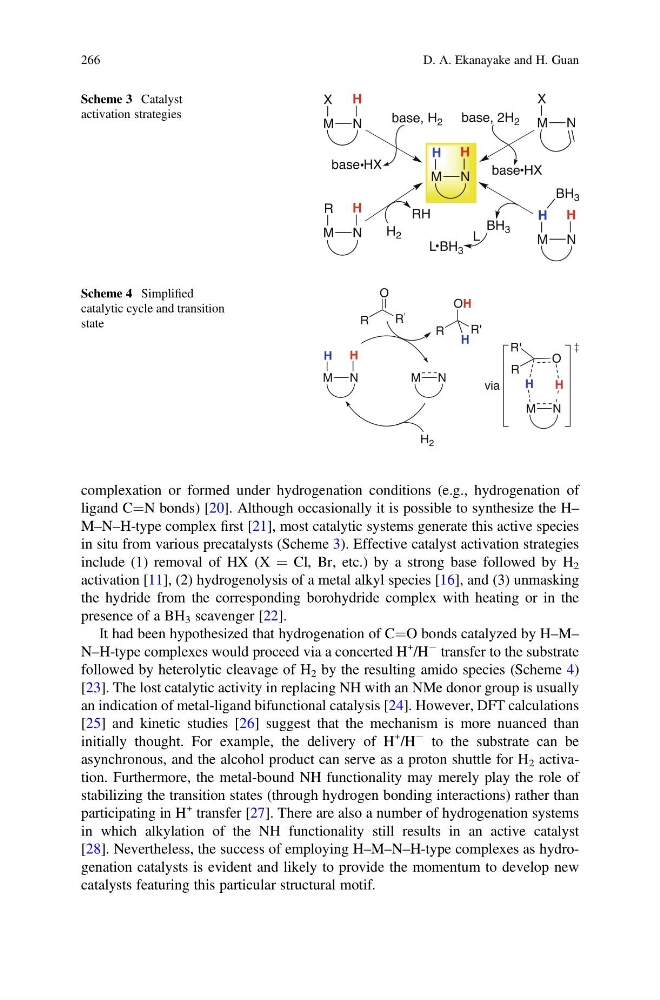
in situ from various precatalysts (Scheme 3). Effective catalyst activation strategies
include (1) removal of HX (X ¼ Cl, Br, etc.) by a strong base followed by H 2
activation [11], (2) hydrogenolysis of a metal alkyl species [16], and (3) unmasking
the hydride from the corresponding borohydride complex with heating or in the
presence of a BH 3 scavenger [22].
It had been hypothesized that hydrogenation of C¼O bonds catalyzed by H–M–
N–H-type complexes would proceed via a concerted H
+
/H
À transfer to the substrate
followed by heterolytic cleavage of H 2 by the resulting amido species (Scheme 4)
[23]. The lost catalytic activity in replacing NH with an NMe donor group is usually
an indication of metal-ligand bifunctional catalysis [24]. However, DFT calculations
[25] and kinetic studies [26] suggest that the mechanism is more nuanced than
initially thought. For example, the delivery of H
+
/H
À to the substrate can be
asynchronous, and the alcohol product can serve as a proton shuttle for H 2 activation. Furthermore, the metal-bound NH functionality may merely play the role of
stabilizing the transition states (through hydrogen bonding interactions) rather than
participating in H
+ transfer [27]. There are also a number of hydrogenation systems
in which alkylation of the NH functionality still results in an active catalyst
[28]. Nevertheless, the success of employing H–M–N–H-type complexes as hydrogenation catalysts is evident and likely to provide the momentum to develop new
catalysts featuring this particular structural motif.
Scheme 3 Catalyst
activation strategies
Scheme 4 Simplified
catalytic cycle and transition
state
266
D. A. Ekanayake and H. Guan
ligand C¼N bonds) [20]. Although occasionally it is possible to synthesize the H–
M–N–H-type complex first [21], most catalytic systems generate this active species
in situ from various precatalysts (Scheme 3). Effective catalyst activation strategies
include (1) removal of HX (X ¼ Cl, Br, etc.) by a strong base followed by H 2
activation [11], (2) hydrogenolysis of a metal alkyl species [16], and (3) unmasking
the hydride from the corresponding borohydride complex with heating or in the
presence of a BH 3 scavenger [22].
It had been hypothesized that hydrogenation of C¼O bonds catalyzed by H–M–
N–H-type complexes would proceed via a concerted H
+
/H
À transfer to the substrate
followed by heterolytic cleavage of H 2 by the resulting amido species (Scheme 4)
[23]. The lost catalytic activity in replacing NH with an NMe donor group is usually
an indication of metal-ligand bifunctional catalysis [24]. However, DFT calculations
[25] and kinetic studies [26] suggest that the mechanism is more nuanced than
initially thought. For example, the delivery of H
+
/H
À to the substrate can be
asynchronous, and the alcohol product can serve as a proton shuttle for H 2 activation. Furthermore, the metal-bound NH functionality may merely play the role of
stabilizing the transition states (through hydrogen bonding interactions) rather than
participating in H
+ transfer [27]. There are also a number of hydrogenation systems
in which alkylation of the NH functionality still results in an active catalyst
[28]. Nevertheless, the success of employing H–M–N–H-type complexes as hydrogenation catalysts is evident and likely to provide the momentum to develop new
catalysts featuring this particular structural motif.
Scheme 3 Catalyst
activation strategies
Scheme 4 Simplified
catalytic cycle and transition
state
266
D. A. Ekanayake and H. Guan