

developed much later. Noyori attributed the difficulty to the preferred coordination
mode adopted by the carbonyl group [8]. Unlike olefinic substrates, simple aldehydes and ketones often coordinate to metals via the oxygen lone pair instead of the
π system [9], which places the carbonyl carbon far away from the hydride to be
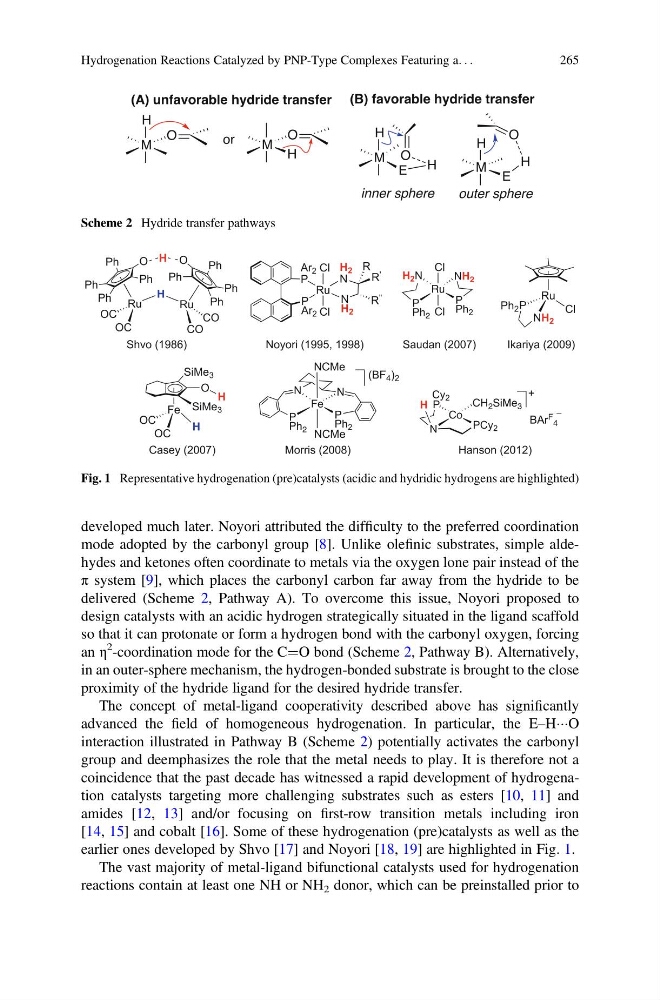
delivered (Scheme 2, Pathway A). To overcome this issue, Noyori proposed to
design catalysts with an acidic hydrogen strategically situated in the ligand scaffold
so that it can protonate or form a hydrogen bond with the carbonyl oxygen, forcing
an η
2 -coordination mode for the C¼O bond (Scheme 2, Pathway B). Alternatively,
in an outer-sphere mechanism, the hydrogen-bonded substrate is brought to the close
proximity of the hydride ligand for the desired hydride transfer.
The concept of metal-ligand cooperativity described above has significantly
advanced the field of homogeneous hydrogenation. In particular, the E–HÁÁÁO
interaction illustrated in Pathway B (Scheme 2) potentially activates the carbonyl
group and deemphasizes the role that the metal needs to play. It is therefore not a
coincidence that the past decade has witnessed a rapid development of hydrogenation catalysts targeting more challenging substrates such as esters [10, 11] and
amides [12, 13] and/or focusing on first-row transition metals including iron
[14, 15] and cobalt [16]. Some of these hydrogenation (pre)catalysts as well as the
earlier ones developed by Shvo [17] and Noyori [18, 19] are highlighted in Fig. 1.
The vast majority of metal-ligand bifunctional catalysts used for hydrogenation
reactions contain at least one NH or NH 2 donor, which can be preinstalled prior to
Scheme 2 Hydride transfer pathways
Fig. 1 Representative hydrogenation (pre)catalysts (acidic and hydridic hydrogens are highlighted)
Hydrogenation Reactions Catalyzed by PNP-Type Complexes Featuring a. . .
265
mode adopted by the carbonyl group [8]. Unlike olefinic substrates, simple aldehydes and ketones often coordinate to metals via the oxygen lone pair instead of the
π system [9], which places the carbonyl carbon far away from the hydride to be
delivered (Scheme 2, Pathway A). To overcome this issue, Noyori proposed to
design catalysts with an acidic hydrogen strategically situated in the ligand scaffold
so that it can protonate or form a hydrogen bond with the carbonyl oxygen, forcing
an η
2 -coordination mode for the C¼O bond (Scheme 2, Pathway B). Alternatively,
in an outer-sphere mechanism, the hydrogen-bonded substrate is brought to the close
proximity of the hydride ligand for the desired hydride transfer.
The concept of metal-ligand cooperativity described above has significantly
advanced the field of homogeneous hydrogenation. In particular, the E–HÁÁÁO
interaction illustrated in Pathway B (Scheme 2) potentially activates the carbonyl
group and deemphasizes the role that the metal needs to play. It is therefore not a
coincidence that the past decade has witnessed a rapid development of hydrogenation catalysts targeting more challenging substrates such as esters [10, 11] and
amides [12, 13] and/or focusing on first-row transition metals including iron
[14, 15] and cobalt [16]. Some of these hydrogenation (pre)catalysts as well as the
earlier ones developed by Shvo [17] and Noyori [18, 19] are highlighted in Fig. 1.
The vast majority of metal-ligand bifunctional catalysts used for hydrogenation
reactions contain at least one NH or NH 2 donor, which can be preinstalled prior to
Scheme 2 Hydride transfer pathways
Fig. 1 Representative hydrogenation (pre)catalysts (acidic and hydridic hydrogens are highlighted)
Hydrogenation Reactions Catalyzed by PNP-Type Complexes Featuring a. . .
265