

amides, epoxides, nitriles, imines, N-heterocycles, CO 2 (to formate or methanol),
silyl formates, CO (to ethylene glycol or methanol), and cyclic carbonates. When
appropriate, the presence or the lack of metal-ligand cooperativity in these catalytic
systems is highlighted.
Keywords CO 2 reduction · Hydride · Hydrogenation · Metal-ligand cooperativity ·
Pincer complexes
1 Introduction
The development of well-defined transition metal-based catalysts for hydrogenation
reactions has been an active research area for almost half a century [1–4]. Early
efforts were focused on catalytic hydrogenation of C¼C (or C C) bonds. The
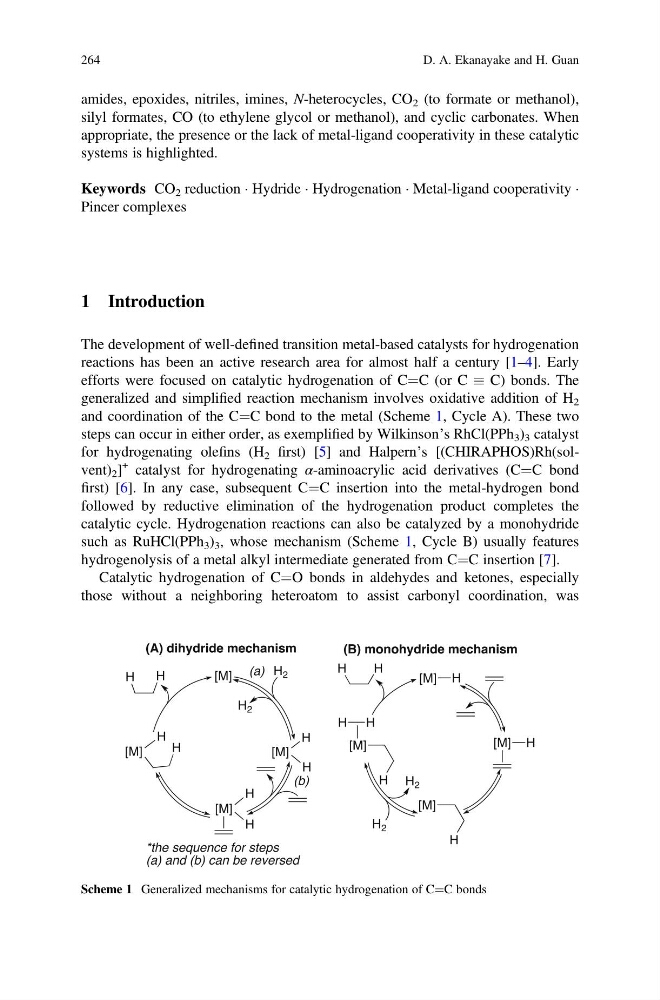
generalized and simplified reaction mechanism involves oxidative addition of H 2
and coordination of the C¼C bond to the metal (Scheme 1, Cycle A). These two
steps can occur in either order, as exemplified by Wilkinson’s RhCl(PPh 3 ) 3 catalyst
for hydrogenating olefins (H 2 first) [5] and Halpern’s [(CHIRAPHOS)Rh(solvent) 2 ]
+ catalyst for hydrogenating α-aminoacrylic acid derivatives (C¼C bond
first) [6]. In any case, subsequent C¼C insertion into the metal-hydrogen bond
followed by reductive elimination of the hydrogenation product completes the
catalytic cycle. Hydrogenation reactions can also be catalyzed by a monohydride
such as RuHCl(PPh 3 ) 3 , whose mechanism (Scheme 1, Cycle B) usually features
hydrogenolysis of a metal alkyl intermediate generated from C¼C insertion [7].
Catalytic hydrogenation of C¼O bonds in aldehydes and ketones, especially
those without a neighboring heteroatom to assist carbonyl coordination, was
Scheme 1 Generalized mechanisms for catalytic hydrogenation of C¼C bonds
264
D. A. Ekanayake and H. Guan
silyl formates, CO (to ethylene glycol or methanol), and cyclic carbonates. When
appropriate, the presence or the lack of metal-ligand cooperativity in these catalytic
systems is highlighted.
Keywords CO 2 reduction · Hydride · Hydrogenation · Metal-ligand cooperativity ·
Pincer complexes
1 Introduction
The development of well-defined transition metal-based catalysts for hydrogenation
reactions has been an active research area for almost half a century [1–4]. Early
efforts were focused on catalytic hydrogenation of C¼C (or C C) bonds. The
generalized and simplified reaction mechanism involves oxidative addition of H 2
and coordination of the C¼C bond to the metal (Scheme 1, Cycle A). These two
steps can occur in either order, as exemplified by Wilkinson’s RhCl(PPh 3 ) 3 catalyst
for hydrogenating olefins (H 2 first) [5] and Halpern’s [(CHIRAPHOS)Rh(solvent) 2 ]
+ catalyst for hydrogenating α-aminoacrylic acid derivatives (C¼C bond
first) [6]. In any case, subsequent C¼C insertion into the metal-hydrogen bond
followed by reductive elimination of the hydrogenation product completes the
catalytic cycle. Hydrogenation reactions can also be catalyzed by a monohydride
such as RuHCl(PPh 3 ) 3 , whose mechanism (Scheme 1, Cycle B) usually features
hydrogenolysis of a metal alkyl intermediate generated from C¼C insertion [7].
Catalytic hydrogenation of C¼O bonds in aldehydes and ketones, especially
those without a neighboring heteroatom to assist carbonyl coordination, was
Scheme 1 Generalized mechanisms for catalytic hydrogenation of C¼C bonds
264
D. A. Ekanayake and H. Guan